Stephen Hicks

Hicks on “Can socialism be democratic?” [Waterfall]

The second Waterfall course: Socialism. Examine the aspirations, arguments, strategies, and disasters of socialist theory and practice—as well as explore the strongest criticisms of socialism. Authors include Ayn Rand, Karl Marx, Vladimir Lenin, Robert Heilbroner, Alan Charles Kors, George Orwell, Michael Harrington, Ludwig von Mises, Steven Horwitz, and C.S. Lewis. This week’s Waterfall features my […]

Hicks on “Can socialism be democratic?” [Waterfall] Read More »

Russian translation of *Explaining Postmodernism* forthcoming

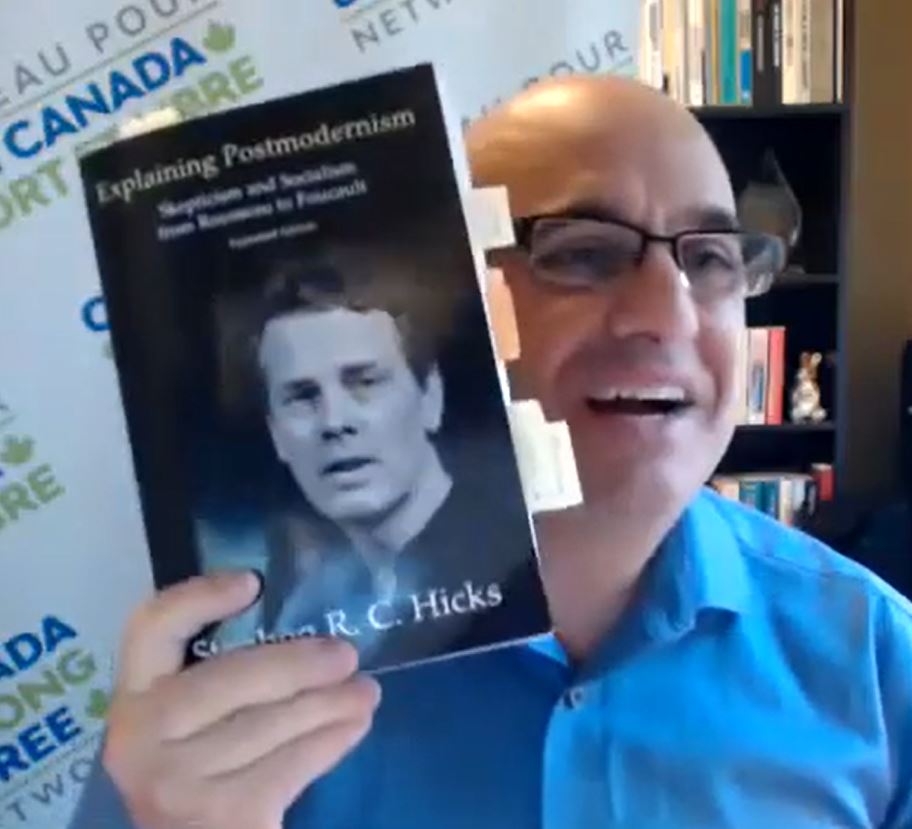
I’m happy to announce that RIPOL Class Publishing of Moscow, Russia will be producing a Russian edition of the Expanded Edition of Explaining Postmodernism: Skepticism and Socialism from Rousseau to Foucault. The translation is being done now and the finished product will be published in 2021. The book’s thesis: The failure of epistemology made postmodernism possible,

Russian translation of *Explaining Postmodernism* forthcoming Read More »

Professor Kors’s classic lecture: “Socialism’s Legacy” [Waterfall]

Waterfall is a guided series of courses for everyone interested in issues upon which Objectivism has something distinctive and important to say. The second course: Socialism. Examine the aspirations, arguments, strategies, and disasters of socialist theory and practice—as well as explore the strongest criticisms of socialism. Authors include Ayn Rand, Karl Marx, Vladimir Lenin, Robert

Professor Kors’s classic lecture: “Socialism’s Legacy” [Waterfall] Read More »

Roman Skaskiw’s hard question about anti-pomo strategy

From Ukraine, Roman Skaskiw asks: “One of my great fears is that the postmodernists, like the Bolsheviks, are correct in prioritizing power over meaning. Those who believe in meaning exhaust themselves making arguments to people who do not believe in truth — modernist argument against a post-modernist ideology. What if a thousand slogans and bad

Roman Skaskiw’s hard question about anti-pomo strategy Read More »

“Can women and minorities think rigorously?” The SJW say “No”

Old-time racists and sexists said: “Clear thinking — it’s not for woman, minorities, and gays.” Social-Justice Wokists today say: “Exactly!!” Rigorous thinking, according to some, is a virtue that leads to safe high-voltage electrical systems, pharmaceutical doses that are precisely calibrated, and bridges that stay up. Not so, says engineering Professor Donna Riley. Rather it

“Can women and minorities think rigorously?” The SJW say “No” Read More »

Locke on slavery

University of Maryland historian Holly Brewer’s very good overview of Locke’s role in English slavery in the mid-1600s and his philosophical opposition as developed by the 1680s: “Slavery-entangled philosophy.” John Locke took part in administering the slave-owning colonies. Does that make him, and liberalism itself, hypocritical? Related: My other posts on Locke. “The Stain of

Locke on slavery Read More »