Un-edited transcription of this previously released podcast. Audio links: iTunes. Stitcher. YouTube.
- Topics and times:
- The “Dark” Ages or The “Brilliant” Ages? The Initial Debate [00:00 — 04:02]
- Chronology [04:02 — 09:14]
- Were there the Dark Ages? [09:14 — 11:16]
- Advertisement: Nietzsche and the Nazis [11:16 — 12:46]
- Why did the activity pick up after the year 1000? [12:46 — 19:41]
- Roger Bacon and Thomas Aquinas [15:58 — 19:41]
- Why is it significant today? [19:41 — 30:42]
- Advertisement: Adventures in Postmodernism tour in Australia [20:01 — 21:41]
- The verdict on Christianity [21:41 — 23:02]
- The verdict on Modernity and the Enlightenment [23:02 — 29:04]
- The third form of conservatism and my argument against it [29:04 — 30:42]
- Outro [30:42 — 32:29]
Transcription:
The Initial Debate
It’s a faux pas in some intellectual circles — mostly conservative ones — to say that there was a Dark Ages in European history.
But the mainstream view, by contrast, has been that the Middle Ages were a dark period in Western history. What were the “Middle Ages” in the middle of? The Greco-Roman era and the Renaissance. Roughly a millennium or a thousand years of time. The evaluative claim is that the glories of Greece and Rome and the achievements of the Renaissance and early Modernity — those truly were outstanding. And by contrast, the Middle Ages look dimmer or actually dark.
The mainstream view of the Medieval is that life expectancy was low. Literacy was low and declining. People were by-and-large superstitious, ignorant of science and of the larger world around them. They had a fearful, stay-at-home mentality — they were scared of Judgment Day and scared of a hostile natural world around them.
On this point, historian Bryan Ward-Perkins, a fellow at Oxford University, puts it this way in his The Fall of Rome and the End of Civilization on the scared-of-the-world mentality:
“And as for trying to sail down the west African coast, everyone knew that as soon as you passed the Canary Islands you would be in the Mare Tenebroso, the Sea of Darkness: ‘In the medieval imagination [writes Peter Forbath], this was a region of uttermost dread … where the heavens fling down liquid sheets of flame and the waters boil … where serpent rocks and ogre islands lie in wait for the mariner, where the giant hand of Satan reaches up from the fathomless depths to seize him, where he will turn back in face and body as a mark of God’s vengeance for the insolence of his prying into this forbidden mystery. And even if he should be able to survive all these ghastly perils and sail on through, he would then arrive in the Sea of Obscurity and be lost forever in the vapors and slime at the edge of the world.’”
The counter-claim by those who reject the “Dark Ages” is exactly that — There was no Dark Age! It’s a travesty to slander on the Medieval era so, to speak of it so! There was lots of good stuff, great stuff in the Middle Ages. For example, here is Anthony Esolen, a professor at Thomas More College:
“Far from the Dark Ages, which it is popularly called, the Middle Ages might better be described as the Brilliant Ages. A startling epic of progress, from science to art, from philosophy to medicine.”
Against those who say there was a Dark Ages, Professor Esolen and his fellow admirers of the Middle Ages will ask, What about X, Y, and Z??? Here are the particulars:
- Let’s talk about philosophers: Have you never heard of Thomas Aquinas, Maimonides, William of Ockham, Duns Scotus?
- What about the universities: all those church schools blossoming into universities and new ones being added? Bologna, Oxford, Padua, Cambridge, Charles, Jagiellonian …
- What about the inventions: the blast furnace, the printing press, the flying buttress, the mechanical clock, and so on, and so forth …
- What about art and literature: Dante, Chaucer, Petrarch, Boccaccio, etc.?
So who has the better of this argument? The deniers of the Dark Ages or those who insist that they were real and, in fact, quite dark. Good historians break the Medieval into two parts: from 400 CE to 1000 CE and that from 1000 CE to 1500 CE time periods. The 400-1000 time period really was awful, and that’s what the “Dark” ages are about. The next 500 years? That’s where the debate really is and should be focused.
Why those dates? 400 to 1500 or so?
Well, we might start a little earlier: 312. Constantine controls Rome. He is the first emperor to be mostly pro-Christianity. Around 325 he convenes the Council of Nicaea to try to formalize what Christianity stands for. Early and on through the 300s, we see the rise of monasticism: St. Jerome and St. Basil in the late 300s, a little later, St. Benedict. And the rise of monasticism was a strong signal of withdrawal from the world. Around 410 is Alaric’s sacking Rome. St. Augustine was 56 years old when Rome was sacked (354-430 AD). And a younger contemporary of his, Hypatia (370-415), is murdered by a mob of Christian monks. By the time we get to 529, the emperor Justinian is closing all of the pagan universities, including, symbolically, Plato’s Academy. So, that time stretch around 400 seems to be especially pregnant with a lot of dynamic cultural, intellectual, political change.
Now, we jump to a thousand years later — if we see that as a bookmarking end of the Middle Ages — the year 1500 or so. In 1492 Columbus is crossing the Atlantic Ocean. A couple of generations earlier, in the 1420s, Brunelleschi build his giant dome in Florence. A generation later, also in Florence and in Milan, we get Leonardo da Vinci. Michelangelo, Leonardo’s younger contemporary, is starting out. Also in the early 1500s: Copernicus is a young man, the Reformation is soon to break out, Martin Luther, John Calvin, and so on. Around 1500, again lots of significant events and the world is changing dramatically.
Now, the debate about the thousand years in between, actually 1100 years in between, from 400 to 1500: Let’s put some specific dates to the events here. In your imagination, if you are listening to the podcast, just imagine a timeline that stretches from the year 400 to the year 1500 and note in memory when the cited important events occurred with the dates attached to them. This graphic (I’ve a graphic I made here) the timeline, I’ll put it up at the Open College podcast site when this is published.
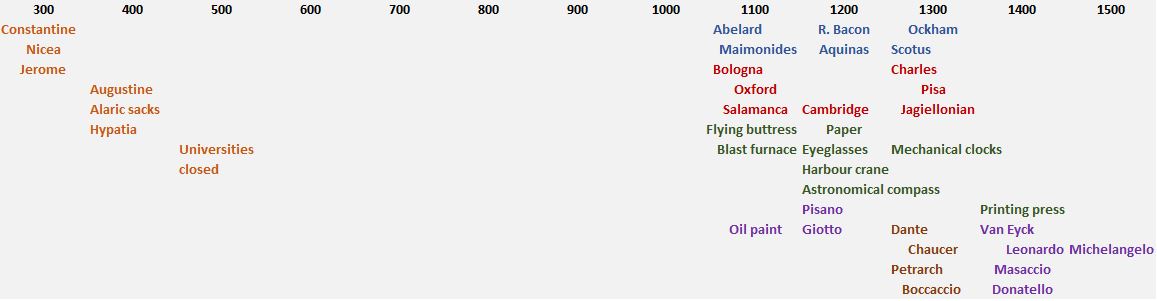
So, to put some dates to the names that we have cited.
* Let’s look at the philosophers: Maimonides, Moses Maimonides — late 1100s, Roger Bacon — 1200s, Thomas Aquinas — 1200s, William of Ockham — 1300s, Duns Scotus — 1300s.
* The universities, all those church schools that grew and developed: Bologna, apparently the first and oldest university in Europe, founded 1088 — so just before 1100, Oxford — early 1100s, Cambridge — early 1200s, Padua — early 1200s, Charles University — 1348, Jagiellonian — 1364 …
* Major inventions: the blast furnace — some time, we think, in the 1100s, the flying buttress — also in the 1100s, the mechanical clock — 1300s, the printing press — 1400s …
* What about literature? Dante — early 1300s, Chaucer — 1300s, Petrarch — 1300s, Boccaccio — 1300s.
What should stand out from just those lists of dates for those who say There was no Dark Ages, here is stuff that was going on in the Middle Ages, is that all of that major activity starts in the 1100s, maybe late 1000s, and picks up speed and steam and metaphorical steam in the 1200s, and then certainly more in the 1300s and 1400s. The point is that all of the good stuff that the Medieval apologists are citing came in the latter part of the Medieval era. What is sometimes called the “High” Middle Ages. But the more important point is that there is little-to-nothing of significance happening from 500 to 1100, or so. Now, just pause to think of that. 500 to 1100 or so — that six centuries of relative nothingness. Dark Ages.
So, were there Dark Ages dark? Well, yes. And the fall of Rome really was a crisis. Rome was a mixture of good things, great things and some awful things. But it was a civilization, and its falling apart really did usher in a dark era. Here is Bryan Ward-Perkins again:
“the mass of archaeological evidence now available, which shows a startling decline in western standards of living during the fifth to seventh centuries. This was a change that affected everyone, from peasants to kings, even the bodies of saints resting in their churches. It was no mere transformation — it was decline on a scale that can reasonably be described as ‘the end of a civilization.'”
There are two more data points I want to put out there about the significance of the decline: one about literacy and one about engineering.
As a result of the Fall of Rome and the rise of the Christian era widespread illiteracy resulted. One significant data point here is Emperor Charlemagne, late 700s-early-800s, uniting the East and the West, first Holy Roman Emperor. But Charlemagne himself was illiterate. Imagine being a head guy in Europe and being illiterate. And one of his common complaints was that he had a huge amount of correspondence to maintain his empire and hold it all together, but he just couldn’t find enough scribes who were literate to keep up with his correspondence. That’s significant.
And about engineering. Here is an anecdote from a historian William Manchester who points out that in the year 1500 the best roads in Europe were roads that had been built by the Romans over a thousand years previously. So that’s really a thousand years of neglect as such that the best roads, obviously not in great condition, but nonetheless the best roads in a thousand years:
“It says much about the Middle Ages that in the year 1500, after a thousand years of neglect, the roads built by the Romans were still the best on the continent.”
Why did the activity pick up after 1000?
Now, a related question — and this takes into one part of the debate — is: If there is not really much going on from 500 to 1100 or so, why did activity pick up after the year 1000 or so? What caused the change?
I think a number of things were going on. One of them comes out of religion itself. If you put yourself in the mindset of a strongly religious person who believes in Judgment Day, who believes it is imminent from a closed reading of scripture — and you add a bit of numerology to that — imagine the way you are thinking about the year 1000 as it approaches. So there you are in the year 900s, 960, 970, 980 getting closer and closer, the year 1000 is going to come. And it makes perfectly good sense to you that that’s when the Apocalypse is going to happen. Judgment Day is going to occur. But, of course, what happens is that the year 1000 arrives and there is no Apocalypse, there is no Judgment Day. So what do you do? Well, who knows when the Apocalypse then is actually going to happen. Maybe it is time actually to pay attention to some earthy, worldly concerns. So, the failure of Judgment Day to arrive, particularly now that we are getting to be about a thousand years after the death of Jesus, maybe we should put Judgment Day on hold and get on with business. So people did start getting on with business.
Another religious element or religious-motivated element, of course, is the Crusades starting from around 1095 or so. But an unintended consequence here is that this leads Western Europeans to have a lot more contact with non-Christians from other parts of the world. So a significant amount of cultural exchange started to occur. Europe opened itself up a little bit.
1085 is a significant year. With the fall of Toledo, the Muslims are forced out of Spain, and Spain becomes fully Christian again. And at Toledo and various other points, the Christians rediscover all sorts of Greek and Roman texts that had been lost to Western Europe especially for many centuries. And curious minds start to read some of these texts and discover these magnificent civilizations that had existed long before and shockingly were not Christian. How was it possible that they could have achieved so much great stuff but they didn’t know the one true faith?
And so much of the Renaissance that was to come along in the next century or two was spurred by the rediscovery of these Greek and Roman materials. The evidence of these magnificent civilizations brought a curiosity about what made them possible. And a lot of what seems to have made them possible didn’t have much to do with Christianity. And so the Renaissance itself was not a result of ideas that were developed within Medievalism itself but was rather a re-importing of some Southern European ideas into Europe almost a millennium later.
But, now, let’s go back to the other side — those who deny the Dark Ages or who are big fans of the Middle Ages — there is a retort here. Doesn’t the fact that Roger Bacon and Thomas Aquinas — both of them were religious men — doesn’t it show that the Church was pro-reason and pro-science? So, we don’t need to have this opposition between superstitious Dark Ages and religious philosophy and more modern humanistic philosophy.
Now, absolutely Aquinas is great. One of my top thinkers historically, and he is a major cause of the Dark Ages ending and our happy transition to the Renaissance. But the important thing here is that Roger Bacon and Thomas Aquinas are active in the late 1200s. Their reintroduction of empirical modes of thinking does mark a healthy turning back to the natural world. But it is also important to recall that even though they were churchmen, in his prime, he and the others who were attracted to this newly rediscovered Aristotelianism and other forms of pagan thought were threatened with excommunication, precisely on the grounds, authoritative grounds, that such attempts to integrate Christianity with pagan classical thought threatens traditional, essentially Augustinian theology — the one that has been dominant and institutionalized now for about 800 years in Europe. And that dominant Augustinian Christian theology is very anti-empirical: it emphasizes revelation, mysticism, authority, and faith. Reason, to the extent that is allowed, is severely subordinated. Minimization of empiricism or exclusion of empiricism is built into the tradition.
Now, 1277 is an important year: Aristotelian philosophy is explicitly condemned by the Bishop of Paris, Etienne Tempier, and by Robert Kilwardby at Oxford. So, the official reactions to Aquinas, the emerging Humanists, and early scientific thinkers like Copernicus — they were consistently negative. And it makes good sense on philosophical, theological grounds. The message that the mainstream Church was teaching in the 1200s was not: Oh, go out and think for yourself, do your own research, trust your independent judgment, challenge us, ask the hard questions and so forth, let’s debate! Rather, it was still very much the opposite; they were still officially taking very seriously all sorts of biblical passages. Just to cite 1 John 2:15-17 here:
“Love not the world, neither the things that are in the world. If any man love the world, the love of the Father is not in him. For all that is in the world, the lust of the flesh, and the lust of the eyes, and the pride of life, is not of the Father, but is of the world. And the world passeth away, and the lust thereof: but he that doeth the will of God abideth for ever.”
So we have a strong opposition between worldly interests, worldly concerns, and otherworldly religious concerns. And it is really, even in the 1200s still, only a few forward thinkers, as I like to think of them — Roger Bacon and Thomas Aquinas among them — who are opening the door to empiricism, opening the door to worldliness and their followers then pushed it wide open. The Church’s intellectuals consistently engaged in rear-guard accommodation with empiricism and emergent science only when they lost the battles.
Now, that’s the history, but why is this history significant for today? As usual, our battles over history are not just battles over history. Our judgment about the Dark Ages really is significant for today’s arguments over ideas and institutions.
And the first one, the big one, is: What is our verdict on Christianity? For contemporary Christians, there is a lot at stake, because during the Middle Ages Christianity was the dominant — if not the monopoly — intellectual and cultural power. Basically, Christianity had Europe to itself for over half a millennium, and Europe was stagnant during that time period. So, a standard interpretation — I think there is a lot of truth to this — is to say that the Dark Ages are a practical result of a reigning philosophy. And that counts as negative evidence against that philosophy. So the efforts by many Christian thinkers to deny that there was a Dark Age under their watch — that makes sense even if it is not true.
So here’s a tendentious analogy: Religious thinkers who deny the Dark Ages — with all of the stagnation of life and the devastation that they wrought — I think they are analogous to socialists who deny or whitewash the Soviet Union and China. “It wasn’t really socialism” denial is not much different from “It wasn’t a Dark Age” denial.
Both of them are ideologically driven attempts to ignore uncomfortable historical evidence about the connection between theory and practice. Ideas matter.
Now, the second important theme, though, is our verdict on modernity and the Enlightenment. And here again, religious conservatives tend to come to the fore because some prominent forms of contemporary conservatism hold that modernity is a mistake, or at least that it is a highly flawed human diversion from proper traditional values. Maybe the Enlightenment was partly good in the physical realm, but, according to this version of conservatism, it has been a disaster in the moral, social, and political realms. Contemporary society is secular and rational. It is a product of the Enlightenment, but that is a bad thing. What we need to do is to return to pre-Enlightenment times, pre-modern times, when things were better morally and politically. So the Middle Ages, from this perspective, are used as a positive example to contrast with contemporary decadence.
Now, let me name some names. Here, for example, is William A. Rusher. He is a former publisher of National Review, a leading conservative publication:
“Today, sobered by a near-century of world wars and tyrannies with global ambitions, we (in the civilized West, at least) appear to stand on the threshold of completing the Enlightenment project.” (p. vii)
So notice the claim that Rusher is making — the Enlightenment is responsible for war, tyranny, and ambitions of global conquest. That’s pretty bad.
Here also another prominent conservative: this is Irving Kristol; he is usually a labeled neo-conservative. He also argues that the 20th century has been a disaster. But he argues that disaster is the consequence of “secular, rationalist humanism” (p. viii). So there we are: the hallmarks of the Enlightenment — humanism, rationalism, and secular philosophy — those are bad things; they caused the disaster that is the 20th century.
Another example, here is Steven J. Lenzer. He is a conservative research fellow at Claremont McKenna College. Writing in The Weekly Standard, another mainstream conservative publication. The title of Lenzer’s article that I’m quoting from is “Two Cheers for Postmodernism.” Now notice that postmodernism is typically, in its first couple of generations, aligned with the far-Left, but here is a conservative finding common cause with them. At least, not three cheers, but at least two cheers for postmodernism. And Lenzer writes of “the soul-deadening effects of modern technological society.” Now, note that the Enlightenment’s prized technological achievements are pitted against spiritual values. And according to Lenzer, what we have is this either-or choice. Either we are going to be soul-enhanced spiritual people, or we are going to be modern technological people.
Just as a sidebar: I want to note that it’s not only left-leaning postmodernists who oppose the Enlightenment. It is also strong right-wing or right-spectrum conservatives who reject it. And this is a theme that I will be repeating frequently in this series. It is not only two choices that we face or two options that we have between a far “left” and a far “right.” We know of the postmodern Left that rejects the Enlightenment and wants to go in a postmodern direction or that we have to choose between them and a Right that is also rejecting the Enlightenment and wants to go back to a pre-modern time.
There is a principled third alternative: Enlightenment modern liberalism that rejects both of them.
But, let’s return to this theme of conservatives against modernity. Here another professor, professor Ernest van den Haag, formally at Fordham University, talking about the Enlightenment and its legacy and the emptiness that it led to:
“Reason did not fill the emptiness left by the destruction of religion. It built no cathedrals, created no faith. We find ourselves alone in the ‘desolation of reality’ [Camus]. … . The philosophes never realized that reason can destroy a community but that only religion can create it.” (p. 82)
So since relying on reason does not guarantee that everybody is going to think that the same things are reasonable, the argument van den Haag goes on to make — the absence of a unifying set of beliefs based on a faith or tradition is going to lead to disputes being settled by force. Absolutely then the Enlightenment leads to violence, and what we have seen in the 20th century has been violence.
Again, a sidebar: Notice that this is very close to arguments made by far-leftists of the Frankfurt School, Adorno and Horkheimer, in their 1947 Dialectic of Enlightenment.
So what we have then are conservatives who start off with a reverence for tradition find themselves disquieted by modernity’s deep liberalism and its diversity. They find they have a distaste for modernity’s secularization. Society, they think, really is going to hell morally and politically. So they have a soft spot for the good old days: back in the day when there was a hierarchical society, when there was a uniform set of beliefs and particularly a universal religious set of beliefs. And that’s exactly what we find in the Medieval Era. So from this perspective, we need to return to the Medieval era and we need to think of it as a good time, not a dark age.
Now, just before I close, I want to mention that there is a third form of conservatism here that is more moderate than the ones I’ve just mentioned. And it holds that modernity is not so bad, so we should accommodate it. But we should try to blend the achievements of the Enlightenment, the achievements of the modernity with the best of old pre-modern conservative traditions. So the goal of this form of conservatism, when it does its history, is to try to find the origins of the good stuff in the Medieval Era and try to claim that it was the Medieval era that made possible those good things. And that therefore there is a continuity between the religious philosophy of the Medieval era and the modern Enlightenment developments pro-science, pro-technology that followed.
Now, I’m going to disagree with that. My view is that really the dominant ideas of the Middle Ages do not get any of the credit. Those ideas, that is to say, the dominant ideas of that era were otherworldly, they were faithful, they were superstitious, and they were authoritarian. They caused and maintained stagnation for over 600 years. It was only once Europe made serious contact with non-European cultures and re-imported and re-discovered the classic Greek and Roman civilizations — that’s when the break from stagnation began. The Renaissance and the Enlightenment that followed were born of a break with the religious culture that had dominated the Middle Ages and did indeed cause a Dark Age.
Sources:
Anthony Esolen, Were the Middle Ages Dark?. Professor at Thomas More College, Providence.
Irving Kristol. Quoted in Rusher, p. viii.
Steven J. Lenzer, “Two Cheers for Postmodernism,” The Weekly Standard, October 25, 1999, p. 38.
William Manchester, A World Lit Only By Fire, p. 5.
William A. Rusher. The Ambiguous Legacy of the Enlightenment, University Press of America, 1995.
Ernest van den Haag, in Rusher, ed. Ambiguous Legacy of the Enlightenment, p. 82. Professor at Fordham University.
Bryan Ward-Perkins, The Fall of Rome and the End of Civilization.
Related:
- Stephen Hicks, “Religion and the Verdict of History.”
- Religion and capitalism? Alvaro Vargas Llosa
- St. Thomas Aquinas on whether sinners should be killed or heretics tolerated
- Christianity: Good or Bad for Mankind?
The complete series of Open College with Stephen Hicks podcasts.
“1085 is a significant year. With the fall of Toledo, the Muslims are forced out of Spain, and Spain becomes fully Christian again. ”
Not so. Granada, the last Muslim emirate, surrendered on January 2, 1492 and after that date the Muslims (and Jews) were forcibly converted or expelled in the decades that followed. Consequently Spain was only fully Christian after 1526.
—
You don’t really go into the fact that western Roman Empire fell after it was overrun by illiterate Barbarian hoards (ie my ancestors). That surely had a profound impact. Nor do you delve into the issue of how powerful the church really was. Certainly from 1100 (roughly onwards) it grew in power but before that date Popes were deposed and installed by Kings. I think you picture the church at the time of the Inquisition (which was created in the 15th century and suppose it cast it’s spell back to the early Christian period.
So it’s more accurate to say that after Toledo, the Muslims who remained in Spain were under dominant Christian rule. Not all of them were forced out.
Prof. Hicks, I greatly admire your approach to philosophy, and in particular your tackling of postmodernism. There is no doubt that we can all learn a lot from you here.
However, on the issue of historiography, as discussed here, I found it very disheartening that you would fall so easily for the myth that is the “Dark Ages”. I see so many of the same taking points of Dan Brown and his debunked conflict thesis being repeated – there is nothing new or challenging being presented. It is the same old polemically-based history that goes out of it way to avoid nuance, and which also happens to be found in the rose-tinted history books of modern-day traditionalists and monarchists.
I do accept that European civilization saw a significant blossoming from the 12th century onwards, but I’ve studied the Byzantium Empire – the continuation of the Roman Empire in the East – too well to know that not all was lost and that, in fact, many important things were created by it after 400. Take for example the Corpus Juris Civilis of 6th century emperor Justinian, which forms the basis of civil law. The empire may have Christianised, it may have shrunk in size, but Constantinople – its capital – remained a prosperous, vibrant city and its inhabitants had no qualms with preserving the texts of their pagan forebears. One simply cannot understand the Early Middle Ages without them, just like one cannot ignore the French or Spanish-speaking peoples impact on the history of North America.
There is widespread ignorance of the legacy of the Eastern Empire, and I do not blame you – it is a kind of “Western Eurocentrism” the Western Church began and the Enlightenment writers were happy to continue – but shoehorning a long period of six centuries as “Dark Ages” or “Stagnation” does lead to such shallow thinking. Byzantine immigrants to Italy played a very important role in making the renaissance possible.
I’d encourage you to take a look at some of the writings of history blogger Time O’Neill from historyforatheists.com. As an Australian atheist, he doesn’t fall neatly into any of the conservatives camps you describe above, and has spend over 10 years challenging the bad history propagated first by the Enlightenment writers, and now regurgitated online by the New Atheist movement, often as memes.
Thank you for reading, and best regards!
Dear Archduke Naboo:
Thanks for your extended comment. I agree entirely that Byzantium was important. I have notes I’m planning to pull together for a podcast on its significance.
Yet please note that this podcast was targeted to conservatives who valorize the entire Medieval period and deny a Dark Age. They never say, “Yes, everything declined a lot in the West, but Byzantium!” Instead they point to this or that 12th-century or later development. The history is that Rome collapsed and fractured, in some ways hastened by Christianity’s rise, and 1,700-kilometers-to-the-East Byzantium’s almost-alone standing out and becoming a haven from the collapse highlights the break-up. Its relative wealth and stability also symbolize by contrast the return to near-subsistence and semi-barbarism for centuries pretty much everywhere else.