I posted a link to the shocking Biblical story of Lot’s offering his virgin daughters to a mob for sex and later having incestuous sex with them. (Link and thread: FB, X.) Many religiously-minded folks immediately offered an array of interpretations. A digest:
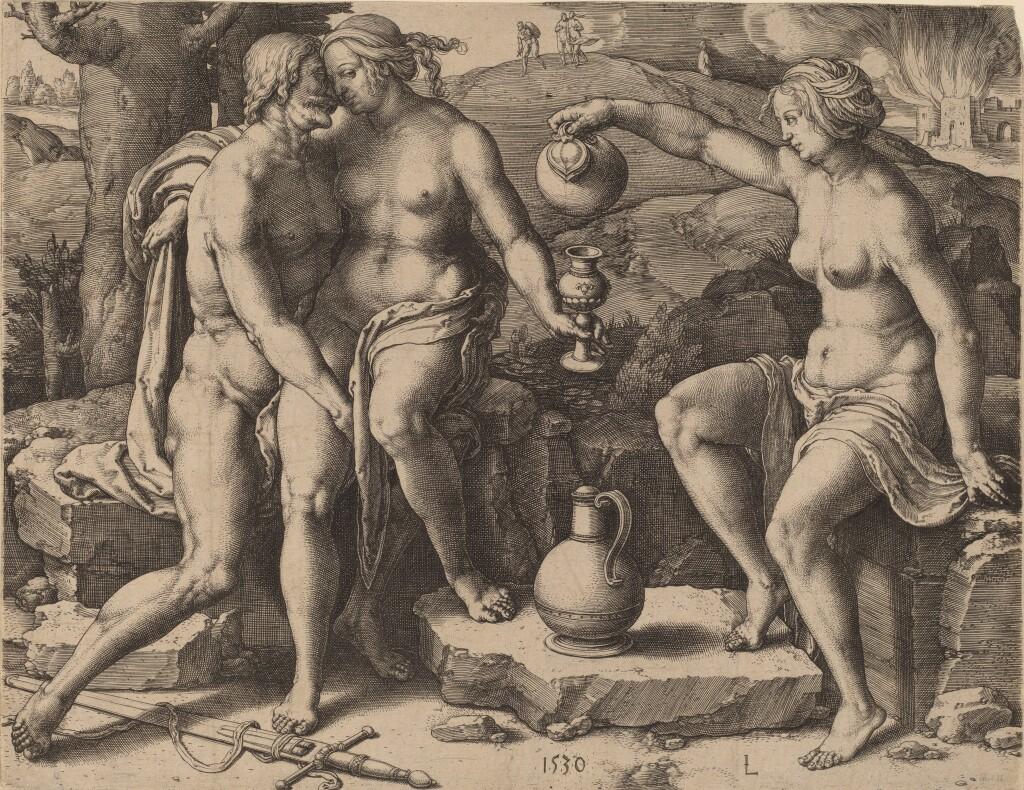
1. It is not a morality story at all, merely a DESCRIPTION of an event.
2. It is a morality story, and Lot is a BAD man but saved only because Abraham asked God for an exception.
3. It is a moral lesson, but Lot is a VICTIM of his daughters’ scheming.
4. God knows Lot is a sinner, but for REASONS KNOWN ONLY TO HIM God decided not to say or do anything in this case.
5. Yes, Lot and his daughters were saved/not punished, but the lesson is that SEVERAL GENERATIONS LATER their descendants did bad things, showing the long-term badness of incest.
6. Lot was a RIGHTEOUS man who protected his guests from the mob, so God overlooked his lesser bad deeds.
7. In offering his daughters to the mob for sex, Lot was just be SARCASTIC, so don’t take the story too seriously.
8. Lot was a disgusting sinner, yes, but ALL OF US ARE DISGUSTING SINNERS, so who are we to judge, and that’s the Bible’s point.
Despite the contradictory interpretations—each offered confidently or condescendingly as THE correct way to interpret the Bible—there was a more unified sentiment about me, the guy who posted the Biblical story for discussion:
1. You are only a philosopher and shouldn’t try theology.
2. You are a fool.
3. You posted the story in English, not the original Hebrew. Bad scholar.
4. You are a weirdo who doesn’t know how to read ancient literature.
5. Your soul is so dirty.
6. Etc.
The real lessons: (1) A certain kind of religious mind will defend its scripture—on every point and by any means. (2) It will attack with hostility anyone who suggests a problem with the religion. By contrast, a healthy mind—whether religious or not—will be open to the difficult problems, welcome critical questions, and be willing to revise its views.
* The image is Lucas van Leyden’s 1530 Lot and His Daughters.
Related: C. S. Lewis | “On Christian Virtue” | Mere Christianity | Philosophers Explained series:
It’s a mystery for sure. Worth discussing respectfully.
I believe that seeking truth and understanding, with humility and an open mind, is always what God wants us to do—so, Go Stephen!
will not get into details, but the interactions were very much reversed to what you reprsent, the hostility was on your part. any AI can decipher that .. I am guessing you projected hostility where there was none and then .. reacted? but to the point >
you also slightly misrepresented the critique which was plentiful even in such circumstances of arrogance and disdain, continuous sarcasm and zero curiosity or good will – which can be excused considering the sub functional level of theology you started from.
here is my attempt at orthodox theology
1. the bible as a “mirror of the fall” the bible is a “revelation of god,” but also a “revelation of man.”
the mistake: starting with the idea that every character in the bible is a “role model” or that every action is “endorsed.” the reality: the bible is a diagnostic tool. it records the raw, unedited state of human nature after it has broken away from God. the story of lot isn’t there to tell you what to do; it is there to show you what we are. it shows the “tragic condition” where even a “good” man is so warped by his environment that his logic becomes monstrous. This is throughout the bible, there are stories of the failure of man, not cherrypicked victories and virtues.. it is the Truth.
2. the rejection of “moralism” in orthodox theology, “moralism” (the idea that religion is just about being “good”) is actually seen as a heresy or a lower stage of understanding. the exegetical shift: we don’t look at lot and ask, “is he a hero or a villain?” we look at lot and see a survivor of a spiritual catastrophe.
the “sane” view: the text is a description of a mess, not a prescription for behavior. god “saves” lot not as a reward for his perfect behavior (which didn’t exist), but as an act of divine economy ; keeping a tiny thread of the human family alive through the wreckage of history.
3. the “pedagogy of silence” God doesn’t say or do anything about the daughters or the incest. the interpretation: God’s silence in these dark moments is a form of respect for human freedom and a recognition of the consequences of sin. the result: the bible simply “lays it out.” it refuses to tidy up the narrative. this “lack of explanation” is actually a sign of the text’s authenticity. it forces the reader to confront the gravity of the fall without a “moral of the story” to ease the discomfort.
4. the “energies” of the story instead of a legal code, let’s look at the “intentions” and “tensions” :
lot’s intention: to protect.
lot’s failure: his method was darkened by the “atmosphere” of sodom. the outcome: life continues, but it is “limping.”
5. and this was mine “the dirty soul” part. The point of Christianity is that Truth and discernment of Truth, or intimacy with Truth / God / The Word, is not intellectual, it is a virtue of the soul. Christians purify their souls constantly, they are required to, it is a core theme.. nothing to scoff at. this can easily be observed in the last 10 years with the exploding polarizing culture wars.
to conclude, the irony of this, is that the first person I observed consciously becoming the object of another’s derangement [as TDS is] was Ayn Rand. AR derangement syndrome was, and still is probably, all over reddit [commies banned me]. Yet you Stephen, who lived through it and saw many others .. act identical to those moochers. People display with grace their wisdom in front of you, and you avoid the work to follow through or humble yourself on such a beautiful and solemn topic.
Do double-check, RFP, which side of the debate used the words “fool,” “dirty soul,” “retard,” etc., etc. You will see that 100% of those insults came from your side.
I wanted to take a moment to respond to Dr. Hicks’s argument presented in the link:
https://www.stephenhicks.org/2026/02/15/lots-mob-and-drunk-incestous-sex-and-how-to-interpret-scripture/?fbclid=IwY2xjawQBgztleHRuA2FlbQIxMABicmlkETE0TE1oNmdncURaNGVFTGtIc3J0YwZhcHBfaWQQMjIyMDM5MTc4ODIwMDg5MgABHl2yR7umnM4bMXqzjceQlND9E02o3QoDL4F_97uGw5RqR_7C66gNgCRBfp-9_aem_r5LV1Dx6e84A1Q3iTptqpQ
He reaches two conclusions:
“The real lessons: (1) A certain kind of religious mind will defend its scripture — on every point and by any means. (2) It will attack with hostility anyone who suggests a problem with the religion. By contrast, a healthy mind — whether religious or not — will be open to the difficult problems, welcome critical questions, and be willing to revise its views.”
He comes to this conclusion after a plethora of responses to another and quite provocative argument he made in a separate post. His previous argument is shown below:
“The Bible is upheld by its true-believers as a moral guide. We are to learn our lessons by reading its stories and noting whom God saves, whom God tolerates, and whom God punishes.
1. Lot offers his daughters to the mob for sex. He is saved.
2. His daughters can have drunken incestuous sex with Lot. They go on with their lives just fine.
The lesson is that God tolerates and even saves these people.
A normal person would condemn them as immoral.”
There are several problems with this argument so let’s look at each premise:
P1: “The Bible is upheld by its true-believers as a moral guide. We are to learn our lessons by reading its stories and noting whom God saves, whom God tolerates, and whom God punishes.
First, the scriptures of the old and new testaments are not primarily seen as a “moral guide” although, the bible does possess moral teaching. Primarily and historically, Christians have defined and perceived the bible to be a revelation from God. The content of which concerns several topics including morality but in principle is essentially about God.
Here we see that because Dr. Hicks assumes in advance that the bible is primarily a moral guide that he interprets the bibles various stories as moral teachings. The response to this is that it is clearly observed by atheist and Christians alike that not all stories in the bible are seeking to establish some moral prescription or prohibition. The second part of premise 1 is true. We are to learn our lessons about God from reading His revelation but of course that does not preclude proper interpretive methods.
P2: “Lot offers his daughters to the mob for sex. He is saved.”
Here we have a simple factual error. Lot is not saved on the basis of his alleged offering of his daughters for sex to the mob instead of the guest. Rather, he is saved from the impending destruction of Sodom on the basis of God’s relationship to Abraham (Genesis 19:29):
“So when God destroyed the cities of the plain, he remembered Abraham, and brought Lot out of the catastrophe that overthrew the cities where Lot had lived.”
God saves Lot because of Abraham’s prayer in Genesis 18:22–32. This can be demonstrated through exegesis of the text. The claim that Dr. Hicks makes in P2 is not supported by scripture and it cannot overcome the weight of the textual evidence present in Genesis that Abraham’s relationship with God was the basis of Lot’s rescue.
P3: “His daughters can have drunken incestuous sex with Lot. They go with their lives just fine.”
Here, Dr. Hicks claims that despite Lot’s daughter’s egregious sins against their father, God seems to have to have no issues with their conduct because we see no evidence of judgement in their lifetime. But the absence of recorded judgment in the text is not sufficient for establishing the claim that Hicks makes, namely, that God is morally indifferent to the reprehensible conduct of his daughters. If it were the case that God is morally indifferent to the incestuous acts committed by Lot’s daughters why does God condemn it in the Sinaitic law given to Moses in Leviticus 18:6-?
6 “ ‘⌊None⌋ of you shall approach anyone who is ⌊his close relative⌋ to expose nakedness; I am Yahweh. 7 You must not expose your father’s nakedness or your mother’s nakedness — she is your mother; you must not expose her nakedness. 8 You must not expose the nakedness of your father’s wife — it is your father’s nakedness. 9 As for your sister’s nakedness, whether your father’s daughter or your mother’s daughter, whether ⌊born at home⌋ or ⌊born abroad⌋, you must not expose their nakedness. 10 As for the nakedness of your son’s daughter or your daughter’s daughter, you must not expose their nakedness, because they are your nakedness. 11 As for the nakedness of the daughter of your father’s wife, she is your sister, a relative of your father; you must not expose her nakedness. 12 You must not expose the nakedness of your father’s sister; she is ⌊your father’s close relative⌋. 13 You must not expose the nakedness of your mother’s sister, because she is ⌊your mother’s close relative⌋. 14 You must not expose the nakedness of your father’s brother; you must not ⌊have sex with⌋ his wife — she is your aunt. 15 You must not expose your daughter-in-law’s nakedness; she is your son’s wife; you must not expose her nakedness. 16 You must not expose the nakedness of your brother’s wife; she is your brother’s nakedness. 17 You must not expose the nakedness of a woman and her daughter, or her son’s daughter, or her daughter’s daughter; you must not take her as wife to expose her nakedness; they are ⌊close relatives⌋ — that is wickedness. 18 And you must not take as wife a woman with her sister, to be a rival-wife, to expose her nakedness before her ⌊during⌋ her life. (LEB Leviticus 18:6–18)
It seems regarding P3, the weight of the textual evidence acts as a defeater for Hick’s claim.
Thus, we reach Dr. Hick’s conclusion in his first post:
“The lesson is that God tolerates and even saves these people. A normal person would condemn them as immoral.”
This is Hick’s central claim, and he uses these two stories concerning Lot to buttress this point. But as we were able to demonstrate, Hick’s conclusion is false because the premises that support it have been found to be incorrect. God does save these people but not because of Lot’s offer and despite their immorality. God is not a moral monster nor is he abnormal about incest. On the contrary, he condemns it. God sees incest even more reprehensible than Dr. Hicks since it is God’s own character that provides the standard of moral right and wrong as where Dr. Hicks considers “normality” (whatever that means) as the standard of moral behavior. This is a perfect example of how the assumptions you bring to the text can interfere with proper interpretation of an ancient text. Ultimately, Hick’s misinterpretation of the text stems from his assumption that everything in the bible is a moral story, and his lack of contextualization compounds the issue.
Finally, we reach Dr. Hick’s conclusion after the backlash he received at accusing the God of one of the world’s largest religions as being a moral monster. I must admit that Hick’s surprise at the results of his claim is quite confusing. What did he expect? The claim is extremely provocative and of course people’s emotions will be stirred. Nevertheless, Hick’s concludes from the backlash that:
“The real lessons: (1) A certain kind of religious mind will defend its scripture — on every point and by any means. (2) It will attack with hostility anyone who suggests a problem with the religion. By contrast, a healthy mind — whether religious or not — will be open to the difficult problems, welcome critical questions, and be willing to revise its views.”
Let’s look at his conclusion:
Here Dr. Hick’s argues against a strawman. Not all of his interlocuters are defending the bible by “any means,” or even at “every point.” Certainly there were plenty of responses that were below the belt and uncharacteristic of the charity that is required of followers of Christ. For those people I apologize Dr. Hicks. But at the same time you should not be surprised at that all too human reaction-believer or not- when you claim that what some people consider sacred is actually profane. You also told me that I “told everyone to shut up and only believe what bible experts” have to say. That wasn’t fair to me and was a misrepresentation of my own argument, that is just as much a failure as it is those Christians who bore their fangs at you.
Part 6 – One Clean Paragraph for You
Stephen Hicks posts a provocative moral critique of the Lot story, then complains that believers respond defensively and illogically. But he ignores the strongest replies – like Razvan Popescu’s – which show (1) Lot was saved due to Abraham, not his own actions (Genesis 19:29), (2) incest is later condemned in Leviticus 18, so God does not “tolerate” it, and (3) the Bible can be read as a diagnostic “mirror of the Fall” rather than a collection of moral endorsements. Hicks’ conclusion that “a certain kind of religious mind will defend scripture by any means” is a hasty generalization from weak examples, and he fails his own standard of open-mindedness by refusing to engage substantive corrections. Razvan’s reply is deeper, more accurate, and more intellectually honest.
Part 5 – Final Judgment
Question Answer
Does Hicks make a valid point about contradictory interpretations? Yes, but he ignores that ancient texts can have legitimate multiple meanings (literary richness, not confusion).
Does he correctly identify some hostile reactions? Yes. Some believers responded badly.
Is his conclusion (“religious mind defends by any means”) fair? No. It’s a hasty generalization based on weak replies while ignoring strong ones like RFP’s.
Does RFP successfully defend a coherent theological reading? Yes. He provides exegesis, a hermeneutic framework, and corrects factual errors.
Who “wins” the exchange? RFP. He addresses the actual text and Hicks’ errors. Hicks mostly complains about tone and avoids engagement.
Part 4 – Answering Your Implicit Question: Who is Right?
On the Lot story itself:
RFP is clearly more accurate.
Genesis 19:29 directly refutes Hicks’ claim that Lot was saved because of offering his daughters. He was saved despite that, due to Abraham.
Leviticus 18 refutes Hicks’ claim that God “tolerates” incest. The condemnation comes later in the same book.
The “mirror of the Fall” interpretation (Bible describes human brokenness without endorsing it) is a standard, respectable hermeneutic.
On the meta-argument (hostility, open-mindedness):
Mixed.
Hicks is right that some believers responded with insults (“fool,” “dirty soul”). That’s real.
But Hicks invited hostility with his framing (“A normal person would condemn them”). And he then used the worst replies to generalize about “a certain kind of religious mind” – while ignoring substantive replies like RFP’s.
RFP’s claim that Hicks projected hostility is plausible: Hicks’ own tone is condescending (“normal person,” “healthy mind”), so he should not be surprised by defensive pushback.
On the “healthy mind” standard:
Hicks fails his own test.
A healthy mind is open to revision. But when RFP provides a detailed, text-based correction, Hicks (in the original post) does not engage – he simply concludes that religious minds are defensive. That’s not open-mindedness. That’s confirmation bias.
Name Depth (1–10) Rhetoric (1–10) Factual accuracy Primary flaw
Stephen Hicks 4 5 Medium (misses Leviticus, Abraham reason) Strawman + hasty generalization
Razvan Popescu 8 6 High Slightly abrasive, but not wrong
Razvan Popescu (RFP – long comment)
Metric Assessment
Core thesis Hicks misreads the Bible as a moral guide; it’s actually a “mirror of the Fall.” God’s silence is not approval. Lot saved via Abraham, not his own righteousness. Incest condemned in Leviticus. Hicks projected hostility and then complained about it.
Factual accuracy High. Genesis 19:29 explicitly says Lot was saved because God remembered Abraham. Leviticus 18 explicitly condemns incest.
Argumentative move Corrects factual errors (basis of Lot’s salvation), offers alternative hermeneutic (diagnostic vs. prescriptive), then accuses Hicks of projection.
Depth 8/10 – Engages the actual text, provides a coherent theological framework (Orthodox/patristic), distinguishes description from endorsement, addresses God’s silence pedagogically.
Rhetoric 6/10 – Clear but dense. Some sarcasm (“sub functional level of theology”). The “dirty soul” section is interesting but slightly off-topic.
Logical strength Strong. He identifies Hicks’ central factual error (why Lot was saved) and shows that Hicks’ conclusion about God tolerating incest is false given Leviticus. The “mirror of the Fall” hermeneutic is a legitimate alternative to Hicks’ moralistic reading.
Verdict: RFP makes a substantive, text-based counter-argument. He does not defend the Bible “by any means” – he gives specific exegetical and theological reasons. His claim that Hicks projected hostility is plausible given Hicks’ own tone (“normal person would condemn them”).
Stephen Hicks (OP)
Metric Assessment
Core thesis The Lot story shows God tolerating immorality; believers react with hostile defensiveness, revealing an unhealthy mindset.
Factual accuracy Mixed. The story is shocking. Believers do offer varied interpretations. But his claim that God “tolerates” incest ignores later condemnation in Leviticus.
Argumentative move Provocative framing (“normal person would condemn them”) + meta-conclusion about “religious mind” from ad hominem responses.
Depth 4/10 – He correctly identifies contradictory interpretations, but never engages with the strongest theological replies (e.g., the Bible as diagnostic, Lot saved due to Abraham). He assumes his reading is the obvious one.
Rhetoric 5/10 – Clear, provocative, but self-congratulatory (“healthy mind … willing to revise”). The “I am the rational skeptic surrounded by cultists” tone weakens him.
Logical problems 1) Selection bias – He cites only the weakest believer replies (insults, contradictions). Ignores more substantive ones (like RFP’s later). 2) False dichotomy – Either you agree with his moral reading or you’re a defensive apologist. 3) Hasty generalization – From some hostile comments to “a certain kind of religious mind.”
Verdict: Hicks makes a provocative but shallow case. He mistakes his own inability to see theological depth for its absence. His conclusion is partially true (some believers react badly) but overgeneralized and self-exempting.
note just use AI more 🙂 it does a great deal to your growth . because you are clearly blind to reason when it comes from your “opponents” or whoever you think an enemy.
also.. this is a bit out of context because if we would look at the facebook post this is based on and which you did not document, you would see another objective analysis where you would be the aggressor and the one lacking grace.
reminder to investigate this for a few minutes with AI or whoever you deem a reasonable mind