Por que a arte se tornou feia?
My essay on “Why Art became Ugly” translated into Brazilian Portuguese by Ronaldo Bassit and Matheus Pacini.
Here are the original article in English (PDF) or online with links to the images discussed. Also: translations into German [pdf], Spanish, and Korean [pdf].
Also: My related lecture in Buenos Aires at ESEADE University:
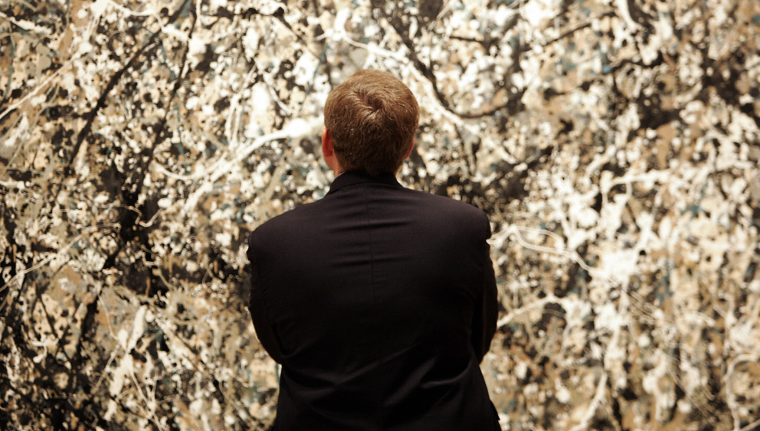
Professor Hicks’ monograph on this subject is incisive and insightful — I hope to reread it many times! The visual arts do not use words which expands their subjective side. “I love Jackson Pollocks’ &c!” Why? “I just love it!” When art is more formless (i.e. “realistic”) the door is open to crankish viewers and pure poseurs : “You don’t like Kandinsky? [You poor oaf,] you can’t possibly understand it!” Continuing down this path we have the men with hammers busting up a Steinway. However, the cause of this “artistic anarchy” [see the old book by Huntington Hartford] is that a class of people, as in New York immigration in the late 19th century, with no artistic aptitude or tradition of visual artistry, came to dominate the media, the NY Times, and thence, the taste-setting of the Big Apple. We have the Guggenheim Museum as their monument. As if by Gresham’s Law bad art drove good out of circulation, but the collection of Peggy Guggenheim, to cite one example, skyrocketed in value. No standards in art, then, why have ’em in morals, music, foodstuffs, or politics. It takes all kinds! Or does it?
Another invaluable tome on this subject is Jacques Barzun’s FROM DAWN TILL DUST, a very neat and quid-pro-quo history of 20th Century “art.” We have also the emergence of photography as “art” — rarely the case, as very few photographers can use a camera like a brush and palette (i.e. Steichen, Cartier Brisson) and the eventual advance of TV, magazines, and the Internet, all of which quell the visual appetite. In the good old days, one’s only chance to see the Grand Canyon in NYC was a painting. Portraiture also suffered, and became a luxury. Moreover, painters of genius would be more underpaid than ever. Illustrators like Pyle and N.C. Wyeth (and later, Normal Rockwell) got into that empty niche. There yet remains the field of children’s books, primarily visual. Artists like Richard Scarry (Little Golden Books) who can give children wholesome art — even Dr. Seuss, that rare “poet”-painter, do so, at great profit. But what’s on the ceiling of the Metropolitan Opera — a Marc Chagall!
I leave it at that, the subject is open ended ad infinitum. Reread Dr. Hicks essay, and the situation will resolve itself in your mind, if modern art has not already driven you mad!