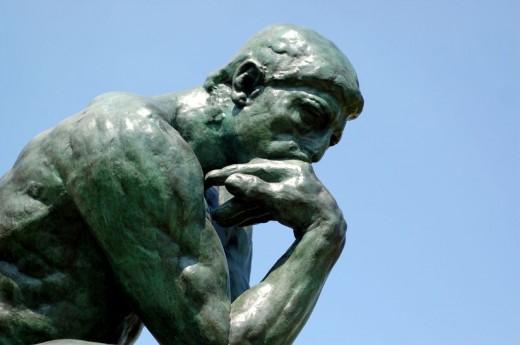
Following up on “The constant decline of civilization?” — a series of quotations from across the centuries of intellectuals from Plato to Wordsworth to T.S. Eliot bemoaning the sorry state of their generation’s intellectual and moral life.
Here, from a review of Mark Lilla’s The Reckless Mind: Intellectuals in Politics and Richard Wolin’s Heidegger’s Children: Hannah Arendt, Karl Löwith, Hans Jonas, and Herbert Marcuse (both books recommended), is a twenty-first century intellectual carrying on the tradition by assessing the merit of four mid-twentieth century political philosophers.
“Although all these thinkers are gifted, few deserve truly extended study. I say this despite the fact that each is more penetrating than nearly anyone writing today. We are declining from our decline.”
And here is another intellectual, commenting directly upon our current generation:

“Historians will write of this time that the U.S. was in a period of intellectual decline, a kind of anti-renaissance of thought. Simplicity, and brevity displaced thoughtful dialogue. Repetition passed as true conviction, cult-like adherence to shallow philosophies unseated consideration of creative alternatives and honesty gave way to spin.
“This is not an era when thinking about anything for long is valued.”
How do we make great sweeping judgments like this, and why do some of us make them so confidently? My view is the opposite — we have more brilliant people than ever, and more awesome work is being done. But mine is a soft impression, and it’s an open question in my mind how we should weigh the data.
Is it this: History has sorted the good from the bad, so when we read history we tend to ignore the mediocre and shallow and be impressed with the intellectual and moral giants who once lived. But our own age has not been sorted, and we are painfully aware of the large number of chatterers and blitherers out there. So is it a presentist cognitive bias in our personal data sets?
Or is it projection? If one is pessimistic — and there is a lot to be pessimistic about— then one looks for, focuses on, and assigns greater evidential weight to the morons and the mediocre; but if one is optimistic — and there is a lot to be optimistic about — then one does the opposite.
So a question: How should we make an objective judgment about our generation’s stature and the trend-line over history?
* * *
Sources:
Professor Mark Blitz, “The Political Responsibility of Intellectuals”. Reviews of The Reckless Mind: Intellectuals in Politics, by Mark Lilla, and Heidegger’s Children: Hannah Arendt, Karl Löwith, Hans Jonas, and Herbert Marcuse, by Richard Wolin. Claremont Institute, 2002.
Professor Kathleen Reardon, “Reversing the Intellectual Decline.” Huffington Post, 2005.
I am rather inclined to take up the views of “Intellectuals,” as espoused by Hayek and Nozick.
So many (too many?) are no more than “wordsmiths” bearing some flamboyant academic or popular escutcheon on a flimsy paper shield (not for contests).
It’s remarkable how accessible information is now and what one can learn so easily if he’s inclined to seek out the knowledge. While a lot of individuals use this access to seek out the inane (look at the latest google trends), civilization still reaps rewards as men who want to know things have less impediment from knowing them. I share in your optimism. As long as men want to know and do things of importance (spoiler: they always will), they’ll seek out the means and make it possible. How can civilization not benefit as the means become easier?
As it concerns Reardon’s article. It’s important to point out that intellect involves understanding and fitting together a wide variety of concepts. A leader of true intellect (in any field) is able to understand large systems, add new knowledge to them, and make the best decisions. Some (such as Reardon) raise this idea of an intellectual “reading a lot of books” or “thinking about things for a long time.” While these neither qualify nor disqualify someone as having high intellect, one should not underestimate the intellectual capacity of one who makes quick and confident decisions (you do touch on this). If one makes good decisions quickly and confidently it’s a true sign of intellect. He understands the concepts and systems at play and knows them well enough that it takes little time to make a rational decision.
You asked: “How should we make an objective judgment about our generation’s stature and the trend-line over history?”
One objective measure is provided by the UCLA college-freshman survey. Since 1967, they have asked “What are your objectives in attending college?”
http://heri.ucla.edu/PDFs/pubs/TFS/Norms/Monographs/TheAmericanFreshman2011.pdf
The percentage answering “Essential” or “Very Important” for “developing a meaningful philosophy of life” was 47% in 2011 — down from 80% prior to 1970. This percentage has been flat (40-50%) since 1985.