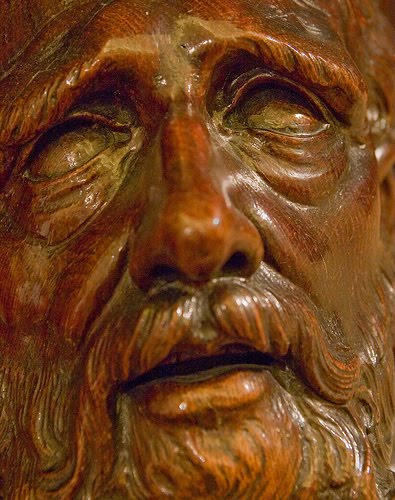
Following up on two posts on the achievements of modern anatomy (“The Knife Man” and “Anatomy and Philosophy”), here is St. Augustine (354-430) disapproving of the practice:
“With a cruel zeal for science, some medical men, who are called anatomists, have dissected the bodies of the dead, and sometimes even of sick persons who have died under their knives, and have inhumanly pried into the secrets of the human body to learn the nature of the disease and its exact seat, and how it might be cured … ”
(City of God, Book xxii, 24)
Those bad scientists are driven by an Intellectual sin: curiosity.
“There is another form of temptation, even more fraught with danger. This is the disease of curiosity … It is this which drives us to try and discover the secrets of nature, those secrets which are beyond our understanding, which can avail us nothing and which man should not wish to learn.”
And the bad-scientist actors are motivated by an unethical goal — trying to improve life in this world.
“But such is the stupid pride of these men who suppose the supreme good is to be found in this life.”
(City of God, xix, 4)
Despite such natural philosophers/scientists’ sinful pride, St. Augustine prays to God that they can be reformed and redeemed:
“For with their understanding and wit, which Thou bestowedst on them, they search out these things; and much have they found out; and foretold, many years before, eclipses of those luminaries, the sun and moon, – what day and hour, and how many digits, — nor did their calculations fail; and it came to pass as they foretold; and they wrote down the rules they had found out … . At these things men, that know not this art, marvel and are astonished, and they that know it, exult, and are puffed up; and by an ungodly pride departing from Thee, and failing of Thy light, they foresee a failure of the sun’s light, which shall be, so long before, but see not their own, which is. For they search not religiously whence they have the wit, wherewith they search out this. Thou madest them, they give not themselves up to Thee, to preserve what Thou madest, nor sacrifice to Thee what they have made themselves; nor slay their own soaring imaginations, as fowls of the air, nor their own diving curiosities, nor their own luxuriousness, as beasts of the field, that Thou, Lord, a consuming fire, mayest burn up those dead cares of theirs, and re-create themselves immortally.”
(Confessions Book 5, pp. 77-8 of Pelican edition)
One more datum in the millennia-old religion-versus-science skirmishes and wars.
In my judgment, St. Augustine is one of the two most important Christian theologians of all time. (The other is Thomas Aquinas).
Related: Augustine on Why Babies Are Evil. Aso: St. Augustine on “Righteous Persecution.”
“There is another form of temptation, even more fraught with danger. This is the disease of curiosity. It is this which drives us to try to discover the secrets of nature, those secrets which are beyond our understanding, which can avail us nothing and man should not wish to learn.”
Isn’t this a somewhat terrifying perspective? It seems to be war against knowledge. It seems humanity, thanks to curiosity, has learned so much about how the world works since Augustine’s time. Medicine, physics, electronics, astronomy, engineering, microbiology, DNA, genetics, forensics, psychology, “central heating and the flush toilet.”
Isn’t Augustine exalting ignorance? Shouldn’t someone question religion? Shouldn’t normal people be suspicious? Claiming faith is the most important thing: believing without evidence.
Isn’t this what Abrahamic religion does, what rabbis, imams, priests, pastors do: “just have faith,” “trust in faith,” “work on your faith?” How does this differ from telling one to stay dumb?
I realise that I may be quite late to this. In any case I thought this was an interesting article to comment on.
The first quote is very much taken out of context from St. Augustine’s book ‘The City of God’ (here is a link to the full quote which is in the fourth paragraph of chapter 24: http://www.newadvent.org/fathers/120122.htm). Augustine talks about how the human body was yet to be explained as to how all its organs worked together. Of course, while we do understand these workings much better today, Augustine could only work with the scientific knowledge that was available to him at the time. What he condemned were the men that, in the search for scientific cures for diseases, disregarded and disrespected the bodies of dead people and even the bodies of those who were alive but sick, some of whom were killed from the experimentation. Augustine does not mean to say that we must not seek to cure disease, but rather that we must do so humanely, being respectful to the bodies of the dead and certainly not treating those who are alive as mere experiments to satisfy curiosity. In other words, the ends don’t always justify the means.
The second quote here I remember reading in Richard Dawkin’s book ‘The God Delusion’. This is another misquote, although this one is far more dishonest. The actual quote was 490 words long and reads very differently (here is the link to the actual quote, which is in chapter 35, paragraphs 54-55: http://www.newadvent.org/fathers/110110.htm). Augustine was talking about the perverted curiosity which leads crowds of people to gather around a mangled corpse simply to experience the feeling of sorrow and horror that it gives them. This morbid sort of curiosity is what he says can “avail us nothing” and seeks no beauty. This is very different from any sort of scientific curiosity.
For the third quote I do not even need to seek the context. It is clear that he is in no way claiming it is unethical to improve life in this world. Rather, he is merely stating his belief that a greater good is to be found in Heaven rather than on Earth. This can hardly be taken to mean we mustn’t improve this world.
The final quote is also quite clearly not criticising the science, in fact it would seem that he admires the calculations of the astronomers. He is criticising both the scientists and the ignorant of science for thinking that these calculations are an explanation of eclipses in and of themselves.
To conclude, it is unfortunate that a few American fundamentalists have made Christianity seem to some to be at odds with science. I am Christian myself, but just as vehemently against these types as any Atheist. Traditionally science was considered by Christians to be a noble pursuit to better understand God’s creation. The overwhelming majority of Christian churches still believe this. If anyone wishes to criticise Christianity (or Atheism for that matter), I would advise against attempting to strawman everything and rather have a rational and genuinely intellectual debate. Christians (particularly fundamentalists) can learn much from Atheists when both sides are being fair, as I myself have learned much from them (even if I find their arguments ultimately unconvincing). On the other hand, Atheists can learn much from Christians in fair and civil discussions as well.
I enjoyed writing this and I hope that someone will find my criticisms interesting. Have a nice day and God bless.
Hi Charles: Your reading says more about you than it does about Augustine, which reflects well upon you. But your reading requires adding softening things that are not in Augustine’s text and/or overlooking harsh things that are.