A new episode of my podcast series, produced by Possibly Correct out of Toronto.
Audio:
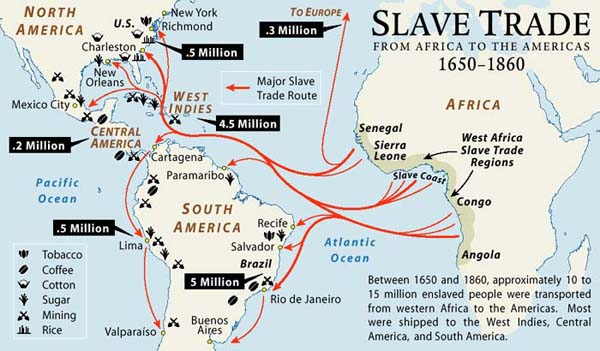
Topics and times: The decline of slavery as a moral achievement // History: Slavery practiced everywhere before modernity // The internal African slave society and trades // The Atlantic trade and where the slaves went // Early American anti-slavery voices // Wilberforce and the British // The French // The lesson of anti-slavery history: steps but not automatic, the Humanism and the Enlightenment // Does religion get credit? // Contemporary battles over slavery’s legacy // Methodological individualism in apportioning blame and credit.
Transcription: Forthcoming.
Sources:
- Henry Louis Gates, Jr. “Ending the Slavery Blame-Game.” The New York Times. April 23, 2010.
- Don Jordan and Michael Walsh, White Cargo: The Forgotten History of Britain’s White Slaves in America. New York University Press, 2008.
- Mungo Park, Travels in the Interior of Africa. See “Chapter 22 – War and Slavery.” Based on his experiences with African natives, Park wrote: “whatever difference there is between the negro and European, in the conformation of the nose, and the colour of the skin, there is none in the genuine sympathies and characteristic feelings of our common nature.” (Source)
- “Slave” etymology. Wiktionary.
- Slave Ports, West Africa 1870.
- Slave Trade from Africa to the Americas 1650-1860.
- Sheldon M. Stern, “The Atlantic Slave Trade.” Academic Questions 18:3 (Summer 2005), 16-34.
- William Wilberforce. Excerpt from 1789 Parliament speech: “I must speak of the transit of the slaves in the West Indies. This I confess, in my own opinion, is the most wretched part of the whole subject. So much misery condensed in so little room, is more than the human imagination had ever before conceived. I will not accuse the Liverpool merchants: I will allow them, nay, I will believe them to be men of humanity; and I will therefore believe, if it were not for the enormous magnitude and extent of the evil which distracts their attention from individual cases, and makes them think generally, and therefore less feelingly on the subject, they would never have persisted in the trade. I verily believe therefore, if the wretchedness of any one of the many hundred Negroes stowed in each ship could be brought before their view, and remain within the sight of the African Merchant, that there is no one among them whose heart would bear it. Let any one imagine to himself 6 or 700 of these wretches chained two and two, surrounded with every object that is nauseous and disgusting, diseased, and struggling under every kind of wretchedness! How can we bear to think of such a scene as this? … As soon as ever I had arrived thus far in my investigation of the slave trade, I confess to you sir, so enormous so dreadful, so irremediable did its wickedness appear that my own mind was completely made up for the abolition. A trade founded in iniquity, and carried on as this was, must be abolished, let the policy be what it might,—let the consequences be what they would, I from this time determined that I would never rest till I had effected its abolition.”
Related:
- The battle against slavery and serfdom (PowerPoint)
- The French Revolution and the ending of slavery
- “The Dim Ruins of the Enlightenment” [Open College transcript]
- Frederick Douglass’s letter to his former master
- Frederick Douglass and Adam Smith
- Frederick Douglass and Ayn Rand
The complete series of Open College with Stephen Hicks podcasts.
I must disagree with Professor Hicks’s minimization of the role of religion in the abolition movements. If you look at who the abolitionists were, in either Britain or the United States, you’ll find huge numbers of religious individuals; many of them, if you look at their writings, regularly cite the Bible, especially the Hebrew Scriptures, to buttress their antislavery arguments. Abolitionists like Theodore Dwight Weld, for example, cited the Biblical passage “He that stealeth a man and selleth him, or, if he be found in his hand, he shall surely be put to death” (Exodus xxi. 16). Other favorite passages were the story of the selling of Joseph (the title of an antislavery essay by Samuel Sewall, 1700), the prophet Isaiah (“untie the cords of the yoke to let the oppressed go free”). Strikingly, the two strongest abolition movements sprung up in Britain and the UK; the abolitionists were Protestant, not Catholic. Why? Because Protestantism encouraged the reading of the Bible, and the overarching messages of the Hebrew Scriptures imbued abolitionists’ thought. The messages were that all men are created equal (all being descended from Adam and created in God’s image) and that God intervenes in history to free slaves (the Exodus story). Yes, the Bible allowed slavery, but it regulated and limited it to make it more humane; this was a compromise with the necessity of bonded agricultural labour in the Ancient Near East. Yes, proslavery figure also cited scripture. But the abolitionists themselves (even less religious ones, like Frederick Douglass) regularly appealed to the Bible to argue against the legality and morality of slavery. In France, a Catholic country, there was never a popular abolition movement; the French Enlightenment did lead to the abolition of slavery, but Napoleon brought it back to Haiti.
The role of religion had less of an impact on slavery than it could have only because the Church was losing its authority over the masses and economics were becoming more important. I could go on about the role of the Church in the West in ushering in the Scientific Revolution, but that’s not the point of my comment, only for background to the Western development of reason and rationalist thinking which led to the abolitionist movement.
Slavery was a normal part of ancient life. So what caused it to become something of a moral movement to end it? Does religion play a significant role in it?
King Charles I of Spain, usually known as Emperor Charles V, was following the example of Louis X of France, who had abolished slavery within the Kingdom of France in 1315. He passed a law which would have abolished colonial slavery in 1542, although this law was not passed in the largest colonial states, and it was not enforced as a result.
From 1435 to 1890, we have numerous bulls and encyclicals from several popes written to many bishops and the whole Christian faithful condemning both slavery and the slave trade.
The date of the first Bull from 1435 is very significant. Nearly 60 years before the Europeans were to find the New World, we already had the papal condemnation of slavery as soon as this crime was discovered in one of the first of the Portuguese geographical discoveries.
But here was obviously widespread non-acceptance on the part of Catholic clergy and laity.The prevalent attitude of the American hierarchy, with some notable exceptions in both directions, was that many aspects of slavery were evil, but that to change the law would be, practically speaking, a greater evil. It was decided that papal pronouncements against slavery, particularly Gregory XVI’s , did not apply to the institution as it existed in the United States, thus yielding on this issue a sort of Americanized Gallicanism.
England interpreted that Gregory XVI was condemning only the slave trade and not slavery itself, especially as it existed in the United States. England evidently felt justification for this dissent lay in the episcopal (mis)interpretation of .
These arguments are not dissimilar to the widespread dissent from the Church’s teachings against slavery by bishops, priests and laity that was common from the 17th to 19th centuries. For the Catholics of the United States—as for Catholics everywhere—there was the consistent, historical teaching of the Church, as presented through Eugene IV. Pius II, Paul III, Gregory XIV, Urban VIII, Innocent XI, Benedict XIV, Pius VII and others.
For the early 19th century, in the midst of the volatile decades before the Civil War, Gregory XVI issued , with its clear condemnation of both the slave trade and slavery itself.
Since that Constitution mentioned the documents of the previous pontiffs, it is hard to understand how the American hierarchy was not aware of the consistency of the teaching and its nature.
All of these teachings, nonetheless, went unknown to the Catholic faithful of the U.S., perhaps through willful ignorance, or were explained away by many of the American bishops and clergy. Thus, we can look to the practice of dissent from the teachings of the Papal Magisterium as a key reason why slavery was not directly opposed by the Church in the United States.
Perhaps religion gave our ancestors a moral and ethical consideration but it was resisted for a long time due to economic factors and that obviously was the stronger pull than religious considerations.
Hi Maria:
Yes, the history of religion on slavery gets more complicated after the 1200s, with several (partial) limitations placed on slavery. The most important obstacle to reform, though, was the Bible itself, both old and new testaments. E.g.,
Exodus 21:20-21: If a man beats his male or female slave with a rod and the slave dies as a direct result, he must be punished; but he is not to be punished if the slave gets up after a day or two, since the slave is his property.
Leviticus 25:44-45: Your male and female slaves are to come from the nations around you; from them you may buy slaves. You may also buy some of the temporary residents living among you and members of their clans born in your country, and they will become your property.
1 Peter 2:13: “Submit yourselves for the Lord’s sake to every authority instituted among men.”
2:18: “Slaves, submit yourselves to your masters with all respect, not only to those who are good and considerate, but also to those who are harsh.”
Ephesians 6:5-8: “Slaves, be obedient to them that are your masters according to the flesh, with fear and trembling, in singleness of your heart, as unto Christ.”
It’s not until well into modernity — with all the intellectual changes that brought — that a significant number of the religious are willing to ignore parts of Scripture and use their own judgment.
Partly why the laity were often not aware of the anti-slavery arguments is that during the 1800s the Church was putting many anti-slavery tracts on its list of forbidden books.
Even as late as 1866, the Vatican issued a statement — apparently triggered by the passage of the US 13th Amendment — that “Slavery itself … is not at all contrary to the natural and divine law …”.
To my understanding, that did not change until the early 20th century.