Stephen Hicks, Ph.D.

Philosopher

The Enlightenment vision

apple-88x50Stephen Hicks discusses the Enlightenment vision of the eighteenth-century. This is from Part 14 of his Philosophy of Education course.

Clips 1-3:

Previous: What modernism is.
Next: Post-modernism’s themes.
Return to the Philosophy of Education page.
Return to the StephenHicks.org main page.

Posted 1 week, 3 days ago at 12:37 pm.

Add a comment

The French Revolution and the ending of slavery

When did slavery end?

Intellectual historian Zeev Sternhell makes the following observation:

french-revolution-163x100“But it is above all the French Revolution that is overlooked. Slavery was in fact abolished by the French Revolution. The slaves, like the Jews, were liberated, and for the first time in history, all men living within the frontiers of a single country, France, were subject to the same laws and became free citizens with equal rights.”

That’s from page 46 of Sternhell’s The Anti-Enlightenment Tradition (Yale University Press, 2010).

The “first time in history” is striking. Anti-slavery societies had been founded during the Enlightenment in the United States, Great Britain, and France.

But, despite its many sins, the French Revolution should get major credit for being the first to eliminate this ugly, ugly practice.

Posted 3 months ago at 7:16 am.

Add a comment

Herder on multicultural relativism

[This excerpt is from Chapter 4 of Explaining Postmodernism: Skepticism and Socialism from Rousseau to Foucault]

Herder on multicultural relativism

herder-50x61Sometimes called the “German Rousseau,”[57] Johann Herder had studied philosophy and theology at Königsberg University. Kant was his professor of philosophy; and while at Königsberg Herder also became a disciple of Johann Hamann.

Herder is Kantian in his disdain for the intellect, though unlike the static and rigid Kant he adds a Hamannian activist and emotionalist component “I am not here to think,” Herder wrote, “but to be, feel, live!”[58]

Herder’s distinctiveness lies not in his epistemology but in his analysis of history and the destiny of humankind. What meaning, he asks, can we discern in history? Is there a plan or is it merely a random happening of chance events?

There is a plan.[59] History, Herder argues, is moved by a necessary dynamic development that pushes man progressively toward victory over nature. This necessary development culminates in the achievements of science, arts, and freedom. So far Herder is not original. Christianity held that God’s plan for the world gives a necessary dynamic to the development of history, that history is going somewhere. And the Enlightenment thinkers projected the victory of civilization over the brutish forces of nature.

But the Enlightenment thinkers had posited a universal human nature, and they had held that human reason could develop equally in all cultures. From this they inferred that all cultures eventually could achieve the same degree of progress, and that when that happened humans would eliminate all of the irrational superstitions and prejudices that had driven them apart, and that mankind would then achieve a cosmopolitan and peaceful liberal social order.[60]

Not so, says Herder. Instead, each Volk is a unique “family writ large.”[61] Each possesses a distinctive culture and is itself an organic community stretching backward and forward in time. Each has its own genius, its own special traits. And, necessarily, these cultures are opposed to each other. As each fulfills its own destiny, its unique developmental path will conflict with other cultures’ developmental paths.

Is this conflict wrong or bad? No. According to Herder, one cannot make such judgments. Judgments of good and bad are defined culturally and internally, in terms of each culture’s own goals and aspirations. Each culture’s standards originate and develop from its particular needs and circumstances, not from a universal set of principles; so, Herder concluded, “let us have no more generalizations about improvement.”[62] Herder thus insisted “on a strictly relativist interpretation of progress and human perfectibility.”[63] Accordingly, each culture can be judged only by its own standards. One cannot judge one culture from the perspective of another; one can only sympathetically immerse oneself in the other’s cultural manifestations and judge them on their own terms.

However, according to Herder, attempting to understand other cultures is not really a good idea. And attempting to incorporate other cultures’ elements into one’s own leads to the decay of one’s own culture: “The moment men start dwelling in wishful dreams of foreign lands from whence they seek hope and salvation they reveal the first symptoms of disease, of flatulence, of unhealthy opulence, of approaching death!”[64] To be vigorous, creative, and alive, Herder argued, one must avoid mixing one’s own culture with those of others, and instead steep oneself in one’s own culture and absorb it into oneself.

For the Germans, accordingly, given their cultural traditions, attempting to graft Enlightenment branches onto German stock has been and would always be a disaster. “Voltaire’s philosophy has spread, but mainly to the detriment of the world.”[65] The German is not suited for sophistication, liberalism, science, and so on, and so the German should stick to his local traditions, language, and sentiments. For the German, low culture is better than high culture; being unspoiled by books and learning is best. Scientific knowledge is artificial; instead Germans should be natural and rooted in the soil. For the German, the parable of the tree of knowledge in the Garden of Eden is true: Don’t eat of that tree! Live! Don’t think! Don’t analyze!

Herder did not argue that the German way is the best and that it is justifiable for the Germans to become imperialistic and impose their culture upon others—that step was taken by his followers. He argued simply as a German in favor of the German people and urged them to go their own way, as opposed to following the Enlightenment.

Herder is relevant because of his enormous influence on the nationalist movements that were shortly to take off all over central and eastern Europe. He is also relevant to understanding how far from Enlightenment thinking the German Counter-Enlightenment was. If Kant is partially attracted to Enlightenment themes, Herder rejects those elements of Kant’s philosophy. While Herder is broadly Kantian epistemologically, he rejects Kant’s universalism: for Herder, how reason shapes and structures is culturally relative. And in contrast to Kant’s vision of an ultimately peaceful, cosmopolitan future, Herder projects a future of multicultural conflict. Thus, in the context of the German intellectual debate, one was offered a choice—Kant at the semi-Enlightenment end of the spectrum and Herder at the other.

References

[57] Barnard 1965, 18.

[58] In Berlin 1980, 14.

[59] Herder 1774, 188.

[60] Herder 1774, 187.

[61] In Barnard 1965, 54.

[62] Herder 1774, 205.

[63] Barnard 1965, 136.

[64] Herder 1774, 187.

[65] Herder 1769, 95; see also 102.

Bibliography.

[The chapter from which this section of Stephen Hicks's Explaining Postmodernism (Scholargy Publishing, 2004) is excerpted can be downloaded as a PDF at the Explaining Postmodernism page. The full book is also available at Amazon.com.]

Posted 5 months, 4 weeks ago at 8:53 am.

Add a comment

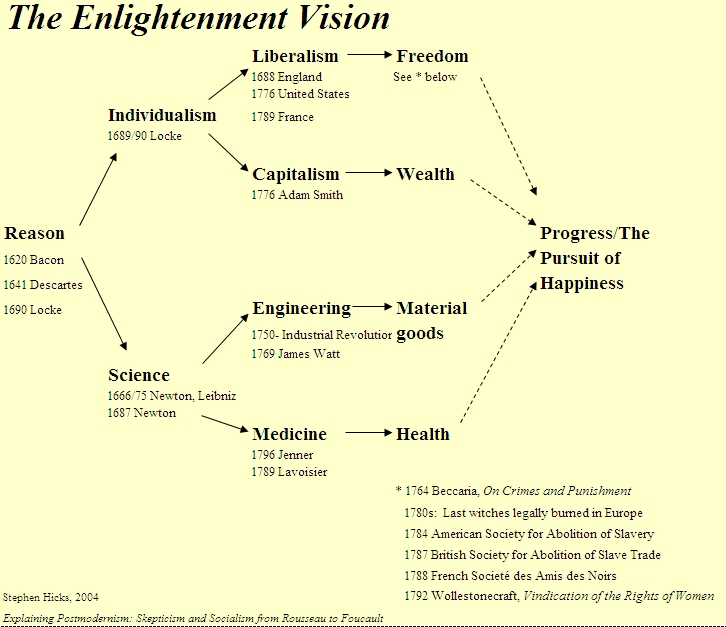
The Enlightenment Vision — Flowchart

The Enlightenment of the long 18th century was an era of awesome intellectual and cultural transformation.

hicks-enlightenment-vision-flow-chart-180x100My Enlightenment Vision flowchart [pdf] is pitched at a high level of abstraction, showing schematically how the philosophical revolution of the 17th century led to the 18th-century revolutions in science, technology, politics, and economics — which in turn led to the dramatic increase in health, wealth, freedom, and goods in the 19th century.

To put it another way, the chronology shows how the ideas played out as philosophy, then as an intellectual movement, then as activism, then as the working technology of culture.

I use the chart in my classes and published a version of it in my 2004 Explaining Postmodernism. It’s here as a PDF and as an Excel file, in case you’d like to adapt it for your own purposes.

Posted 9 months, 3 weeks ago at 6:28 pm.

Add a comment

The Counter-Enlightenment Attack on Reason

ep_50x78At the Explaining Postmodernism page, Chapter Two of my book is now available online. This chapter traces the decline of epistemology from Kant’s “Copernican Revolution” to the dominance of speculation and irrationalism in the nineteenth-century, setting the stage for the collapse of reason in the twentieth century, which is the subject of Chapter Three.

Here are the chapter’s sections and page numbers:

Chapter Two: The Counter-Enlightenment Attack on Reason [pdf]

Enlightenment reason, liberalism, and science 23
The beginnings of the Counter-Enlightenment 24
Kant’s skeptical conclusion 28
Kant’s problematic from empiricism and rationalism 29
Kant’s essential argument 33
Identifying Kant’s key assumptions 36
Why Kant is the turning point 39
After Kant: reality or reason but not both 42
Metaphysical solutions to Kant: from Hegel to Nietzsche 44
Dialectic and saving religion 47
Hegel’s contribution to postmodernism 50
Epistemological solutions to Kant: irrationalism from
Kierkegaard to Nietzsche 51
Summary of irrationalist themes 57

Posted 10 months, 1 week ago at 5:16 pm.

Add a comment

Explaining Postmodernism: Chapter One online

ep_50x78

My Explaining Postmodernism: Skepticism and Socialism from Rousseau to Foucault has, gratifyingly, had two hardcover printings and eight softcover printings from 2004-2009.

Over the next while I will be making portions of the book available online at this new Explaining Postmodernism page here at my site.

To start, here are the Table of Contents [pdf] and Chapter One: What Postmodernism Is [pdf]. Hope you enjoy.

And, of course, it’s available at Amazon.

Posted 10 months, 2 weeks ago at 10:56 am.

Add a comment