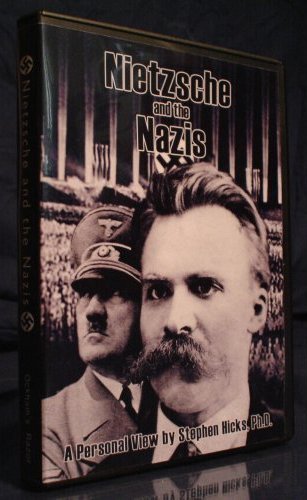
 Since its 2006 publication, my 2:45-hour documentary on Nietzsche and the Nazis has been available from Amazon, Netflix, and other venues.
Beginning this summer, Netflix has made the documentary available via video-stream, which has led to a healthy uptick in feedback — including gratifying praise, interesting new angles, thoughtful disagreement — and a smattering of ad hominem and/or otherwise vituperative attacks from those whose interpretations of National Socialism or Nietzsche are very different than mine.
Probably par for the course when dealing with such weighty matters and polarizing political movements and philosophers.
This summer I have been turning the script into a manuscript (and am almost finished). The manuscript includes the footnotes for all the key quotations and assertions, along with a full bibliography. This will enable scholars and other interested thinkers to check everything for accuracy and to use it for other scholarly purposes.
The script and manuscript are in 38 sections [pdf of the scene selection menu]. The plan is to release the manuscript sections serially over the next few months, each section containing the text, relevant images, and being available in both HTML and PDF formats. When all of the sections of the manuscript have been released, a full version in PDF will also be made available.
Alongside that process, I will post in response to the many very good emails I’ve been receiving from those who have watched the documentary. By far, the most email I’ve been receiving focuses on the two most controversial interpretive points in the documentary:
 1. On the Nazis: I argue that they were socialists and anti-capitalist. .
.
 2. On Nietzsche: I argue that he is an individualist only in a very limited sense and that he is much more a collectivist than he is an individualist. .
Those two theses have generated the most heat, so in near-future blog posts I will take up two important issues:
Were the Nazis really socialists?
and
Was Nietzsche an individualist or a collectivist?
If those issues interest you, please sharpen your debating skills, brush up on your history and philosophy, and prepare for some serious intellectual fun.
[Go to the Nietzsche and the Nazis page. Go to the StephenHicks.org main page.]
I didn’t know you had a website … the following is a post I made in the private political forum at Websleuths:
Political documentary: Nietzsche and the Nazis
Nietzsche and the Nazis is an excellent 2006 documentary by Stephen Hicks, Ph.D., available at Netflix as a play online movie. It gives a history of the development of the national socialism and its relationship to the philosophy of Nietzsche. It also clarifies the differences in socialism/fascism and communism. Some of the parallels with the current developments in the United States are striking, including the anti-individualism and anti-capitalism of the Nazis and the growth of collectivism and group identities and conflicts, even the anti-reason and pro-passion and emotion. The political strategy of Nazism was to inflame the passions of the masses in order to oppose the facts and arguments of reason and to replace the rights of the individual (liberty, property, pursuit of happiness) with the entitlements and service to the requirements of the collective. Reason, logic and objectivity were scorned, only passionate support of the collective course was endorsed. Government control of education and news media was essential to the national socialist cause, as was control of the economy. It is amazing how so few gained power and control over so many in so little time. “They used democracy to achieve anti-democratic ends.”
Russell
Your documentary is a real eye-opener. Pop-culture and leftists quote Nietzsche often. I think you are right to say that we have not defeated the ideas, yet.
I appreciate the feedback, Tim. I agree about the long-term battle.
Stephen Hicks, I’m commenting out of anger. Why do you, as an American educator, refuse to acknowledge the Egyptian achievements of the past? In your documentary, when you refer to ancient civilization you only mention Greece and Rome. Have you no idea about the Great Pyramids and the civilization that built them? Is it because the Egyptian civilization influenced Greece, which influenced Rome? The columns and pillars that you would find in Ancient Greece is undoubtedly inspired by Egyptians. For example, Greece does not have lions because they are indigenous to Africa; however, you can go to the Greek island of Delos and see ancient statues of lions with Egyptian style columns in the backdrop.
Don’t just mention the white civilizations of the past because that is the custom. The forefathers of America acknowledged Ancient Egypt and had the forethought to pay homage via the Seal of the United States. They knew truths and I’m sure they would have taught these truths to future generations. Don’t mess up their country by hiding these truths, professor.
Furthermore, you insulted the Egyptian Military when you said Rome was the mightiest military in the ancient world. Do you not know that the Egyptian civilization and it’s military lasted longer than Greece, Rome, and all other ancient and modern western civilization combined? Are you apart of the conspiracy to ignore and refuse to recognized the historical achievements of the ordinary African because of our modern-day crisis? You and your colleagues are the main reason why Americans are not properly educated. Instructors like you make me want to drop out of college, because your hidden agenda is easily recognizable to the critical mind. You guys leave out truths, so when reality doesn’t match text, confusing is created. Here is an analogy: “Anyone can teach an elementary school child that one plus one equals three, and that ignorant child will take those teachings as truth; but when the application of one plus one is used, and the result is not three, then either confusing or awakening will take place.”
Just like the Germans might have been the most literate group prior to and during Hitler’s reign, that doesn’t mean that they were the smartest. They probably just believed what they were taught. And their instructors probably left out critical information about his-story. A characteristic that you undeniably demonstrated on your heavily opinionated documentary. And if you are any type of historian you will recognize this truth, because history has a tendency to repeat itself. And we know, based on history, what a literate but ignorant population will allow.
Hi Michael:
I’m not sure what your anger is about. The documentary is primarily about the Nazis and Nietzsche, so ancient civilizations are discussed in the documentary only insofar as they are relevant to understanding the Nazis or Nietzsche. Would discussing the ancient Egyptians more shed light on those topics?
As for which ancient civilizations are mentioned in the documentary: the Chinese, the Indian, the Arabs, and the Japanese are mentioned positively in the Nietzsche sections; so it’s hardly a “white” thing going on here.
As for comparing the military might of Egypt with that of Rome: please note that there I am simply reporting Nietzsche’s assessments, in the context of my being a historian explaining Nietzsche’s views. I’m not speaking there in my own voice, so perhaps your argument is with Nietzsche?
You also seem to think there’s some conspiracy afoot to keep people in the dark about ancient Egypt. Given the huge amount of historical and archaeological interest, the number of books published each year, the amount of tourism to see the pyramids and so on, and the fact that pretty much every school child in the country knows something about the ancient Egyptians — I ‘m not sure why you think there’s some sort of cover up.
However, the main issue is your criticizing the documentary’s lack of Egyptian material: If there is something about Egypt that I have missed in explaining Nietzsche’s views and their relevance to the Nazis, please do let me know.
http://www.stephenhicks.org/publications/nietzsche-and-the-nazis/
Stephen Hicks,
My anger is with Western Institutions and Instructors for crediting Western Civilization to Ancient Greece, when we know that Ancient Greece was influenced by Ancient Egypt. Your documentary was just another tool that I witnessed to emphasize that trend.
Also, I’m familiar with you mentioning other civilization, but they were not mentioned in the same context of Greece and Rome. Therefore, that’s an invalid point.
On the subject of Romes military might, I apologize and do note that those are not your words.
And I have no doubt that there is a conspiracy to ignore the contributions that the West adopted from Ancient Egypt. I’m not saying people do not know about Egypt or information is suppressed about Egypt. I know a vast majority of people know about Egypt. My point of criticism is with the refusal to acknowledge it’s contributions with the ranks of Greece and Rome. Nothing more, nothing less.
Two follow up questions for you, Michael, to improve or correct the historical record.
1. Given the hundreds of Greek achievements in science, technology, math, politics, visual art, theater, philosophy, economics — what are, in your judgment, the top ten most important of them for which the Greeks are indebted to the Egyptians?
2. From the perspective of our own 21st-century civilization, what are, in your judgment, the top five most valuable things for which we are indebted and should be thankful to the ancient Egyptians?
Stephen Hicks,
1) Today, every modern nation has hundreds of achievements in science, technology, mathematics, politics, visual arts, theater, philosophy, and economics. Though, to the contrary, Greece and Rome did accomplish this feat in ancient times. However, what must be noted is, where did it originate? The answer to every one of those fields, except politics, originated in Ancient Egypt and were adopted by the Greek. Textbook writing, Eurocentric, historians contribute Western civilization to Greece because it is where most Europeans received their civilization although it was never the originator.
2) 1. Civilization itself
2. Economics
3. Science & Technology
4. Philosophy
5. Visual Arts or Architecture
Can you get more specific, Michael?
What particular achievements of the Egyptians did the Greeks learn from them?
For example, your earlier example about lions is a good one, as there were no lions in Greece. So if the lion becomes an important motif in Greek art, it makes sense to hypothesize an important connection to Africa.
Do you have more specific examples like that?
It is hard to be too specific because when you attempt to be too specific, you generally are asking for individual contributions from one person to the other. What has to be considered is anthropology and archeological evidence since individual records were not kept in as good of keeping in ancient times for us to uncover. To be a little more specific though:
CIVILIZATION
Our forefathers were very intelligent because they did not have to go through the public educational institutions that most school age children have to go through today. The designer of the Great Seal was Charles Thomas, a forefather, who was enrolled into a Latin school in Philadelphia and was the founder of a Philosophy group. If he was educated by Latin studies means that he knew historical truths and that’s a contributing reason why he was chosen to develop the Great Seal.
“Fifty-three at the time, Thomson had served the past eight years as Secretary of the Continental Congress where he acquired a reputation for fairness, truth, and integrity. Well-versed in the classics, he was once a Latin master at an academy in Philadelphia (http://www.greatseal.com/committees/finaldesign/index.html).
So if our civilization originated in Greece or Rome why would a well educated, fair, truthful, and honest “Master of Latin” pay homage to Ancient Egypt?
On the front of the Great Seal
We are thought that it is an eagle with spears and olives in tow, and it is an eagle today. However, I beg to differ about the original makeup of the bird. I believe, based on visual evidence and logical conclusion that the bird is a phoenix. The reason I believe this is because of the attention to detail illustrated by Thomas’ depiction. If you were to look at his original work (same website as above), you would find something noticeable on top of the birds head. This attachment is not foreign and was depicted as much apart of the bird as it’s wings. Of all the images that I’ve seen of Eagles, I have yet to see one with such an attachment on top of it’s head. In addition, the wings of the original bird feathers decreased in length from the tip of the wings towards the body of the bird. In an eagle, the length of the feathers is relatively equal in size. These two observations of the original bird is consistent with the image of a phoenix instead of an eagle. I like to invite you to compare. An a phoenix is synonymist with Ancient Egypt.
On the subject of the olives in tow, olives were first mentioned on earth in the Hebrew Bible. In Genesis a dove carrying an olive is a sign of peace. Also, after the great flood a dove came back to Noah with an olive leaf in her mouth (Genesis 8:11).
In modern times, when a parent is teaching a toddler or young child how to read they usually get a stack of words and pictures that match. They would get a word that says, “cow” and the child will have to find the picture of a cow and match them. Back to history, it is known throughout the intelligent black community that the Hebrew Bible is a plagiarism of Egyptian hieroglyphics. The reason this is known is because Hebrew Biblical text matches Egyptian hieroglyphics. Just like a child matching the word and image of cow.
The flood in Genesis happened annually in Egypt because their world (Earth surrounded by Nile) flooded annually. If it happened to rain ( which hardly happened) during that flood, then it would become a great flood.
Therefore, since we can prove that Hebrew text was forged from Ancient Egypt and that text indicates that olives were growing in the flooded land of Ancient Egypt, then we must conclude that olives grew in Ancient Egypt.
On the subject of arrows in tow, arrows were Ancient Egypt most offensive weapon. However, arrows are found throughout the ancient world therefore, the only credit to Egypt that the bundle of arrows have is that they were being carried by a phoenix.
On the back of the Great Seal
The pyramid represents the original civilization in which this country evolved. The “Eye of Providence” is just the American depiction of the “Eye of Horus” (Egyptian Deity). The halo behind the eye is a representation of the Sun. And the Sun is the god of all Ancient Africans who brings energy and life to Earth. Since Europe is too far from the Sun and did not develop that type of relationship with it. They also didn’t understand why the Greeks were worshiping the Sun and other African Deities. The Romans recognized the flaw and put a face on it. That’s why most of the images of Jesus have a halo or Sun in the backdrop. The forefathers knew this truth and were mostly atheist.
Also, when it comes to religion. The Roman Catholic Church is just an institution and they will do anything to maintain their stability. They are the ones that blamed the Jews for Jesus’ death during and prior to Hitler. They made a pact with Hitler. Isn’t it funny that the Vatican is in Rome? Not so funny right now because I haven’t made my point. But here it is.
In 1935, Rome is the capital of Italy who is the Ally of Japan who sold Ethiopia weapons. Historically speaking, Ethiopians along with Nubians out of the Sahara are the populators of the Nile River Valley. Ethiopians brought the spirituality aspect and the Nubians contributed the agricultural and architecture aspects that fused a mighty civilization. The Ethiopians are credited, probably quietly, for developing the Jewish religion. That’s why they can go to Israel to this day and become a Jew over all other nations. And with a Roman Catholic Church in command of Italy, Mussolini had the pretense, provided by his Ally of Japan to go to war with Ethiopia of all other nations on earth. Just to suppress the originators of Western Religion. Now that shol’ is funny!
Hi again, Michael:
If it is hard for you to be specific about connections between Egyptians and Greeks, then why are you so angry with people who are unaware of them?
If you are asked for evidence of Egyptian-Greek connections and your response is to talk about an 18th-century American seal designer and the actions of the Catholic Church during World War II, then why would you expect people to take seriously claims of a conspiracy of silence?
Stephen Hicks,
I said that it was hard to be too specific on an individual basis. However, it is not hard to determine where western civilization originated. When I get some time I’ll research some specific archeological evidence that will lay it all out for you, if you want me to.
Also, I mentioned Thomas and the Church in order to show modern day connections to original conceptions.
Thanks for the dialog Mr. Hicks.
All the best for your further research and thinking, Michael.
I just finished watching the documentary last night. I think your in depth look at the thinking that led to the Nazi’s power was a real education. I wish every high school student could see it.
I have always wondered about Nietzsche, as I have never read his works. Your overview of his philosophy was interesting, and I find it hard to believe that he is so popular today. That’s frightening. I guess you can tell I am a Christian and also not much of a “predator”. I’m sure he would have found me to be quite expendable:)
Thanks!
Thanks for the comment, Michelle. I agree that parts of Nietzsche are scary indeed. I also think that parts of his thinking are invigorating and ask exactly the right deep questions. I too would like to have every high school student see the documentary. : )
I understand that his life ended very badly. Do you attribute that to his philosophy in any way?
Stephen,
Thank you for Nietzsche and the Nazis. Although I don’t agree with your “Nietzsche as collectivist” angle, most of what you say is right on target and that point really becomes a minor one in this very important film. Clearly the Nazi’s saw Nietzsche as a guide. Nietzsche, however, would have thought the Nazi’s hijacked his work their own deranged purposes. Nietzsche’s work is important, complex, and intentionally vague. But clearly he was no proto-Nazi. A bit on Nietzsche’s hatred of Wagner would have been a helpful addition to the film and would have help make that point a bit more clear. Bottom line: Nietzsche was a passionate, brilliantly-observant, and ultimately flawed human being. Your work has painted a vivid picture of the man and tumultuous period that unfolded after his death. Ideas do matter, and, as you say, we must vigilantly defend the truth whenever it comes under assault. Your film shows how much damage can be done when powerful ideas become the tools of madmen. Keep up the good work.
Thanks for the focused points here, Neal.
The issue of Nietzsche’s collectivism/individualism is one of the two most heat-generating parts of my analysis.
I wonder if it would help if you specified what criteria you use to judge whether one is individualist?
My criteria in the documentary are:
1. Seeing individuals as ends in themselves.
2. Seeing individuals as self-responsible for achieving their ends.
3. Seeing individuals as self-developing their characters and beliefs and as self-initiating their actions.
I can’t tell yet whether you think my criteria are incorrect or whether the criteria are fine but you think I misinterpret whether they fit Nietzsche.
I appreciate also that we share a commitment to the importance of ideas.
Best,
Stephen
Stephen, thanks for showing an openness to alternative perspectives. It is refreshing to find someone who approaches philosophy as a search for truth about reality rather than simply a defense of his own view of reality. I hope my points below help bring both of us closer to an understanding of Nietzsche’s political ideas.
You say Nietzsche was a “collectivist,” which I understand to be a concept describing a political society (state, regime, nation, culture). But in the quotes you use to prove that Nietzsche is an “anti-individualist,” Nietzsche seems to be making “ethical” and “metaphysical” statements rather than making statements about how a political society should be structured.
Your individualist criterion number 1 is the “second maxim” of Kantian categorical imperative, a component of Kant’s personal ethical philosophy (later extended by Rawls to his political “rights” philosophy). Clearly Nietzsche was not a big fan of Kant or this specific dictum. But does disagreement with this imperative make him “collectivist,” or rather does it make him simply “immoral” or “amoral” as defined by the prevailing cultural norms? Andre Gide’s “The Immoralist,” and many of Camus’s characters (especially Meursault in The Stranger) can be understood in this same immoral/amoral vein. In my view, Nietzsche was an “immoralist” in that sense to be directly contrasted with Kant (and Rawls anachronistically). But in no way does this make him a political collectivist.
Your individualist criteria numbers 2 and 3 seem, as I said, to be closer to “metaphysical” ideas when combined with the quotes you provide from Nietzsche in the film. Without even debating whether or not Nietzsche would disagree with 2 or 3, I would suggest that in the quotes you provide in the film, Nietzsche may be referring to larger non-societal forces. Rather than the opposites of 2 and 3 being “collectivist” notions in Nietzsche, I would call their opposites “determinist.” Nietzsche’s quotes have more to do with the universal forces that we might collectively call the human condition or human nature than with a specific outline of a political society, whether it be individualist or collectivist.
In essence, I don’t see Nietzsche as either individualist or collectivist in political terms. I see him as silent on the matter. But rather than approaching the subject in a “negative” way as you have done (i.e., providing individualist criteria and providing quotes showing how Nietzsche apparently “disagrees” with these individualist ideals), maybe you could show some “positive,” direct evidence in Nietzsche’s work showing him to be sympathetic to the idea of a “collectivist” society. In my reading of him, I have not seen any evidence of this.
That explains your reaction nicely. I don’t use “individualism” or “collectivism” politically in discussing Nietzsche in the documentary. Rather, I’m using the terms morally: Who is the standard of the good? Who is responsible from bringing the good about? Who should be the beneficiaries of the goods? Answers to those questions can shape political discussion, but they’re questions of ethics.
I also touch on the metaphysical uses of “individualism” and “collectivism” in discussing Nietzsche: Is the metaphysical nature of man such that he is essentially and individual or part of a collective? Again, answers to that question can have political implications, but it’s a metaphysical question.
“Individualism” or “collectivism” can also be used epistemologically in asking whether as knowers we operate as individuals essentially or as social beings; but I don’t go into those issues in connection to Nietzsche in the documentary.
I don’t think Nietzsche’s politics are worked out enough to determine the degree of his individualism or collectivism.
But I do think on the ethics questions (and to some extent on the metaphysics of man questions) Nietzsche is much, much less of an individualist than he is commonly made out to be.
Hope this helps clarify.
I appreciate your response, Stephen, and I think I understand what you are trying to say about Nietzsche. The word “collectivism” threw me off, but now we are back on track.
One thing is clear, Neitzsche hated the idea of political, moral, metaphysical egalitarianism because he thought it ignored
distinctions of rank, collapsing the great and the worthless into one level heap. The very idea of “rank” or “social hierarchy” requires that the fundamental social unit be thought of as the political community as a whole, from peasant to prince, since to be considered of higher or lower rank necessitates more than one individual. Modern libertarian thought starts with artificial notion of the atomistic individual as the fundamental unit of society. So in this sense, Nietzsche’s philosophy is without a doubt contrary, at a very fundamental level, to the modern notion of atomistic Lockean individualism and all variants of individualism following therefrom.
Now the question is, if Nietzsche was not an “individualist” does that make him a modern “collectivist,” in the vein of say a Marxist. I think not and here’s why. Nietzsche, like the ancients, believed that social hierarchy and distinctions of rank were necessary and to be celebrated. The implications of this for the political regime are not necessarily “collectivist,” however. Or maybe I should say, I don’t think you want to label all political communities prior to eighteenth century as “collectivist.” I think to do this would be a mistake. These two polar opposites (individualism and collectivism) are at best limited scientific conceptual tools and at worst modern ideological conceits. They are derived from thought-experiments like the idea of “the state of nature” or “the brotherhood of man.” These notions are not properly descriptive of any observed political society. For example, was the Athenian democracy individualist or collectivist? Neither, I would say, because it was an organic community first and foremost, animated by a mixture of both individualist and collectivist ideals.
The point is that the terms “individualism” and “collectivism” are artificial, abstract concepts. They are helpful in some discussions, but at the same time, they are ulimately reductionist. In practice, in the real world, in a real community, there is no such thing as pure individualism or pure collectivism. Authentic, organic political communities are always a mixture of these two ideals, at times leaning more to one pole or the other.
So as I see it, Nietzsche is definitely not a individualist. We agree on that. But we disagree that Nietzsche’s thought can be properly labeled “collectivist.” I say he is not a collectivist because, unlike Marx, Nietzsche does not see society as capable of being remade into a “brotherhood of the proletariat” or some such nonsense. His understanding of society (including political society) is pre-modern and uses a natural hierarchically-established community as the fundamental unit. This does not make him a collectivist. It simply makes him a cogent observer of the historical fact that any individual is born into a community with some type of hierarchical structure.
Thanks again for providing the forum.
I don’t know the details of his condition but I’ve read the speculations that it was physiological in nature. In any case, his arguments stand or fall on their own merits.
I have enjoyed reading about Nietzsche, particularly the bits and pieces of discussion that relate to his views of basic human nature. After I developed the BRACE Character Profile, I realized that the core aspects of human nature that are reflected in the profile in many ways parallel Nietzsche’s views. So to me, while reading about Nietzsche, I was thinking about ancient King Solomon’s views of basic human nature and how they relate to Nietzsche. Such thoughts are way above my head, but I entertained them anyway. Just in case this make sense to anybody else (just my train of thought), Solomon presents his descriptive analysis of basic human nature in Proverbs and Ecclesiastes. Solomon uses characters (i.e., the simple, scorer, and foolish) as prototypical types who have stable characteristics of thought and behavior — these are recognizable “types” with identifiable characteristics. So I did a modern day functional analysis of these three types (Type A., Type B., and Type C, which form the basis of the BRACE Character Profile.) These three types are core aspects of human nature that require active management for adaptive development and social order. Actually, each individual consists of all three types, with more or less of each type being reflected in the individual’s thoughts, behavior and motivation throughout each day and throughout their lifetime. (Left to their own devices humans do not blossom into adult versions of innocence.) It seems to me, based on my very limited knowledge of Nietzsche, that he took these three core aspects of human nature and formulated his worldview based on them. Seems to me his reasoning was that since basic human nature cannot be avoided, the individual should maximize taking advantage of it. Consequently, Nietzsche would consider a profile with low Type A (dependency/any limitations) characteristics and high Type B (power and control) characteristics, and high Type C (pleasure and comfort) characteristics to be the most desirable profile to achieve. This would be the profile of a sophisticated psychopath. An entire social order reflecting these characteristics would systematically weed out the weak and helpless while actively promoting the survival of the fittest.
Russell
Dr. Hicks: I just watched your documentary, Nietzsche and the Nazis, on Netflix. I am not a philosopher or an expert in the field but there were two aspects that bothered my logic. In the beginning of the program, you identified various reasons for the rise of Nazis in Germany and then eliminated them. But surely each of those reason contributed to the rise of Nazis. Furthermore, could not some supporters of the Nazis have been motivated by different reasons or combinations of different elements. You seemed to focus on a kind of “nationalism” and a common goal by the volk to “improve” society. But for some followers, could it not have been enough to offer them jobs, improved economics, prosperity… or to attract followers who were anrgy and found a emotional release in blaming the Jews (anti-semitism). For as complex a situation as the rise of the Nazis, I find it had to believe that there is one simple answer.
The second problem I encocuntered was what I would call the biological model of animals applied to humans. Yes, I suppose humans are animals with certain biological traits, but humans are also different from all other animals. What other organism produces art? What other organism has a conscious… or id, ego, and super-ego… Do we know any other organism that has the emotional range of humans – love, hate, lust, guilt, sorrow… Just consider human sexuality to see the complexity of human behavior. After watching the documentary, I felt that Nietzsche was too focused on biology – survival of the fittest… hunters and grazers. One of the short-comings of behavior modification is that it addresses only biological elements and ignores other factors.
As I said earlier, I am just an average person – and I enjoyed the mental exercise your documentary presented – but I have to wonder about the completeness of this work.
P.S. – Just a personal note – you moved your eyebrows too much when you were filmed reading the script. I assume that you were trying to emit some personality but those dark eyebrow bouncing up and down were rather distracting. I am surprsed that the director didn’t give you an injection of botox just to stop the “tic-like” movement. There seemed to be less eyebrow movement in the later part of the film. Some of us are very “visually -oriented” and I would have preferred to look at graphics and listen to your voice. Just my opinion…
Why did you downplay the role the Soviets played in WWII? Too inconvenient?
For the same reason I downplayed the role of the French, Americans, British, etc.? The documentary is about the rise of the Nazis in Germany, not about other movements in other nations.
Inconvenient in what respect?
Mr. Hicks: I watched your documentary on Nietzsche and the Nazis, and enjoyed it immensely. I found it on Netflix. I was compelled to do a search for Nietzsche because I was in the midst of reading “Thus Spake Zarathustra”.
I do not think any of the labels that people use to define Nietzsche or his work apply. Collectivist or Individualist? Nietzsche would sneer; but, then, that was what he did.
I suspect that had Nietzsche been present when the Nazis rose to power he would have referred people to Zarathustra’s comments about “The Tarantulas”, and also his comments about “The State”, among other things. It seems to me that he would never have advocated genocide or ethinic cleansing. Rather, he seemed to advocate conflict as a means by which the strong would naturally overcome the weak, and, as you pointed out, he held no bias to any particualr race in that respect; also, he was not fond of the contemporary German in particular.
Nietzsche’s philosophy was a philosophy of evolution which took all things into account. As Zarathustra, he plainly states that the Overman is quite a ways off: millenia, even. I believe Nietzsche thought that the Overman would be an inevitable, arbitrary product of evolution, not something people could premeditate. Hence Zarathustra’s laughter at the folly of reason, and, really, at everything.
At the end of the story, when Zarathustra finds the higher men worshipping the Ass, he is shocked. He bids them to rise from their knees and asks them to explain themselves; but after they do he laughs, seeing the joke in the whole thing, and makes merry with them, even exhorts them to do so.
But Zarathustra never bends the knee; and this I believe reveals the true value of Nietzsche’s philosophy.
I appreciate your comments, Rommial, and I think the thrust of your remarks is on target about Nietzsche’s likely response to what subsequent generations made of his work.
Hi Stephen,
I admired your documentary for its clear and concise explanation of two difficult subjects. I am currently taking a course on existentialism at ASU. The professor says the correct interpretation of Nietzsche is that he is really writing about meta-ethics and not about ethics or applied ethics and that other philosophers who use the older interpretation are simply wrong. What is your take on this?
Thanks for your positive comment about my documentary, Alan. I appreciate it.
About interpreting Nietzsche and whether he is doing meta-ethics, ethics, or applied ethics. He does all three, though with different focuses in different works. He clearly is occupied with meta-ethical issues about the nature and source of values. He also clearly is opposed to many particular positions in ethics and systems of morality, e.g., slave morality. And while he is less systematic, he also has things to say about many applied ethics issues, such as the status of democracy, socialism, the health of contemporary German culture, and so on.
Hi Stephen,
Actually, I admit that I was put off by the production, but I came back later and found your thesis fascinating. I left a post on Netflix that included a quote from a guy named Aliester Crowley, popularized by such notables as Ozzy Osborne (“Mr. Crowley”),and the Beatles (“Sgt. Pepper”). Thinking about it later, I wonder if Nietzsche could have summed up his entire philosophy with Crowley’s “Do what thou wilt shall be the whole of the Law”. I know the bible much better than Nietzsche or Crowley, but either philosophy/theology is of course glorifying the animal nature, which is antithetical to the bible. If you haven’t read it already, you may find “The Selfish Gene” (Richard Dawkins) a revelation. Without looking, I would predict that the Nazis were demonstrably more nepotistic than racist (according to their degree of relatedness). In my view, selfishness is the “flesh” that Paul describes in the New Testament, and it is why the world (including the US) has as many problems as it does. Cudos on your work!
Stephen, thanks for your outstanding presentation. I’ve lived in Germany 11 years and studied the German culture and the Nazis over a long time, and FINALLY somebody clearly and articulately explained what I’ve been trying to say for years. So many people think Nazism was some sort of twisted game devoted simply to the cynical individual pursuit of political power, and don’t understand that the Nazis themselves actually sincerely believed in their own worldview. That doesn’t validate the worldview, of course, but unless you break through to that understanding you can never move off the ‘I just don’t understand how that could have happened’ peg and have to resort to all those ‘weak sauce’ sorts of explanations by default that you mentioned up front.
Thank you for your contribution!
I appreciate very much the positive feedback, Ben. Thanks.
Hi Professor Hicks
I am about to watch your documentary for the fourth time. It is the only satisfactory explanation I have heard of this exceptionally important question and I do hope that it is the answer because as another poster said, we need to know the cause so we can then watch for it wherever it may begin again.
It does seem that it can be reduced to a true cultural belief regardless of how new the belief was.
I sometimes feel that we are headed to similar, though hopefully not as violent, divisions among people today in the US.Anyway,
My question is whether you can address the role of Neitzche’s sister in corrupting his philosophy. Did she?
Hi Ann:
I appreciate very much your reaction to my documentary. Thanks for letting me know.
I agree that you can find many of the Nazi positions operative among some sub-sectors of contemporary society. Those ideas have not died away, though the most virulent of them are hopefully marginalized. But, like you say, we have to be alert in case it begins again.
I don’t have a scholarly answer to your question about Nietzsche’s sister’s editing. I have not compared her editions with the originals or properly edited versions of Nietzsche’s writings; I’ve only read the latter. So I only know, like you do, that many scholars say her editions slant some things and omit others.
This Michael Powell is another supreme philistine that it so fond of inventing history, so that certain groups can receive a false sense of pride and accomplishment. As has been proven by genetic testing of mummies, the original Egyptian aristocracy were of purely indo-European stock, although over time they mixed with racial other groups which led to their collapse (as with every great civilization). The fact remains that there has never been a black civilization nor has there ever been a written language written by blacks. In fact, most Africans did not even have the wheel until the Europeans introduced it to them during colonization. In the past, most occidental historians believed that indo-Europeans developed all civilizations, including those located outside of Europe (India, Egypt). One will certainly learn more about history by reading Gobineau than reading the liberal quasi-Marxist dribble of someone like Howard Zinn.
To reference Nietzsche, Michael Powell is your typical modern liberal with a slave morality.
BTW, Mr. Hicks, you have done a splendid job with this documentary. The horrid hack Walter Kaufmann defamed Nietzsche’s name and work after Germany lost WW2. Anthony Ludovici and Oscar Levy understood Nietzsche’s better than Kaufmann — a man with a pathetic post-war agenda — ever could. You make it crystal clear in the documentary as to why most modern “Nietzscheans” are wrong in their assertion that Nietzche had no real serious influence on the National Socialists.
Maybe you could add some more material to the documentary on the “fascist” writers/philosophers Nietzsche influenced. I would love to hear your thoughts on Oswald Spengler, Hanns Heinz Ewers, Otto Weininger, Miguel Serrano, Alfred Rosenberg, Houston Stewart Chamberlain, Francis Parker Yockey, Arthur Moeller van den Bruck, Baron Julius Evola, Ernst Jünger, Anthony Ludovici, Pierre Drieu la Rochelle, and more modernly…..Guillaume Faye.
If you need any “leads” I would be more than willing to help you. Lets just say I am a “student of all things fascist.”
I stumbled upon your film on Netflix and I must say – thanks for the amazing overview of these subjects. I am fascinated by all things non-American, but because I’m a disgruntled US citizen or anything, but rather because I think it’s amazing how we can live our lives one way yet countries on the other side of the world can live and think completely differently.
It’s extremely educational and important to know how the human mind works and how non-scientific changes in the world often come to be. Your documentary/lesson/mini-course did an excellent job of going in-depth but covering a lot of content and connecting it all together.
Keep up the good work.
Oops – made a typo. I meant to say “NOT because I’m a disgruntled US citizen”…
…instead it say “but because I’m a disgruntled US citizen.”
Not quite the same thing. Thanks!
Thanks, Scott. I appreciate the feedback very much.
Hello Stephen,
just watched your documentary, and found it very informative, engaging and provocative; though i may not agree with your portrayal of Nietzsche’s thought in every respect, i very much do appreciate your particular contributions and conjectures, and their evidentiary support stemming from his own, written works. I am in no way an expert on Nietzsche’s philosophy; i recently received my BA in philosophy, yet Nietzsche was almost entirely omitted from the curriculum, and maybe rightly so, in lieu of more “analytical” pathways and subsidiaries. Regardless, i do specify my emphasis and focus as being “continental” in nature, stemming from Kant to Sartre. Thus, the primacy of my understanding of Nietzsche is very much autodidactic.
That being said, you tend to portray Nietzsche as a deterministic sort of naturalist, psychologically describing men as they are, and not as they ought to be. In many ways, on the cusp of Darwinian naturalism, a lot of this strikes me as novel as pertaining to my understanding of Nietzsche, but in fact, exactly right. However, I don’t really see much of Nietzsche being portrayed normatively at all in your documentary. The problem with this is that I tend to asses Nietzsche predominantly as a normative ethical philosopher, asserting positive statements about what man OUGHT to be (forgive the caps, no italics) regardless of the biological/sociological/psychological condition he has been thrust in.
My main point is this then: You (possibly incorrectly, but never the mind) downplay Nietzsche’s individualistic overtones, overshadowed by a sort of behavioristic naturalism that is engrained psychologically in every creature, kind of stating that mankind “is what it is;” being predominantly dumb and herd like, it is advanced that mankind is better to seek collective ends instead of trying to assert their individuality. However, could you say that Nietzsche would truly have concurred with Hitler and the Nazi’s in that individuals should ACCEPT this docile acquiescence and thus would have in fact supported that Hitler and that Nazi’s total disregard for human life and support of veritable enslavement? Nietzsche antithetically denounces mankind for this loathsome, apathetical acceptance of power, established by contrived, man-ordained systems of morality (e.g. The Antichrist, Twilight OTI, Geneology of Morals etc.) , and instead asserts that people need to shake themselves of exactly this apathetical indolence that has perpetuated their “herd-i-ness” in order to assert their individuality, embracing their instinctive will to power, thus advancing toward the overman. To me, Nietzsche, throughout the majority of his philosophy seems to despise enslavement, and yet this is exactly what the Nazi’s seem to champion him as espousing. I think this is a fundamentally standard and valid point that dissuades people from aligning Nietzsche with the Nazi’s, and yet it does seem to be tacitly alluded to or implied anywhere in your documentary.
Thanks so much, appreciate the discussion opportunity, and keep up the good fight!
Best,
Brett Dinovo
second to last sentence should read “doesn’t seem…”
Stephen,
Thank you for your scholarship and leadership.
Marie
Hi Stephen,
Are you familiar with Rudiger Safranski’s work on Nietzsche?
“Nietzsche could envision this higher stage of mankind only as a culmination of culture in its ‘peaks of rapture,’ which is to say in successful individuals and achievements. The will to power unleashes the dynamics of culmination, but it is also the will to power that forms a moral alliance on the side of the weak. This alliance works at cross-purposes with the goal of culmination and ultimately, in Nietzsche’s view, leads to widespread equalization and degeneration. As a modern version of the ‘Christian theory of morality,’ this alliance forms the backbone of democracy and socialism. Nietzsche adamantly opposed all such movements. For him, the meaning of world history was not happiness and prosperity of the greatest possible number but individual manifestations of success in life. The culture of political and social democracy was a concern of the ‘last people,’ whom he disparaged. He threw overboard the state-sponsored ethics of the common welfare because he regarded such ethics as an impediment to the self-configuration of great individuals. If, however, the great personalities were to vanish, the only remaining significance of history would be lost in the process. By defending the residual significance of history, Nietzsche assailed democracy and declared what mattered was ‘delaying the complete appeasement of the democratic herd-animal'(11,587; WP 125) … Nietzsche opted against democratic life organized according to the principle of welfare. For him, a world of that sort would signal the triumph of the human herd animal…
If we are content to regard this highly personal philosophy and these maneuvers of self-configuration with fascination and perhaps even admiration, but are not willing to abandon the idea of democracy and justice, it is likely that Nietzsche would have accused us of feeble compromise, indecisiveness, and epitomizing the ominous ‘blinking’ of the ‘last men.”
Also:
“And yet, Nietzsche reacts to the overthrow of the noble valuation with anything but equanimity. Not only are his works suffused with grand schemes to bring about a rebirth of a brutal aristocratic order in the modern period, but Safranski helpfully notes that, when it came to the public policy debates of his day, Nietzsche invariably sided against the vulnerable. He rejected “shortening the length of the workday from twelve hours a day to eleven in Basel.” He was “a proponent of child labor, noting with approval that Basel permitted children over the age of twelve to work up to eleven hours a day.” He opposed the education of workers and thought that the only consideration in their treatment should be whether (in Nietzsche’s words) their “descendants also work well for our descendants.””
Hi Stephen,
Thanks for the great historical work. I’ve recently been very fascinated with the societal forces that shaped the development of the nazi party. The role that the current state of biological thought played was also crucial as far as I can tell. For example, evolutionary theory was co-opted, misrepresented, and totally mis-understood by the nazi’s. I think there is an important parallel between the nazi’s use of philosophy, be it Darwin or Nietzsche to achieve their goals.
Dear Prof. Hicks:
I am interested in conducting a brief course of adult education at our church about our conceptions of everyday ethics (not Christian ethics, necessarily) and I would be delighted to have your permission to show your film to a group of about 20 “seekers” as an instance of a sound process to weigh arguments in an ethical dispute. Could you send me a note via email to either extend or withhold permission for this use?
I am especially interested in the question of investing texts with absolute authority in an effort to justify what in your schema would be the “instincts” of the followers of an idea. And, while your critique did cover a whale of a lot of territory, I still found myself wondering about your thoughts on two other issues:
1) Nietzsche’s preoccupation with beautiful language and originality of style;
2) The peculiar decay of Nietzsche’s mental powers as evidenced in his autobiographical “Ecce Homo”.
I think I must linger on these topics because of my own preoccupations with language, as a poet.
Thank you for your consideration.
Jabez L. Van Cleef
Excelent article. Some additional info can find here
In 1919 Gustav Landauer, one of the chief figures of the German Revolution of 1918-19, invited Gesell to become finance minister in the shortlived Bavarian Republic. Both men were arrested and charged with treason. Landauer was murdered in prison; Gesell was acquitted. He continued to publish actively in Berlin where he died in 1930.
http://www.ces.org.za/docs/Gesell/en/neo/gesell.htm
WIR was founded by businessmen Werner Zimmerman and Paul Enz in 1934. It was a direct response to the Great Depression. They built on the legacy of Silvio Gesell, whose thinking also was the basis for the famous Wörgl Scrip and today’s German Regional Currencies, like the Chiemgauer.
http://realcurrencies.wordpress.com/2012/04/19/the-swiss-wir-or-how-to-defeat-the-money-power/
In discussing the future of the Reichsbank, Feder declares that “The breaking of interest slavery is by far the greatest task of National Socialism.”
http://www.counter-currents.com/2012/11/two-volumes-by-gottfried-feder/
Money for Nothing
http://www.counter-currents.com/2012/01/money-for-nothing/
http://inthesenewtimes.com/2009/12/17/a-new-religion-eugenics-occultism-and-vedic-india-in-the-third-reich/
President Roosevelt’s Campaign To Incite War in Europe: The Secret Polish Documents.
http://www.ihr.org/jhr/v04/v04p135_Weber.html
The major cause of World War II was fear of Germany’s new banking system, and also the barter trading system that was allowing Germany to displace the USA, Britain, and others in world trade.
I haven’t read all the comments
just this : there’s used to be lions in Greece, on some islands !!
nowadays, biologists confirm it, it is one of the oldest example about disappearance of a specie from heavy hunting (yes, even during antiquity, we haven’t change much overall :))
but you know it if you read Homer …