A course by Stephen R.C. Hicks, Ph.D., Professor of Philosophy. Eight lectures on how philosophy influences strategic decisions about education: curriculum, teaching methods, assessment, teacher selection, and school architectural design. (Trailer.)

Professor Hicks connects the philosophies to the major historical eras’ approaches to education, including ancient Greek, early Christian, Renaissance Humanism, Enlightenment liberal education, Prussianism, Progressivism, Montessori, and Entrepreneurism.
Key philosophers include Plato, Aristotle, Augustine, Aquinas, Locke, Rousseau, Kant, Dewey, and Montessori. The philosophers covered all (a) have been historically influential in both philosophy and education, (b) wrote specifically about education from their philosophical positions, and (c) are mostly opposed to each other philosophically and so advocate widely diverse education programs. Dr. Hicks establishes each philosopher’s intellectual context, presents his or her most influential arguments, and quotes directly from the philosopher’s important books or essays.
The course trailer is here, and the syllabus is below.
Lecture One: Why Philosophy of Education? The Radical Greeks. From Homer to Aristotle
Themes: “Philosophy” of “Education.” Your ideal school. The radical Greeks. Parents as first teachers: bedtime stories. Homer as educator. Contrast to Ramayana and Gilgamesh. Arachne and Athena. Core issues: Religion. Questioning. Human-centered. Method: Socratic (e.g., conversational, discussions after story). Content: Aristotle on knowledge and character and as teacher of Alexander the Great.
Texts: Homer, Iliad and Odyssey. “Arachne and Athena.” Aristotle, Nicomachean Ethics.
Lecture Two: What Is Religious Education? From Plato to Augustine
Themes: Plato’s Myth of the Cave and Myth of Gyges. The quarrel between Philosophy vs. Poetry. The Romans captured Greece but the Greeks conquered Rome. Christianity institutionalized. Augustine as rejection to the pagan philosophies. Core issues: Super-naturalism. Dualities. Human inequality. Human badness.
Texts: Plato, The Republic. St. Augustine, Confessions.
Lecture Three: The Renaissance Ideal. From Aquinas to Alberti
Themes: The Toledo School. Aquinas and integrating Aristotle and Christianity. The method of the Summa. Scholastics, Humanists, and Protestants (Calvin, Luther). Is it a sin to read the Bible? Tyndale and Servetus. Michelangelo, Da Vinci. Core issues: Overcoming the dualisms. God and nature. Mind and Body. Individualism.
Text: Leon Battista Alberti, Self-Portrait of a Universal Man.
Lecture Four: Enlightenment Thinkers and Doers. From Galileo to Locke
Themes: Montaigne. Milton. Copernicus. Galileo. Locke as continuation. Core issues: Reason. Harmony. Integration. Liberalism. Bacon’s “Knowledge is Power.” Education as empowerment. Modern liberal education.
Texts: Galileo Galilei, “Letter to the Grand Duchess Christina.” John Locke, “Some Thoughts concerning Education.”
Lecture Five: Spontaneous Life and Natural Feeling. From Rousseau to Wordsworth
Themes: Rousseau against the Enlightenment. Romanticism as anti-rational religion (Schleiermacher, Kierkegaard). Romanticism as anti-mechanical/industrial nature-worship (Wordsworth, Keats). Some Romanticism as extension of the Enlightenment (Dumas, Hugo). Core issues: Emotions. Anti-reason. Anti-determinism.
Texts: Jean-Jacques Rousseau, Émile. William Wordsworth, The World is Too Much With Us.
Lecture Six: The Prussian Model. From Kant to Fichte
Themes: Napoleon defeats but energizes Prussia. Sulzer, Kant, and Fichte. Core issues: Duty, Obedience. Nationalism.
Texts: Immanuel Kant, On Education. J.G. Fichte, Addresses to the German Nation.
Lecture Seven: Progressive Pragmatic Education. From Dewey to Du Bois
Themes: America’s rise. Woodrow Wilson as professor and president. Pragmatism. James and Dewey. Progressives. Deep democracy and Social Justice. Addams, Adams, and Du Bois. Examples from Sidney Hook. Teachers as agents of social transformation.
Texts: John Dewey, Democracy in Education. Jane Addams, Democracy and Social Ethics, W.E.B. Du Bois, The Souls of Black Folk.
Lecture Eight: Entrepreneurial Education. From Montessori to the Future
Themes: Our entrepreneurial age. Montessori. The new Socratics. Learning as play. Core issues: Agency. Freedom. Work as creative play. Social win-win. Concluding claim: Education as philosophy in practice.
Text: Maria Montessori, The Montessori Method.
About the Instructor
Stephen R. C. Hicks, Ph.D., has been Professor of Philosophy at Rockford University, Illinois; Visiting Professor of Business Ethics at Georgetown University, Washington, D.C.; Visiting Professor at the University of Kasimir the Great, Poland; Visiting Fellow at Harris Manchester College of Oxford University; and Visiting Professor at the Jagiellonian University, Poland.
In 2010, he won his university’s Excellence in Teaching Award.
Dr. Hicks is author of Explaining Postmodernism: Skepticism and Socialism from Rousseau to Foucault, Nietzsche and the Nazis, Entrepreneurial Living, Liberalism Pro and Con, and Eight Philosophies of Education. He has published in Business Ethics Quarterly, Review of Metaphysics, and The Wall Street Journal. His writings have been translated into twenty languages.
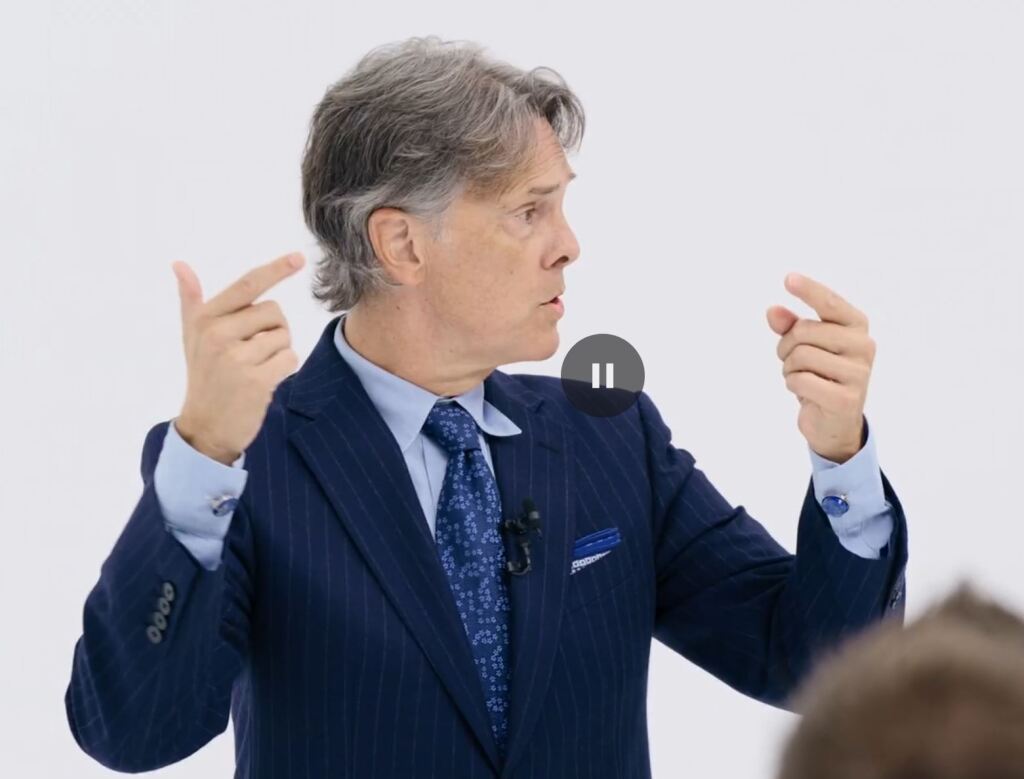

Course trailer and enrollment options at the Peterson Academy site. Professor Hicks’s other courses — Postmodern Philosophy, Modern Ethics, Philosophy of Education, Logic, Philosophy of Politics: From the French Revolution to World War II, and Philosophy of Politics: From the Cold War to After 9/11. His course on Metaphysics and Epistemology is coming soon to Peterson Academy.