Keynes: “It is not true that individuals possess a prescriptive ‘natural liberty’ in their economic activities.”
Or:
Hayek: The economic question is “how to secure the best use of resources known to any of the members of society, for ends whose relative importance only these individuals know.“
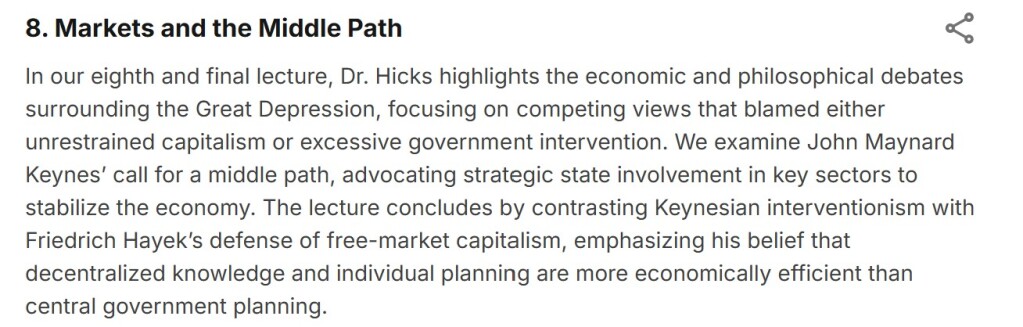
About the Course
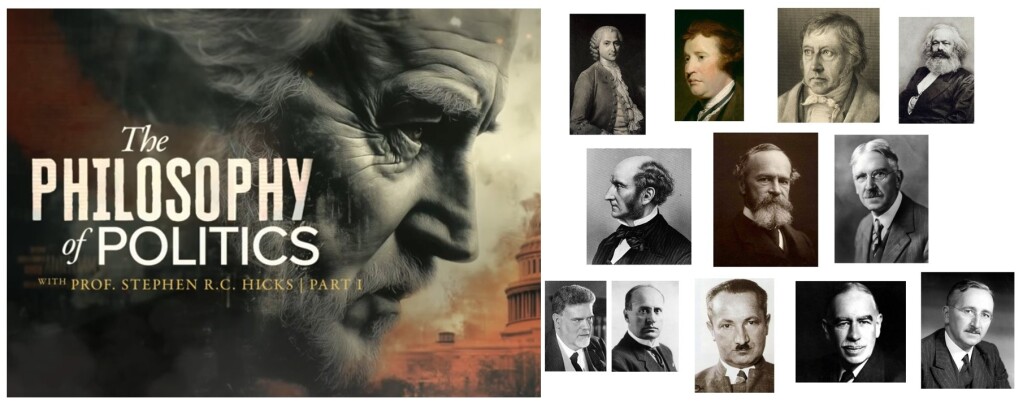
In this eight-lecture course, Professor Stephen Hicks takes us through the development of political philosophy from the late 18th to the early 20th century, focusing on key thinkers and movements that shaped the modern world. We examine the Conservative response to the French Revolution, the rise of German Nationalism and Marxism, the defense of Liberalism in England during and after the Industrial Revolution, and the emergence of Pragmatism in America. The course concludes with an analysis of the philosophical foundations of Fascism and Nazism and the competing economic Interventionist and Free-Market theories that arose in response to the Great Depression.
About the Instructor
Stephen R. C. Hicks, Ph.D., has been Professor of Philosophy at Rockford University, Illinois; Visiting Professor of Business Ethics at Georgetown University, Washington, D.C.; Visiting Professor at the University of Kasimir the Great, Poland; Visiting Fellow at Harris Manchester College of Oxford University; and Visiting Professor at the Jagiellonian University, Poland.
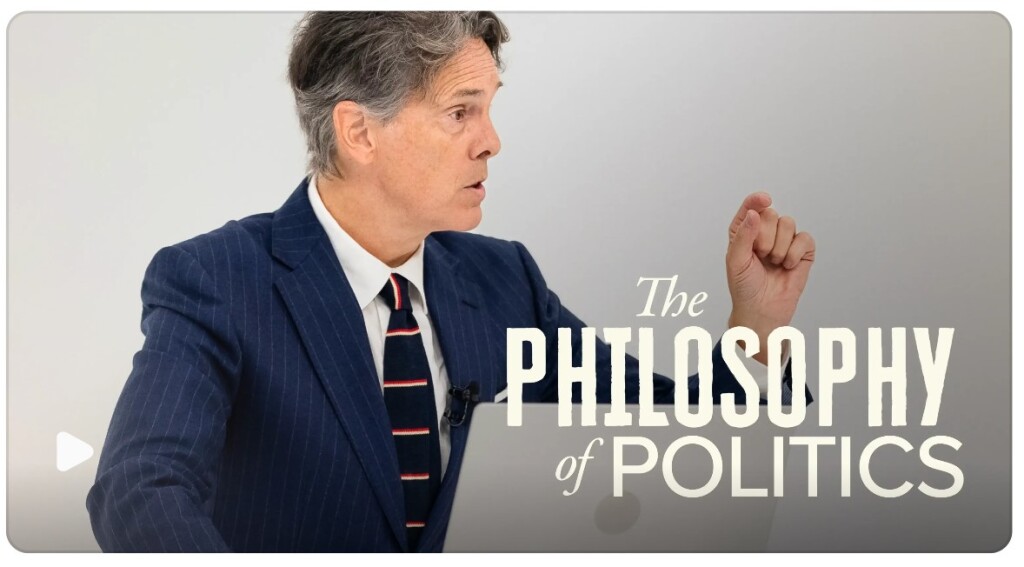
Dr. Hicks is author of Explaining Postmodernism: Skepticism and Socialism from Rousseau to Foucault, Nietzsche and the Nazis, Entrepreneurial Living, Liberalism Pro and Con, and Eight Philosophies of Education. He has published in Business Ethics Quarterly, Review of Metaphysics, and The Wall Street Journal. His writings have been translated into twenty languages.
In 2010, he won his university’s Excellence in Teaching Award.
Course trailer and enrollment options at the Peterson Academy site. Professor Hicks’s other courses — Modern Philosophy, Postmodern Philosophy, Philosophy of Politics: From the Cold War to After 9/11, and Philosophy of Ethics — are available at Peterson Academy.
I found Stephen R. C. Hicks’s lecture titled “The End of Laissez-Faire or the Road to Serfdom: John Maynard Keynes and Friedrich A. Hayek” to be both intellectually rich and timely. It weaves together the philosophical, economic, and historical threads surrounding the decline of classical laissez-faire liberalism and the rise of modern interventionist/state-oriented frameworks. The contrast between Keynes’s advocacy of state-led stabilization and Hayek’s warnings about the encroachment of totalitarianism is handled with nuance. Hicks does an excellent job placing these thinkers in context showing how the shift away from laissez-faire isn’t just economic policy, but a shift in how freedom, responsibility, and human nature are understood. If you’re diving into questions of liberty, purpose, and political economy, this piece is a very strong choice.