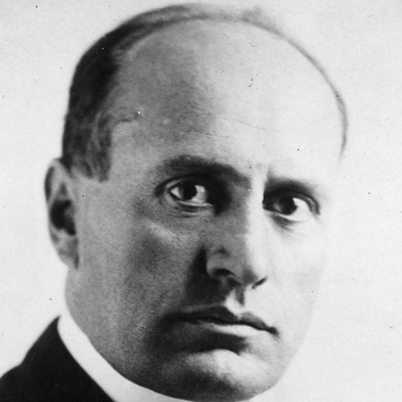
In his 1932 The Doctrine of Fascism, Benito Mussolini quotes approvingly historian Ernst Renan for his “pre-fascist intuitions”:
“The maxim that society exists only for the well-being and freedom of the individuals composing it does not seem to be in conformity with nature’s plans, which care only for the species and seem ready to sacrifice the individual.”
In his 1784 “Review of Herder,” Immanuel Kant wrote: “nature allows us to see nothing else than that it abandons individuals to complete destruction and only maintains the type.” (37/53)
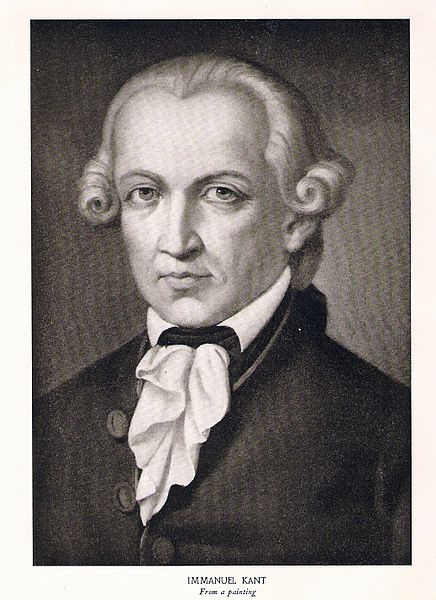
And in “Idea for a Universal History with Cosmopolitan Intent” (1784), Kant wrote: “It appears that nature is utterly unconcerned that man live well, only that he bring himself to the point where his conduct makes him worthy of life and well-being.” (31/20)
Also this from Kant’s “Speculative Beginning of Human History” (1786): “this path that for the species leads to progress from the worse to the better does not do so for the individual.” (53/115)
So: A connection from 18th-century philosopher Kant to 19th-century historian Renan to 20th-century politician Mussolini. It’s important to note that between Kant and Mussolini stand Hegel, Marx, and Nietzsche, all of whom developed the sacrifice-individuals-to-improve-the-species theme.
Further, both Kant and Mussolini state approvingly that nature uses war to improve the species.
Here is Kant: “Man wills concord; but nature better knows what is good for the species: she wills discord.” (“Idea …” 32/21)
Kant again: “At the stage of culture at which the human race still stands, war is an indispensable means for bringing it to a still higher stage.” (“Speculative …” 58/121) Note the indispensable.
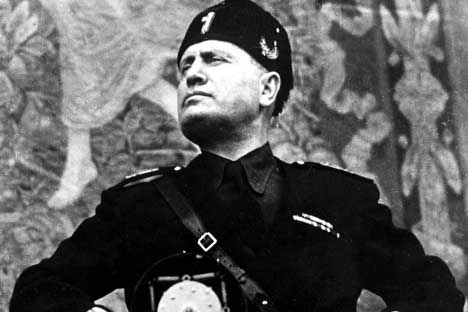
And again Kant: “Thus, thanks be to nature for the incompatibility, for the distasteful, competitive vanity, for the insatiable desire to possess and also to rule. Without them, all of humanity’s excellent natural capacities would have lain eternally dormant.” (“Idea …” 32/21)
Now Mussolini: “Fascism does not, generally speaking, believe in the possibility or utility of perpetual peace. It therefore discards pacifism as a cloak for cowardly supine renunciation in contradistinction to self-sacrifice. War alone keys up all human energies to their maximum tension and sets the seal of nobility on those peoples who have the courage to face it.”
Again, between Kant and Mussolini were Hegel, Marx, and Nietzsche, all of whom urged violence and war as necessary steps towards human progress.
Sources: The Kant essays collected in Perpetual Peace and Other Essays, translated by Ted Humphrey (Hackett, 1983). Online version of Mussolini’s The Doctrine of Fascism, co-authored with Giovanni Gentile. My close reading of it:
If I may play devil’s advocate, it seems pretty easy to make the argument that Kant had an excellent point. From a continental perspective, in 1784, perhaps at that “stage of culture” war really was indispensable in order to break up the existing social hierarchies and allow something better to form. It’s not like there was an upper-middle-class Glorious Revolution just waiting in the wings. The Scottish Enlightenment was Scottish, after all, not German, and the Junkers, Bourbons, and Hapsburgs weren’t just going to go quietly into that good night. If Kant is guilty of something, it’s of taking the particular and extrapolating to the universal.
Of course, this doesn’t excuse Marx for looking at British society and concluding that violence and collectivism was necessary to improve the condition of most members of society.
An aspect of the issue is the difference between a mugger and a cop. Both think violence at times necessary at the present stage of human development, the one aggressively, the other defensively.
Privilege is backed by the state and the implicit or realized threat of violence. Resistance against it is necessary (from advocacy to revolution), but hardly validates Kant’s position that “this path that for the species leads to progress from the worse to the better does not do so for the individual.” The fact that the vicissitudes of outrageous fortune does not ensure 100% of individuals benefit doesn’t mean that a whole lot of them don’t.
He’s setting up here, as in many other places in his oeuvre, the collectivist paradigm and the nihilistic fallacy at its root: that society is something apart from the individuals who comprise it, and dividing society against the individual i.e. setting him up for a hit.
Good point, but Kant was thinking and writing at the tail end of the ancien regime. Everywhere he looked, he would have seen privilege backed by force on the one hand and arbitrary repression on the other. War, and its corollary destruction of individual lives and property, would have seemed quite necessary. Note also his caveat “At the stage of culture at which the human race still stands”. He does not claim universal truth here, only a temporary condition. I’m afraid I don’t know Kant well enough to know at what “stage” he felt that war may not be “indispensable”.
Wouldn’t it be reasonable to conclude that Kant was simply laying the intellectual foundation for the destruction of an obviously repressive regime, using the only means to hand? Perhaps he over-generalized, but most of the fault for ill consequences can easily be laid at the feet of those philosophers who followed him and extrapolated the particular into the universal.
Perhaps Kant serves more as an example of the dangers of examining philosophy outside of its framework of historical and technological context. Should philosophy have a “sell by” date?
Not much time, but I find Kant very much a smoke and mirrors thinker. He assumed the language and sensibility of the Enlightenment while in my view undermining it from within.
For example his view of a society as a ‘kingdom of ends’ strongly evokes the liberal conception of a society of humans politically and legally regarded as ends in themselves. But looking closer, what defined ‘humanity’ as a quality for him was the ability to generate and (at least partially) abide by categorical imperatives – a very different meaning than it has for most. (In my opinion the categorical imperative is an attempt to superimpose a zero on the self, an attempt that – surveying the history of modern totalitarianism – succeeded on remarkable scale).
To return to my original point, it’s worth looking at the (infernally) marvelous selection of quotes on militarism posted on this site under ‘Nietzsche and the Nazis’ to see that these clowns meant war in a virulently initiating and aggressive way: the complete opposite of what we would deem necessary.
Stepping away from my devil’s advocacy, I’m not a fan of Kant. In my opinion, he took a few nuggets of truth (such as his observations on experience vs. reason, or the emperical vs. the theoretical) and generalized from them far more than was reasonable–leading eventually to some of the muddiest of muddy thinking of today.
However, the worst of that extrapolation was done long after Kant’s death, by people who should have known better. They must shoulder the majority of the blame, not Kant. And what occurred to me in reading this post was that at least some of Kant’s erroneous thinking is easily explained as a response to the historical context in which he was working.
I wonder if historical context might be useful in discerning between good philosophy and bad philosophy? For example, not many people these days will defend Plato’s government of philosopher-kings (at least not as such), which in my opinion was largely a reaction to Socrates’ execution by democratic Athens. Can historical context be a guide to understanding which philosophical constructs are universally true and which are true only in their particulars?
Many of Kant’s critics did his work for him, undoing the benign inconsistencies in this thought, bringing to full bloom what were merely pernicious seeds in his own oeuvre e.g. Fichte and Herder his collectivism and Hegel his totalitarianism. Sow the seeds – the root premises – and let others do the dirty work. Harder to critique him that way e.g. “What? Kant spoke of duties to the self and even the desirability of happiness!” But his specific ethical dictums implied self-torture and self-abnegation as ends in themselves. Later Hannah Arendt was to call the concentration camps the central institution of Nazi Germany. I don’t think the two are unrelated. A dominant idea always presses for realization and actualization.
I think historical context can certainly be helpful in understanding a philosophical bent and working towards a universal truth. But history isn’t philosophy. In the example of Plato and Socrates, Enlightenment thinkers and activists like Locke, Jefferson, et al realized fully that unlimited democracy was simply another form of tyranny, what Jefferson called “a multiplication of despots” – or more simply: mob rule. Madison for example specifically referenced the Athenian experience as a caution. Obviously that twenty white men outvote one black man does not a moral case for a lynching make.
Most philosophers (dare I say all of them?) leave bad ideas implied and festering in their body of work. Put another way, we all make mistakes. I have had “spirited discussions” on more than one occasion with supposed Objectivists who conclude from Rand’s thought that there are those who do and those who can’t do–and those who can’t should be deported or worse. I do not think that was Ms. Rand’s intention, in fact it seems obvious that this turns Objectivism on its head.
But the germ of the idea is there in John Galt’s cry to “get out of my way”. It is a short step from “get out of my way” to the use of force to clear the path, if one does not give proper weight to the caveats Ms. Rand also articulated (and perhaps if one is predisposed to the use of force in the first place). It seems to me that putting Objectivism in context as a reaction to totalitarian collectivism helps to avoid this sort of mistake; Clearly, mass deportations cannot be the intention of a philosophy formulated to guard against precisely that sort of collective punishment.
No philosopher is perfect, so no philosophy is perfect. Or, at the least, not perfectly written. It is incumbent on all who follow after, especially after a particularly clever or inventive philosopher, to articulate the limits of applicability of a philosophical concept. To tend the garden of a philosopher’s ideas, so to speak, such that the seeds fall within the garden borders and grow valued plants, rather than outside the borders where they grow into weeds.
If I may continue the analogy in Kant’s case, are we to blame Kant’s garden, or the gardeners who followed him? If we answer that the garden was flawed to begin with, aren’t we just setting ourselves up for over-confidence in our own philosophies?
Many cogent reflections Neil. Re: “If we answer that the garden was flawed to begin with, aren’t we just setting ourselves up for over-confidence in our own philosophies?” We have to be able to say the garden was flawed to begin with – if we have honestly come to that conclusion – otherwise we preclude all criticism. And we have to be able to say why, and to guard against a brash, unfounded confidence in our own positions.