Stephen Hicks, Ph.D.

Philosopher

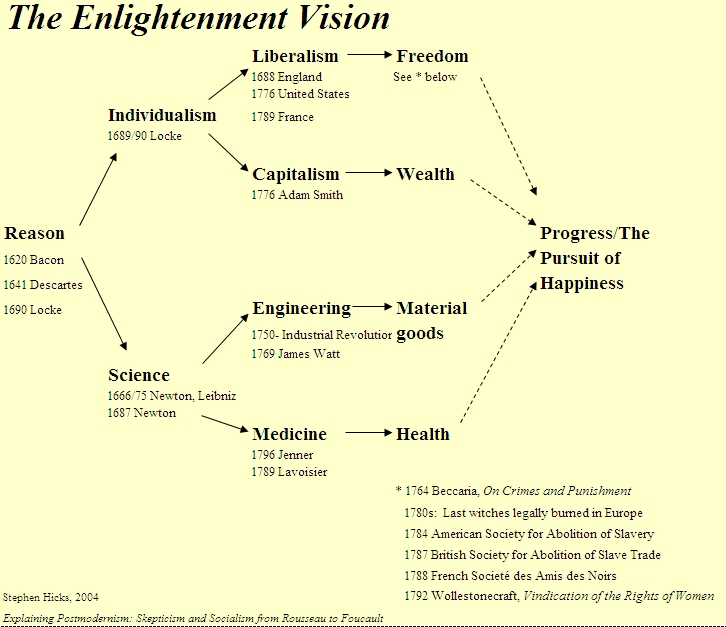
The Enlightenment Vision — updated flowchart

The Enlightenment of the long 18th century was an era of awesome intellectual and cultural transformation.

hickss-enlightenment-vision-flowchart-full

This Enlightenment Vision flowchart is pitched at a high level of abstraction, showing schematically how the philosophical revolution of the 17th century led to the 18th-century revolutions in science, technology, politics, and economics — which in turn led to the dramatic increases in health, wealth, freedom, and goods in the 19th century.

To put it another way, the chronology shows how the ideas played out as philosophy, then as an intellectual movement, then as activism, then as the working technology of culture.

I first develop the chart for my courses in philosophy and intellectual history and published a version of it in Explaining Postmodernism. It’s posted here as a PDF, as a JPEG image, or as an Excel file, in case you’d like to adapt it for your own purposes.

(Thanks to Brian Schwartz for prompting this update.)

Posted 3 months, 3 weeks ago at 8:42 pm.

4 comments

Hans Rosling’s magic washing machine

Count me a huge fan of Rosling’s work:

See also his “200 countries, 200 years, 4 minutes.”

Posted 10 months, 3 weeks ago at 9:52 am.

Add a comment

The Enlightenment vision

apple-88x50Stephen Hicks discusses the Enlightenment vision of the eighteenth-century. This is from Part 14 of his Philosophy of Education course.

Clips 1-3:

Previous: What modernism is.
Next: Post-modernism’s themes.
Return to the Philosophy of Education page.
Return to the StephenHicks.org main page.

Posted 1 year, 6 months ago at 12:37 pm.

Add a comment

Private coins and the Industrial Revolution

I’ve been enjoying George Selgin’s Good Money: Birmingham Button Makers, the Royal Mint, and the Beginnings of Modern Coinage, 1775-1821 (University of Michigan Press, 2008).

anglesey-102x100Come the Industrial Revolution, the number of wage earners rose dramatically, increasing dramatically the need for small denomination coins to pay them and for them to pay for their own purchases. Yet the Royal Mint was slow to respond, continuing to focus its efforts on large denomination gold and silver coinage and paper. So some desperate businesses, mining companies and large manufacturers first, decided to issue their own coinage. An example is the Anglesey Mining Company’s “Druid” halfpenny, pictured here.

Selgin comments on the importance of this development:

anglesey-obverse-105x100“Had it not been for commercial coins, Great Britain’s Industrial Revolution, instead of accelerating to a gallop as the nineteenth century approached, might have slowed to a saunter, if not a snail’s pace, for until these coins made their appearance, manufacturers had to struggle to pay their workers, while retailers had to struggle to make change” (p. 2).

Selgin’s history also has implications for the monopoly status of government money in the modern world.

And of course there’s the important historical question: Why a druid?

Posted 1 year, 9 months ago at 11:23 am.

Add a comment

Conquest and war [Section 37 of Nietzsche and the Nazis]

[This is Section 37 of Nietzsche and the Nazis.]

37. Conquest and war

staub-100pxNow put the above three points together: collectivism, conflict, and irrationalism. What will the social results be?

If you believe wholeheartedly and passionately that your identity is found by merging yourself with your group—and that your group is locked in a mortal, zero-sum conflict with other groups—and that reason is superficial and that passion and instinct drive the world—then how will you assert yourself in that conflict?

For much of the nineteenth century, Western liberal capitalists had begun to wonder, hopefully, whether war was a thing of the past. In their judgment, progress had been made: During the Enlightenment of the eighteenth century, much of the West had embraced the idea of individual rights—the idea that each individual has rights to life, liberty, property, the pursuit of happiness. In the nineteenth century, those rights had been extended in practice to women and slavery had been eliminated. Also in the nineteenth century came the full realization of the power of the Industrial Revolution and the idea that through technology and capitalism, economic production could be increased dramatically.

As a result, the liberal capitalists of the nineteenth century came to believe that we could solve the problem of poverty and eliminate most of our conflicts over wealth. They believed that with rising wealth and education, rational people could learn to respect each others’ rights, that there was more to be gained from trade than from war, and that peace was a natural state that mankind could achieve. The horrors of war could become a thing of the past.[125]

We know from tragic twentieth-century history the National Socialists’ eagerness to use war as their primary tool for achieving their international goals. We know their praising as fundamental the martial spirit and the beauty of the warrior soul. We know of their total recasting of education of children to achieve, as Hitler wanted “a brutal, domineering, fearless, cruel youth. Youth must be all that. It must bear pain. There must be nothing weak and gentle about it. The free, splendid beast of prey must once again flash from its eyes.”[126]

The “beast of prey” phrase is again rhetoric inspired directly by Nietzsche. On the importance and nobility of war, Nietzsche and the Nazis were in almost full agreement. Nietzsche praised war and urged its coming. He wished for a great purge that would wipe out most humans whose lives he thought worthless and an embarrassment to the human species. “All-too-many live, and all-too-long they hang on their branches. Would that a storm came to shake all this worm-eaten rot from the tree!”[127]

But he also longed for war as a means to inspire those humans who have potential to advance us toward the overman. To that end, Nietzsche believed that war is absolutely indispensable:

nn-front-cover-thumbWar essential. It is vain rhapsodizing and sentimentality to continue to expect much (even more, to expect a very great deal) from mankind, once it has learned not to wage war. For the time being, we know of no other means to imbue exhausted peoples, as strongly and surely as every great war does, with that raw energy of the battleground, that deep impersonal hatred, that murderous coldbloodedness with a good conscience, that communal, organized ardor in destroying the enemy, that proud indifference to great losses, to one’s own existence and to that of one’s friends, that muted, earthquakelike convulsion of the soul.”[128]

And against those who believe that we have entered a more peaceful era and that perhaps war is no longer necessary, Nietzsche reminds us, in an especially chilling quotation: “The beginnings of everything great on earth [are] soaked in blood thoroughly and for a long time.”[129]

On this score, the Nazis were thoroughly Nietzschean. Rather than pushing for a recognition of the mutuality of human interests, as Western liberal capitalists had been doing for much of the nineteenth century—and rather than seeking reasonable and peaceful diplomatic solutions to the normal collisions of international politics—the Nazis committed fundamentally to war as their primary means of self-regeneration and dominance over the rest of the world.

References

[125] Richard Cobden in 1835: “The middle and industrious classes of England can have no interest apart from the preservation of peace. The honours, the fame, the emoluments of war belong not to them; the battle-plain is the harvest-field of the aristocracy, watered with the blood of the people.” Also John Stuart Mill: “It is commerce which is rapidly rendering war obsolete, by strengthening and multiplying the personal interests which are in natural opposition to it” (1909). Again Mill: “Finally, commerce first taught nations to see with good will the wealth and prosperity of one another. Before, the patriot, unless sufficiently advanced in culture to feel the world his country, wished all countries weak, poor, and ill-governed, but his own: he now sees in their wealth and progress a direct source of wealth and progress to his own country. It is commerce which is rapidly rendering war obsolete, by strengthening and multiplying the personal interests which are in natural opposition to it. And it may be said without exaggeration that the great extent and rapid increase of international trade, in being the principal guarantee of the peace of the world, is the great permanent security for the uninterrupted progress of the ideas, the institutions, and the character of the human race” (1909, Book III, Chapter XVII, Section 14).

[126] Hitler, 1933.

[127] Z, First Part, “On Free Death”

[128] HAH 477.

[129] GM II, 6.

[Bibliography].

[Return to the Nietzsche and the Nazis page. Go to the StephenHicks.org main page.]

Posted 1 year, 11 months ago at 2:31 pm.

Add a comment

Conflict of groups [Section 35 of Nietzsche and the Nazis]

[This is Section 35 of Nietzsche and the Nazis.]

35. Conflict of groups

nn-front-cover-thumbA second major point of agreement between Nietzsche and the Nazis is their view of conflict. For both, conflict is the fundamental human reality. Both believe firmly that life is a matter of some individuals and groups gaining at the expense of others.

The Nazis were clear about this in theory and practice. They did not believe it possible for Aryans and Jews to live in harmony. Nor did the Nazis believe that Germany could live in harmony with the liberal capitalist nations of the West.

In the liberal capitalist nations, by contrast, many economists and politicians had come to believe that conflict and war may become a thing of the past. The productive power of the Industrial Revolution was creating great wealth and surpluses, and those surpluses were leading to increased trade between nations that was mutually beneficial. Trade was a powerful harmonizing force, leading nations to want to do business with each other rather than make war.[115]

The Nazis rejected that view and argued that recent economic history was a matter of the Jews and the capitalists advancing their interests at the expense of Germany’s.

Nietzsche shares wholly with the Nazis the general point about zero-sum conflict. In his words, “The well-being of the majority and the well-being of the few are opposite viewpoints of value.”[116] But even more strongly, he believes that this conflict is not merely a matter of historical and cultural accident but is built into the requirements of life:

“Here one must think profoundly to the very basis and resist all sentimental weakness: life itself is essentially appropriation, injury, conquest of the strange and weak, suppression, severity, obtrusion of peculiar forms, incorporation and at the least, putting it mildest, exploitation.”[117]

The horse eats the grass; the lion kills the horse; the man rides the horse and kills the lion. Life is an ongoing struggle between strong and weak, predator and prey. Cooperation and trade are possible, but they are superficial interludes between more fundamental animal facts about life. As Nietzsche again puts it: “‘Life always lives at the expense of other life’—he who does not grasp this has not taken even the first step toward honesty with himself.”[118]

On this key point, Nietzsche and the Nazis agree.

Given that conflict is inescapable, the next question is: How will the conflicts be resolved?

References

[115] For example, the great British politician Richard Cobden argued that commerce is “the grand panacea, which, like a beneficent medical discovery, will serve to inoculate with the healthy and saving taste for civilization all the nations of the world” (Cobden 1903, p. 36). Consider also Norman Angell, speaking to the Institute of Bankers in London on January 17, 1912, on “The Influence of Banking on International Relations”: “commercial interdependence, which is the special mark of banking as it is the mark of no other profession or trade in quite the same degree—the fact that the interest and solvency of one is bound up with the interest and solvency of many; that there must be confidence in the due fulfillment of mutual obligation, or whole sections of the edifice crumble, is surely doing a great deal to demonstrate that morality after all is not founded upon self-sacrifice, but upon enlightened self-interest, a clearer and more complete understanding of all the ties that bind us the one to the other. And such clearer understanding is bound to improve, not merely the relationship of one group to another, but the relationship of all men to all other men, to create a consciousness which must make for more efficient human co-operation, a better human society” (quoted in Keegan 1999, pp. 11-12).

[116] GM, end of First Essay note.

[117] BGE 259.

[118] WP 369.

[Bibliography]

[Return to the Nietzsche and the Nazis page. Go to the StephenHicks.org main page.]

Posted 1 year, 12 months ago at 1:37 pm.

Add a comment

Fascinated by history [Section 1 of Nietzsche and the Nazis]

[This is Section 1 of Nietzsche and the Nazis.]

vitruvian_man-100pxPart 1. Introduction: Philosophy and History

1. Fascinated by history

Think about why we are fascinated by history. All of those outstanding individuals and exotic peoples. The rise and fall of civilizations—and wondering why that happens. How did classical Greece achieve its Golden Age—the age of Socrates and Pericles, Euripides and Hippocrates? What explains the remarkable confluence of so many outstanding individuals in one era?

Why, almost two thousand years later, did the Italian Renaissance happen? Leonardo, Michelangelo, Machiavelli, Raphael—again an incredible outpouring of genius in the arts, sciences, and politics.

Jumping ahead three centuries: What made possible the Industrial Revolution and its awesome outpouring of productivity? The ancient Chinese and the ancient Romans made impressive technological advancements—but nothing on the scale of the Industrial Revolution. Why did the Industrial Revolution first take root initially in England and Scotland? Why not in Burma or Botswana?

Or what, by contrast, explains major historical declines? Why did the Roman Empire collapse? The most powerful civilization of the ancient world imploded and became defenseless before successive waves of barbarian invasion. And before the Romans, the powerful military empires of the Hittites, the Assyrians, and the Babylonians also collapsed. Is there a common pattern at work here?

Why did the French Revolution go so horribly wrong, descending in a reign of paranoia, fratricide, and terror? Why, by contrast, did the American Revolution, in many ways fighting the same kind of battle and subject to the same desperate pressures, not go the same self-destructive route? How, a century and a half later, could the most educated nation in Europe become a Nazi dictatorship?

All these questions raise issues of dramatic historical change, for better or worse. But we can also ask questions about long periods during which no dramatic changes took place. Consider the San people of the Kalahari area in Southern Africa, sometimes called Bushmen. Experts estimate that for 10,000 years the San have lived the same way for generation after generation. Let us put that in perspective. If a generation is twenty-five years or so, then 10,000 years means 400 generations of sameness. By contrast, it has been only about twenty generations since Columbus crossed the Atlantic—and consider how much has changed in Europe and the Americas since then.

Yet even the 10,000 years of the San people is dwarfed by the estimated 35,000 years that the Aborigines of Australia have existed in essentially the same way generation after generation. 35,000 years ago is approximately when Neanderthal Man was becoming extinct. Why did the cultures of the San and the Aborigines not change for such unimaginably long stretches of time?

[Return to the Nietzsche and the Nazis page. Go to the StephenHicks.org main page.]

Posted 2 years, 2 months ago at 4:55 pm.

1 comment

The Enlightenment Vision — Flowchart

The Enlightenment of the long 18th century was an era of awesome intellectual and cultural transformation.

hicks-enlightenment-vision-flow-chart-180x100My Enlightenment Vision flowchart [pdf] is pitched at a high level of abstraction, showing schematically how the philosophical revolution of the 17th century led to the 18th-century revolutions in science, technology, politics, and economics — which in turn led to the dramatic increase in health, wealth, freedom, and goods in the 19th century.

To put it another way, the chronology shows how the ideas played out as philosophy, then as an intellectual movement, then as activism, then as the working technology of culture.

I use the chart in my classes and published a version of it in my 2004 Explaining Postmodernism. It’s here as a PDF and as an Excel file, in case you’d like to adapt it for your own purposes.

[This is an excerpt from Stephen Hicks's Explaining Postmodernism: Skepticism and Socialism from Rousseau to Foucault (Scholargy Publishing, 2004, 2011). The full book is available in hardcover or e-book at Amazon.com. See also the Explaining Postmodernism page.]

Posted 2 years, 4 months ago at 6:28 pm.

Add a comment