In my Philosophy of Art course, we are discussing Plato’s philosophy of art, by means of selections from Statesman and Books 3 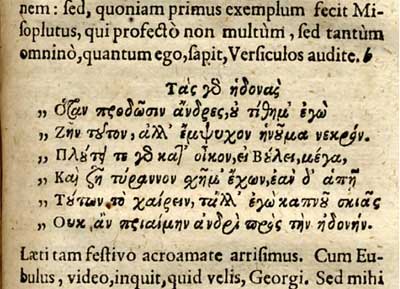 and 10 of The Republic, along with snippets from Ion, Phaedrus, and Symposium.
In The Republic, Plato makes a systematic case for censoring all arts. The task of the Platonic philosopher is to take up the “ancient quarrel between philosophy and poetry” [607b] and to assert the State-enforced dominance of philosophy. To that end, The Republic as a whole is a powerful integration of philosophy, religion, education, and politics, and its argument for the political suppression of most art follows from that integrated system.
Rhetorically, Plato uses Socrates’ discussion with Glaucon and Adeimantus to list a series of grievances against poetry, music, and painting:
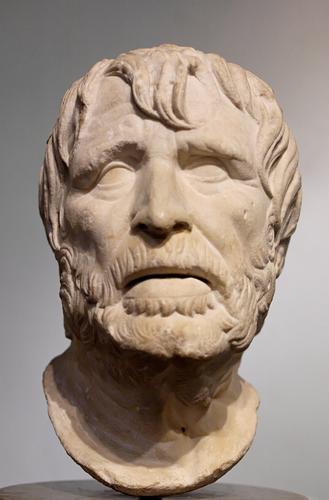 * A good portrait of the gods and heroes will show them as worthy and exalted beings — but poets such as Homer and Hesiod often tell tales of the gods and heroes fighting and bickering and acting immorally [e.g., 390b-391e].
* A moral citizen’s soul will be composed and dignified — but many musical modes stir us up inside and make us jangled and unsettled [398e-400d].
* Good people and gods do not deceive — but painters constantly deceive us by trying to make their fake imitations look real [598c, 602d]. (Meanwhile, Plato allows that politicians (and only politicians) ought to be allowed to lie to their citizens [389b-c].)
* A strong and moral man will not grieve the death of a friend by moaning and wailing like a woman — but poets regularly have their characters issue long, pathetic lamentations [387d-388d].
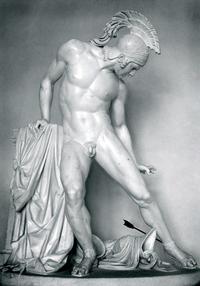 * Courageous men are willing to die in battle — but the poets tell scary stories about the afterlife and make us fear death [386b-d].
* A proper moral of the story will teach that good people meet good ends and bad men meet bad ends [613d-614a] — but tragic poets have will often have bad men profit and protagonists fail and suffer despite their virtues [392b].
* Decent people respect and strive for worthiness — but comic poets appeal to our basest desires and mock and deride everything [e.g., 395d-e, 606c].
And so on.
The Republic‘s overall argument for censorship thus combines a particular conception of morality with religion and authoritarian politics. Formalizing the argument:
1. To have a good society, we must have good citizens.
2. To have good citizens, children must be well educated.
 3. To be well educated, children must be exposed to good material and shielded from bad material [386a].
4. So, to have a good society, children must be exposed to good material and shielded from bad material.
5. It is the obligation of the State to educate its citizens.
6. So the State should allow only good material and suppress bad material.
7. The State’s censorship applies also to art.
8. So the State should allow only good art and suppress bad art [401b, 595a].
[Next: Evaluating Plato’s argument for censoring the arts. Return to the Intellectual History page.]
Plato’s philosophy of art seems to be that it has a vital purpose, to illuminate, instruct, and foster virtues. And that its misuse can destroy a culture. Without granting art total control, I would agree that art serves a purpose, and might say, to illuminate values, including by warning of their destruction, by concretizing for contemplation and education.
Plato’s primary value of art may be to have the individual serve the state, but he sees it working by serving the individual to make him of value to himself and the state. My primary value of art would be art’s service to the individual, but recognizing that this subsequently serves the community. We both recognize that art may have destructive effects on the individual and, thus, the state. But evidently I would grant individuals more powers of resistance.
My additional thought would be that the “state” is an abstraction, not the entity or collective Plato imagined. So, Plato’s epistemology led him astray in evaluating art and justifying censorship.
He saw the operation of the state as necessary for the life of the citizens. Its protections and the productivity from the division of labor were necessary for life. (Quite true. Who could live today without the wider community of productivity?) Plato saw the state as more important than the individual because the individual required the state for life. He failed to note that the state was only a cooperative collection of individuals. They do not require the state, per se, not central control, but only cooperative trade and planning for defense.
Such cooperation does require shared, rational values and virtues. How can this be obtained without central control over their lives? Is it not the duty of parents to “expose their children to good material and shield them from bad material?” Is it not the duty of the state to do the same for citizens?
An obviously duty for parents tailoring activity for varieties of child personalities and ages, within limits. However, Plato continues the error of considering the community a collective, rather than an abstraction, with natural leader, worker, and defender personalities. So, he fails to appreciate that people reason for themselves, evaluating good and bad ideas. They are not controlled by the art they encounter. It is not only the influence of artists or teachers which determines people’s character and beliefs, but their whole experience and intellectual integrations.
Plato’s philosophy of art seems properly tailored to his unfortunately confused understanding of human nature. A far better approach than that of modern-abstract art philosophies which ignore human nature.
[Thanks for the exercise.]
Thanks, this article has lots of good points for my essay!
Right. Keep the citizenry in perpetual childhood, for they can’t deal with reality, including adversity, and make good judgments in the face of it. Only a small clique of leaders are capable of that.
We have Plato to thank for terrible rulers. Plato reminds me of Adolph Hitler who’s actions censored art that he personally disagreed with, for the good of the Fatherland. Subversive artist George Grosz effectively created an introspective judgement of Germany’s corrupted officials and undermined Hitler’s power and propaganda machine and his peculiar version of a superior Germany.
This is so helpful! I have a test on this tomorrow maybe now that I’ve studied for 3 days straight I might not fail lol. Thanks so much.
No, not to keep kids in perpetual childhood, but to keep their character from being demoralized by the perverse and violent context of liberal artists. Kids, from a young age, should be progressively educated on the negative behaviors of society by their family, they shouldn’t discover it from an artist.
Milton is responding not only to the call to license books, but to Plato. He trusts adults to be adults:
¨He that can apprehend and consider vice with all her baits and seeming pleasures, and yet abstain, and yet distinguish, and yet prefer that which is truly better, he is the true wayfaring Christian. I cannot praise a fugitive and cloister’d vertue, unexercis’d & unbreath’d, that never sallies out and sees her adversary, but slinks out of the race, where that immortall garland is to be run for, not without dust and heat. Assuredly we bring not innocence into the world, we bring impurity much rather: that which purifies us is triall, and triall is by what is contrary. That vertue therefore which is but a youngling in the contemplation of evill, and knows not the utmost that vice promises to her followers, and rejects it, is but a blank vertue, not a pure; her whitenesse is but an excrementall whitenesse; Which was the reason why our sage and serious Poet Spencer, whom I dare be known to think a better teacher then Scotus or Aquinas, describing true temperance under the person of Guion, brings him in with his palmer through the cave of Mammon, and the bowr of earthly blisse that he might see and know, and yet abstain. Since therefore the knowledge and survay of vice is in this world so necessary to the constituting of human vertue, and the scanning of error to the confirmation of truth, how can we more safely, and with lesse danger scout into the regions of sin and falsity then by reading all manner of tractats, and hearing all manner of reason? And this is the benefit which may be had of books promiscuously read. ¨
¨ that which purifies us is triall, and triall is by what is contrary ¨- a fine motto for a university.
Dr Hicks’s summary was clear, informed, detailed and wide-ranging. Such a clear, informed and wide-ranging summary. It helps me write about an 1838 South African staging involving black-face and female impersonation. Platonic objections characterise 21st century academic writing about a performance that vanishes as it occurred.
I believe that my interpretation after reading Platos philosophy and the censorship of the arts, how he interprets the arts, depends on his perception of good or bad. Initially, he describes that using the gods and heroes will show them as worthy to their own interpretation and values that those such poets will hold on human life. But is that necessarily true, or just the art of perception? What is the impact, the value that such poets such as Homer and Hesiod will have perceived on the reader? Does the reader also grant that perception, or is there other perceptions being given? That’s the problem with Platos philosophy, because it doesn’t just dwell into philosophy, but I also believe that psychology plays a role in this too. Because you are including the difference between the good and the bad, well then what is good and what is bad? That’s up to you, but it is also up on a societal level. From a personal perspective, it could mean what is considered to be self evident, what you can perceive as that specific trait, whether that be from your own personal experiences or interpretations, such as how you’ve been sculpted throughout your life. From a societal level it could be the perspective from when the overall community shapes that perspective, whether that be good or bad, whether that be chaos and order. Because everyone will have different opinions about different aspects and different forms of art, that will vary depending on the person, which will subsequently then have an effect depending on how popular that perspective may seem to the overall community. When you look at the perspective from the general society, from a community, a societal level, you’ll realise that bias is still included, bias will always be included. The interpretation that one person could have be different from a thousand perspectives, but since our human minds aren’t connected or functions in a synced way, the foundation will always establish one such connection.
Throughout Plato’s explanation, this can be the case for anything, however in this philosophical view Plato is just in reality inputting his own bias, and from that bias we can further examine the psychology behind his philosophy and his perception, because the art that he examined and the art that he viewed to formulate this philosophy, to formulate this theory all comes from his idea. Like for example, when using the idea of a painters form of manipulation or deception to try to make imitations look real, for the time while that could be considered an inherent fact, those interpretations could still differ at the time, and today as the precedence of art has widened, the idea is definitely considered moot, as you have so many different types, different aspects of artists ranging from every single known idea to man that the opportunities and range that art is perceived and evaluated today, well its infinite.