Reprising this post on Zeev Sternhell, an ally in the battle against the nihilism of the Anti-Enlightenment and its heirs. His book is written for scholars, but note this ringing conclusion:
“To prevent the people of the twenty-first century from sinking into a new ice age of resignation, the Enlightenment vision of the individual as creative of his or her present and hence of his or her future is irreplaceable.”*
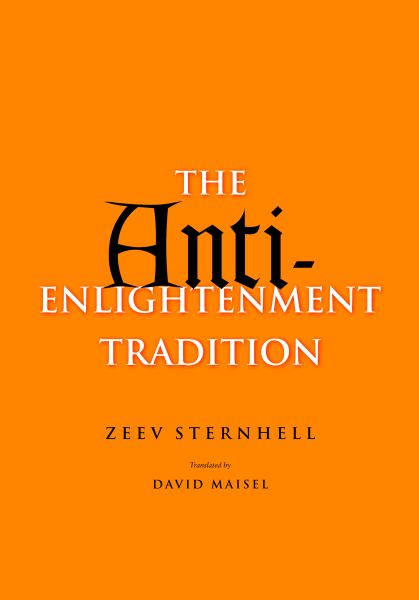
The modern world’s great battle of Anti-Enlightenment-versus-Enlightenment was launched, in Sternhell’s reading, by Johann Herder’s attack on Immanuel Kant:
“Some ten years after [Herder‘s] Bückeburg pamphlet, the polemic with Kant began, which symbolically confirmed the great division between the two types of modernity: the one that stood for universal values, the greatness and autonomy of the individual, master of his fate, the one that conceived of society and the state as instruments in the hands of the individual who had set out in conquest of liberty and happiness, and the communitarian, historistic, nationalist modernity, a modernity in which the individual is determined by his ethnic origins, history, language, and culture” (p. 11).
Sternhell takes Rousseau and Kant to be Enlightenment figures, though he’s very aware of their being “complex and ambiguous figures in the history of Western political thought.”
(By contrast, I take Rousseau and Kant to be Counter-Enlightenment figures, though I agree very much with Sternhell that those are difficult judgment calls. And I laughed out loud at his quoting from Judith Shklar’s Men and Citizens on Rousseau as “the Homer of the losers.” Perfect.)
[*Source: Sternhell’s The Anti-Enlightenment Tradition, Yale University Press, 2010.]
Related: My thoughts on the Enlightenment, the Counter-Enlightenment and our resulting postmodern intellectual condition are here. Also my Reason Papers article “Kant at the Masked Ball” on the widely divergent interpretations of Kant that have come down to us.

Postmodernism is a logos of irrationality precisely because it denies Reason, Truth, and Knowledge as being attainable. It is a system of thinking that needs a psychiatrist, but will refuse the cure offered because it rejects reason.
Reply
The Anti-Enlightenment contest with the German Enlightenment was furious already before Herder countered Kant. Earlier in the eighteenth century, the great philosophic competitors, whose views would be influencing the later contestants were between Wolff (Enlightenment) and Crusius (Pietist, Anti-Enlightenment). I agree that Kant was somewhat mixed. In the Atheism Controversy, both sides tried to woo him to publicly align with them. He entered that public dispute, but chagrined both sides.
Reply
The Anti-Enlightenment contest with the German Enlightenment was furious already before Herder countered Kant. Earlier in the eighteenth century, the great philosophic competitors, whose views would be influencing the later contestants, were Wolffians (Enlightenment) and followers of Crusius (Pietist, Anti-Enlightenment). I agree that Kant was somewhat mixed. In the Atheism Controversy, both sides tried to woo him to publicly align with them. He entered that public dispute, but chagrined both sides.
Reply
Prompted by your post, I’ve started reading Sternhell’s book and am flabbergasted by his interpretation and apology of Rousseau as a champion of liberty. His awareness of the opposite view is clear by the lengthy footnote (No 13 to pages 23-25 in my folio edition), as he complains about Rousseau being the subject of “so much hatred from the enemies of enlightenment”, but he -inexplicably- avoids acknowledging that Bertrand Russell himself -whom to call an enemy of enlightenment would be quite absurd- was a very harsh critic: “tends to a justification of the totalitarian state”; “complete abrogation of the rights of man”, “collective tyranny” are just a few of his comments on the Contrat Social (History of Western Philosophy). I can’t help feeling that the book will turn out to be a somewhat naive defense of everything progressive against all conservative countercurrents. If I ever finish it, because it’s long, long…
Reply
I agree, Jan.
Reply