Why democratic society is ‘cruel’ to some of its members:
Aristocratic society makes people believe their circumstances are inherited destiny and so cannot be helped. But democratic societies encourage people to believe that their destinies depend on their own actions. For some—those who feel themselves to be inferior in some important way—this latter is a terrible realization.
First, Alexis de Tocqueville on the psychology in aristocracy:
“When the citizens of a community are classed according to their rank, their profession, or their birth, and when all men are constrained to follow the career which happens to open before them, everyone thinks that the utmost limits of human power are to be discerned in proximity to himself, and none seeks any longer to resist the inevitable law of his destiny.”[1]
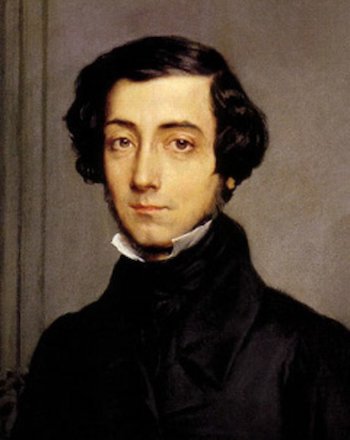
Second: Then comes a successful transition to democracy. One symptom: The more equal the society, the more ferocious it becomes about remaining inequalities. Tocqueville again:
“When inequality of conditions is the common law of society, the most marked inequalities do not strike the eye: when everything is nearly on the same level, the slightest are marked enough to hurt it. Hence the desire of equality always becomes more insatiable in proportion as equality is more complete.”[2]
This is Tocqueville’s Paradox of Equality.
Sources: [1] Tocqueville, Democracy in America, Volume II, Part I, Chapter 8, “The Principle of Equality Suggests to the Americans the Idea of the Indefinite Perfectibility of Man”) [2] Tocqueville, Democracy in America, Volume II, Part II, Chapter 1, “Why Democratic Nations Show a More Ardent and Enduring Love of Equality than of Liberty.” Henry Reeve’s 1840 English translation
Related: J.S. Mill on American culture and politics, with a nod to Tocqueville.