In the following two passages, with a nod to Tocqueville, Mill makes two strong claims.
First he praises American culture: “Almost all travellers are struck by the fact that every American is in some sense both a patriot, and a person of cultivated intelligence. … No such wide diffusion of the ideas, tastes, and sentiments of educated minds, has ever been seen elsewhere.”
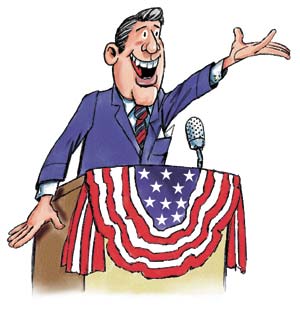
But he follows with this about American politicians: “political life is indeed in America a most valuable school, but it is a school from which the ablest teachers are excluded; the first minds in the country being as effectuallly shut out from the national representation, and from public functions generally, as if they were under a formal disqualification.”
Mill published that 1.5 centuries ago, but comparisons to the present are apt. He is talking about democratic-republican politics, which he thinks is better in most respects than the alternatives. But it has its own weaknesses, one being the types of people it attracts and repels from political life. So some follow up questions, if this really is a systematic problem in our politics.
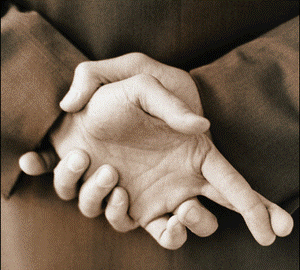
First: Are politicians really less able than the first-rate people in other walks of life — scientists, physicians, business executives, artists? How would we determine this?
Second: If so, what is it that makes politics less attractive to the most able and more attractive to the moderately able?
Is it that smart and able people better see the compromises involved and the damage to their integrity? Or the scrutiny of their personal lives? Or they are interested less in wielding power over others than they are in positive values such as seeking scientific truth or building a great business or creating artistic significance?
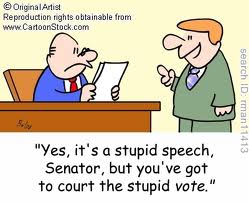
And by contrast, are the moderately-able are more willing to be compromisers? They are less able to be first rate scientists, artists, or business professionals, so they are more likely to seek significance through power over others?
Or is it that in our political system, elections are decided by marginal or moderate voters, and that fact in some way creates a lowest-common-denominator dynamic?
Other factors? (Please avoid ad hominem and other cheap shots abut particular politicians. Mill is pointing us to a systematic problem, not the foibles of particular individuals, parties, or generations.)

Source: John Stuart Mill, “Of the Extension of the Suffrage,” Chapter VIII of Considerations on Representative Government (Easton Press, 1995; originally published 1861), p. 157. Also available online here. Related: My primer on Mill in the Philosophers, Explained series:
I think that Ayn Rand captured the issue, as one of second-handedness and selflessness versus independence and rational selfishness.
Business is all about wealth creation and trade, not about collective dependence, but individual independence; not about self-sacrifice, but about rational self-interest; not about charity, but about profit. In business, in a free market, one is good due to one’s rational, intellectual independence and productive ability. In politics, one is good due to one’s ability to voice and act upon the dominate moral view(s), to give “the people” what they truly and predominantly want, to lead them where they most want to go.
Depending on one’s moral views, business is either profoundly good or perhaps a tolerated, necessary evil requiring eternal vigilance and governmental control. Likewise, depending upon one’s moral views, collectivism, in various forms, is either profoundly good or profoundly evil, or individualism is profoundly good or profoundly evil.
Politics is all about morality. Politics rests on morality, and it is the culturally dominant moral views that inform and guide politics. The only way to argue what ought to be legally or politically is by reference to some code of morality. It doesn’t work the other way round.
Altruism is the culturally dominate ethics or morality of America and the world. Bill Gates was a good businessman prior to becoming a philanthropist, but was he held to be an exemplar of morality, or did he only start to become morally admired once he decided to take on the role of philanthropist?
The “public good” is not questioned, but held to be the fundamental guide for political policy. “Public good” trumps individual rights, which is but another way of saying that individual rights are not the fundamental issue of a proper government, of politics, of law. When push comes to shove, that which is held as primary trumps anything else.
So we get politicians who are first-rate in the area of politics guided by altruism, and the “best” rise to the top promising their focus on and concern for the “public good.”
A politician is “good” if he appeals to the “public good,” to altruism, to self-sacrifice. They are selfless leaders for a culture that fundamentally or dominantly values self-sacrifice for the “public good,” for the good of society. They are “good” because most or a great number of people tell them that they are good.
“Isn’t that the root of every despicable action? Not selfishness, but precisely the absence of a self. Look at them. The man who cheats and lies, but preserves a respectable front. He knows himself to be dishonest, but others think he’s honest and he derives his self-respect from that, second-hand. The man who takes credit for an achievement which is not his own. He knows himself to be mediocre, but he’s great in the eyes of others. The frustrated wretch who professes love for the inferior and clings to those less endowed, in order to establish his own superiority by comparison.” – Ayn Rand, “The Nature of the Second-Hander”
Reply
Of relevance, here’s an 8 minute, 2010 interview of Thomas Bowden, from the Ayn Rand Institute, by Brad Davis on the subject of Hugo Chavez’s socialism and the morality that supports him:
http://arc-tv.com/hugo-chavez/
Reply
Dr. Hicks, here’s an article by Dr. Andrew Bernstein, which I’ve only just read, that gets to the heart of the matter:
“Objectivism vs. Kantianism in The Fountainhead” (The Objective Standard):
http://www.theobjectivestandard.com/issues/2012-spring/objectivism-kantianism.asp
Reply
Thanks very much, John. I will check it out.
Reply
Valid criticism, but did Europe do any better? Perhaps a more highly educated and cultured class of politicians, due to aristocratic wealth and privileges, but history shows that this is a superficial judgment of best minds.
I note that these problems of the American political class, especially the exclusion of the best minds, was not characteristic of the founding generations. Then, (1) the pay of political office was not sufficient for a good living, and (2) the power of offices was not so extensive to grant economic favors, to social engineer the society, and to create great corruption. Officials had to be sufficiently wealthy by their own labor in private life to devote time to official duties; plus, be educated and honorable enough to attract knowledgeable voters. Since votes were limited to property owners.
Over time, as the voting franchise is expanded, so is incompetence. Most people are smart enough in chosen fields, but have not the time or interest to be educated in everything: economic theory, foreign policy, military operations, medical fields, engineering fields, educational theory and practice, manufacturing, etc. They are incompetent to vote on most issues. They should know that government employees will not be competent either. But they assume good leaders will know and should decide, rather than professionals in free markets. They can only select leaders by perceived personality and goals, not competence in administration and needed fields. They cannot foresee long term consequences. And, of course, they have an altruistic moral sense corrupting their judgment. Their votes corrupt government policies and selection of leaders.
As the regulatory bureaucracy expands with anti-freedom policies, anti-freedom people find a home; then people with self-respect, willing to face life’s challenges, shun it. They are not interested in personal power or a free ride of limited horizons. As the pay and benefits for officials rise, and accountability falls, the low self-esteem, power and prestige seeker, envious, and lazy are attracted. That is, the best people do not want the life of government officials (or to associate with them), the worst people crave it, and the voters cannot tell the difference. The situation gets worse with the years — accelerating as politicians focus on the education system, especially through subsidizing, and render citizens more generally incompetent.
Some people develop superior administrative and planning skills, become good judges of character, and broaden their education. They rise in their fields, accumulating wealth and property. That is, they demonstrate their competence in the free market. These are the people who should be the voters . . . or have the most votes. (Still would have a lot of fool celebrities voting, but they would tend to cancel each other out if they bothered, while the business class would be dominant. Unfortunately, this assumes a free market, not the crony capitalism of today.)
Basically, I would grant votes by a percentage of taxes and fees paid, and make paying taxes voluntary, except for service fees for legal services: courts, contracts, property registration, etc. The point being that those who rise in a true capitalist society will understand its principles and want to preserve it — especially by limiting it. They will volunteer taxes to gain votes to influence officials chosen for administration and to protect it when they see it threatened by internal or external enemies?
The crucial thing is to drastically limit government salaries and benefits to avoid attracting those seeking the unearned. Personal financial support through free market processes is required as an objective measure of general competence for voting. Not sufficient, but necessary. The bottom thirty percent, say, of society should not even want to vote; recognizing that the vote was already in the best hands. Hands that are already working to create the best conditions for them to prosper.
Ayn Rand’s moral philosophy is needed to reshape society and reverse the trend to collectivism. Maybe as conditions deteriorate things will get so bad that resistance grows and buys time? The Trump phenomenon, however inconsistent, gives some hope to this process.
Reply
I think the problem is that Congress does too much. We need to elect congresspeople who will vote for term limits.
We don’t need people running for Congress with the intention of gaining political influence and power in order to get rich. Who then leave Congress to become lobbyists in order to make even more money.
As we know, Congress and the executive branch impose their will upon civil society and the economy too much. Exacerbated by the massive growth of K Street. We have ~22 lobbyists per representative.
Too many laws, too, and many regulations – many contradicting each other.
The ~100-year Prøgressive [ø=not] encroachment in government needs to be reversed so that we can revive and conserve the Founder’s original intention of having a small, unintrusive government.
Our government should exist solely to protect the rights of individuals.
Reply