Before A.I., pretty much every new information tool was feared and opposed as an enemy of human cognitive advance.
Television (1985): “People will come to love their oppression, to adore the technologies that undo their capacities to think.” [1]
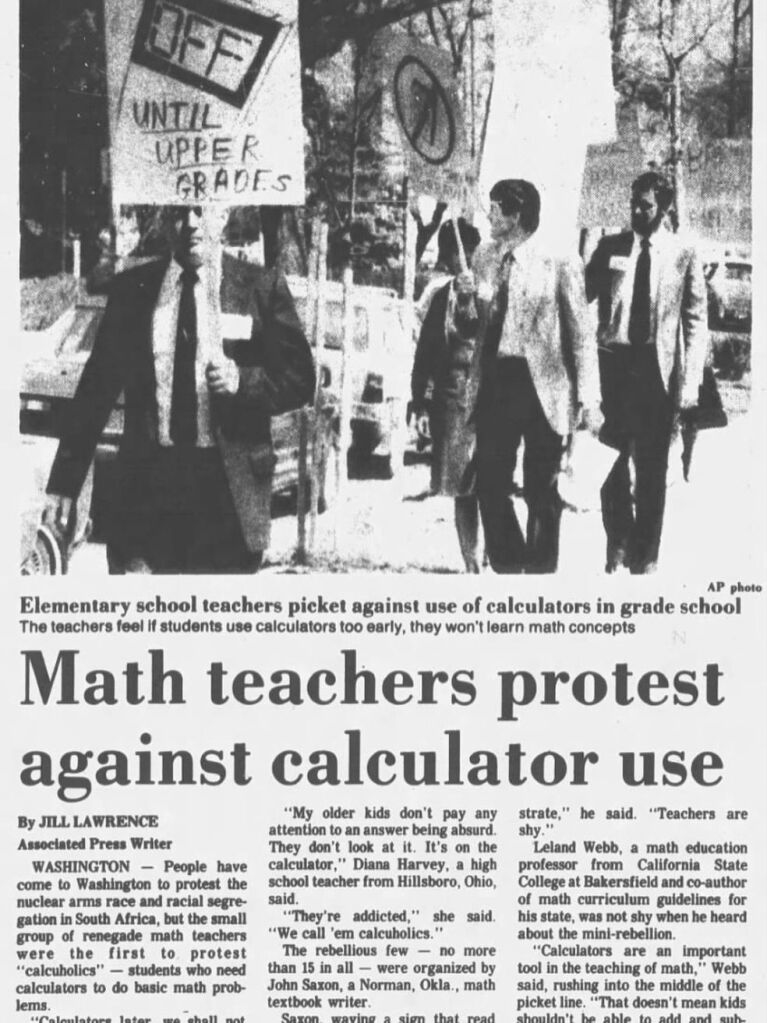
Calculators: This 1986 protest by teachers against the use of calculators. Kids are “addicted” to them, a teacher said. “We call ’em ‘calcuholics.'”
Personal computers (1990): “Through the computer, the heralds say, we will make … our minds better—best of all, ourselves better. This is, of course, nonsense.” [2]
And this from 1995 on the triviality of what users of computers learn: “What are they learning? That the world is a passive, preprogrammed place, where one click on the mouse gets the right answer? They’re learning transitory and shallow relationships from instant e-mail. That discipline isn’t necessary when they can zap frustrations with a keystroke. That grammar, analytic thought and human interactions don’t matter.” [3]
Question: In hindsight, have we become more uninformed and/or stupid, or have television, calculators, and computers been positive tools? The same questions and answers are now everywhere in discussions of A.I.
Sources: [1] Neil Postman’s foreword to his Amusing Ourselves to Death: Public Discourse in the Age of Show Business, 1985. [2] Postman, “Informing Ourselves To Death” (October 11, 1990). [3] Clifford Stoll, Silicon Snake Oil (1995)
Related: My talk at Francisco Marroquin University:
The productive do more, the lazy do less. All the way back to the wheel.