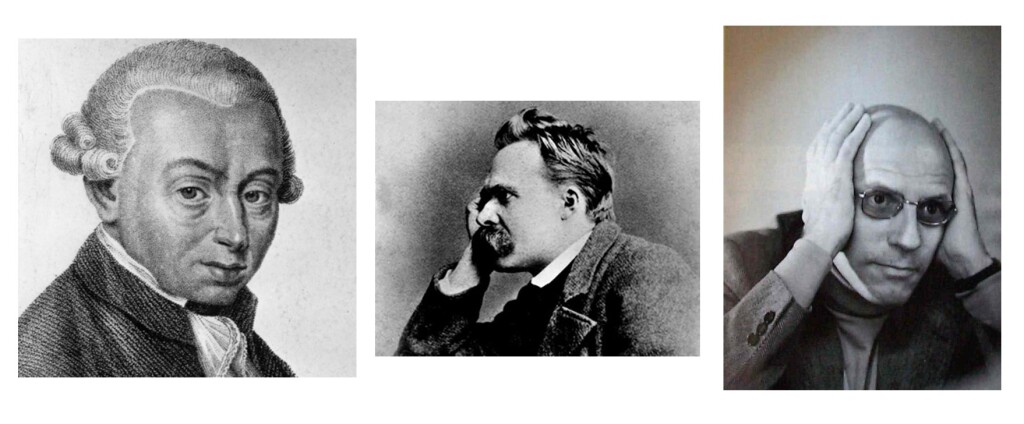
Immanuel Kant (1724-1804): “I had to deny knowledge in order to make room for faith.”
And: “All human reason is wholly incompetent to explain this [morality], and it is a waste of trouble and labour to try. … According to my account of the supreme principles of morality, reason can’t render comprehensible the absolute necessity of an unconditional practical law (such as the categorical imperative must be). If you want to complain about this, do not blame my account—blame reason!”
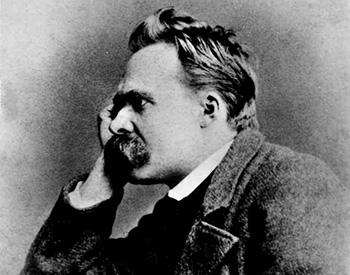
Friedrich Nietzsche (1844-1900): “When Kant says: ‘reason does not derive its laws from nature but prescribes them to nature,’ this is, in regard to the concept of nature, completely true.”
And: “The innermost essence of being is will to power.”
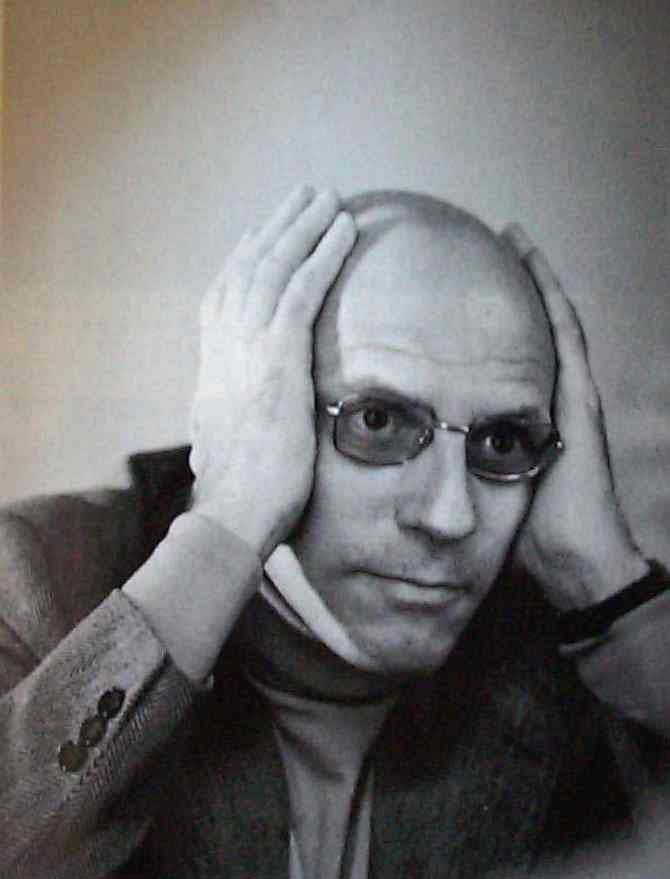
Michel Foucault (1926-1984): “I am simply a Nietzschean, and I try as far as possible, on a certain number of issues, to see with the help of Nietzsche’s texts.”
And: “All knowledge rests upon injustice; there is no right, not even in the act of knowing, to truth or a foundation for truth; and the instinct for knowledge is malicious (something murderous, opposed to the happiness of mankind).”
Sources: Kant: “Second Preface,” Critique of Pure Reason (1781/1787), Bxxx. Groundwork for the Metaphysic of Morals, “Concluding Remark,” Section 128, Bennett translation. Nietzsche: Human, All Too Human, Part I, Section 18. Will to Power, Section 693. Foucault: Foucault Live (Interviews, 1961-1984), New York: Semiotext(e), 1989, p. 471. “Nietzsche, Genealogy, and History,” in Language, Counter-Memory, Practice: Selected Essays and Interviews (Cornell University Press, 1980).
That’s the short version. The full account is here in text form or in audio: