Heidegger: “Russia and America, seen metaphysically, are both the same: the same hopeless frenzy of unchained technology and of the rootless organization of the average man.“
And:
“German Socialism wants an order of merit based on inner confirmation and achievement: it wants the inviolability of service and the absolute honor of all labor. That is what we mean by national freedom.”
About the Course
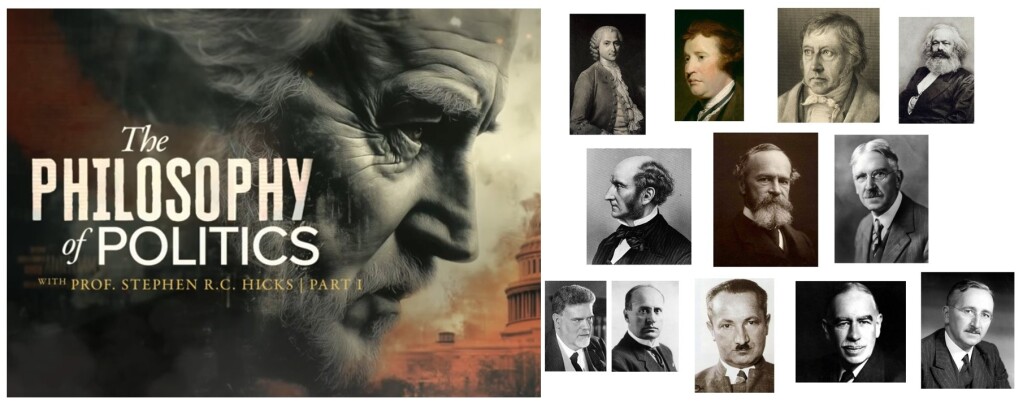
In this eight-lecture course, Professor Stephen Hicks takes us through the development of political philosophy from the late 18th to the early 20th century, focusing on key thinkers and movements that shaped the modern world. We examine the Conservative response to the French Revolution, the rise of German Nationalism and Marxism, the defense of Liberalism in England during and after the Industrial Revolution, and the emergence of Pragmatism in America. The course concludes with an analysis of the philosophical foundations of Fascism and Nazism and the competing economic Interventionist and Free-Market theories that arose in response to the Great Depression.
About the Instructor
Stephen R. C. Hicks, Ph.D., has been Professor of Philosophy at Rockford University, Illinois; Visiting Professor of Business Ethics at Georgetown University, Washington, D.C.; Visiting Professor at the University of Kasimir the Great, Poland; Visiting Fellow at Harris Manchester College of Oxford University; and Visiting Professor at the Jagiellonian University, Poland.
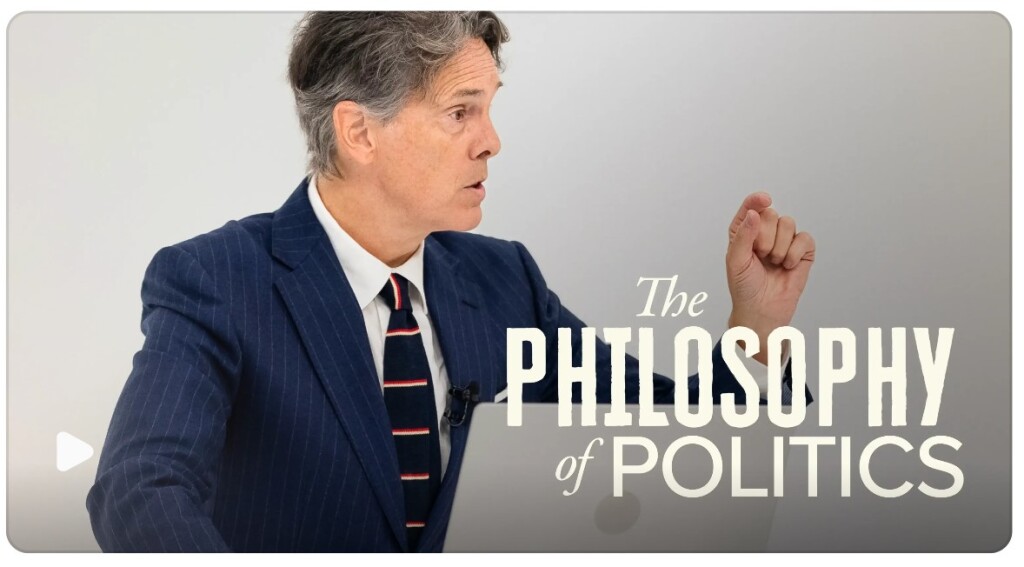
Dr. Hicks is author of Explaining Postmodernism: Skepticism and Socialism from Rousseau to Foucault, Nietzsche and the Nazis, Entrepreneurial Living, Liberalism Pro and Con, and Eight Philosophies of Education. He has published in Business Ethics Quarterly, Review of Metaphysics, and The Wall Street Journal. His writings have been translated into twenty languages.
In 2010, he won his university’s Excellence in Teaching Award.

Course trailer and enrollment options at the Peterson Academy site. Professor Hicks’s other courses — Modern Philosophy, Postmodern Philosophy, Philosophy of Politics: From the Cold War to After 9/11, and Philosophy of Ethics — are available at Peterson Academy.
The two quotes at the top here have nothing whatsoever to do with national socialism. The first, from a passage in his notebooks of the 1930s, anticipates his elaborate critiques of technological society, a theme which could appear in any Marxist critique of capitalism, such as Marcuse’s Heideggerian Marxism.
The second quote echoes a history of inquiry into what socialism could be which traces back to at least late 19th century Catholic Social Teaching (Pope Leo the XIII) which was overtly seeking to steer public thinking away from Marxist Communism (made evident by the Paris Commune).
That Catholic effort was also echoed by attempts to theorize a socialism (an idea which originated in English trade unionism) on non-Marxist grounds: Herbert Cohen, at Marburg University, sought to create a Kantian socialism (inspired by Kant’s Categorical Imperative), a venture which became a school of thought: The Marburg School of Philosophy, active when young Heidegger was in residence there.
Throughout the 1920s, there were various notions of a nationalism and socialism in the crucible of post-War vertigo. That also led to various notions of national socialism, especially among trade unionists.
When Hitler sought power in the German Workers Party, he co-opted well-circulated notions of nationalism and socialism in Germany. (See Oxford Handbook on the Weimar Republic chapter on nationalism.)
Heidegger’s hopes for viable community basis for German nationality was partly inspired by Rudolf Bultmann’s enthusiasm about a “national socialist movement” which had nothing to do with Hitler.. Indeed, it was Bultmann who used the phrase “inner truth and greatness of the national social movement” in a 1932 letter to Heidegger. And Bultmann became a leading voice in the anti-nazi Christian underground.
The Chancellor of Germany in 1933 was understood as just another chancellor appointed by Hindenburg, who had appointed and fired several in recent months. No one anticipated the Hitlerism which resulted after Hindenburg died, August 1934.
In mid-1933, all public officials were required to join the Nazi Party. A rectorate position in Germany was a state employee position, though normally elected by a university’s faculty. Heidegger did not choose to join the Party, but he was hopeful for regional-based influence on Berlin educational policy.
When he resigned the rectorate position, Nazi bureaucrats appointed a new Rector for Freiburg and announced that in the local newspaper as “Freiburg University’s first Nazi Recrot.”
After WW-II, Heidegger wrote that he never attended any Party meetings. No one has disputed that.
Also, Hitler in 1933 required all public officials to sign-off with “Heil Hitler.” The rubric was commonly regarded as a joke.
Heidegger called Hitler a “bozo” (German equivalent) in a letter to Elisabeth Blochmann, summer 1933 (published in the 1991 special issue of the New School Graduate Faculty Journal, special issue on “Heidegger and Politics”).