A course by Stephen R.C. Hicks, Ph.D., Professor of Philosophy. Eight lectures on fundamental questions about reality, causality, space and time, knowledge, mind and body, and volition.
We work through the big questions — and the debates over the best answers to them — guided by claims and insights from major philosophers including Plato, Aristotle, Ockham, Kant, Hume, Nietzsche, Heidegger, Rand, and others.
Course Trailer and Syllabus.
Lecture 1. Origins of Reality
In our introductory lecture, Dr. Hicks poses philosophical questions about the origin of reality by examining three competing narratives: the Big Bang theory, Hindu creation stories, and the Judeo-Christian Genesis account. We examine how they reflect differing metaphysical views—physicalism vs. spiritualism, monism vs. dualism, progress vs. regression—and contrasting approaches to knowledge itself. The lecture concludes by introducing metaphysics and epistemology as disciplines that investigate what is real and how we can know it, setting our foundation for deeper philosophical inquiry into these fundamental questions about existence, consciousness, and human nature.
Lecture 2. The Essential Questions
In lecture two, we look at fundamental metaphysical questions, beginning with the Ship of Theseus paradox to examine identity and change, then covering core concepts like being, existence, identity, change, space, and time. We consider major positions on whether existence can be explained or simply affirmed, whether identity is intrinsic or imposed, and whether change is real or illusory, drawing on Aristotle, Plato, Parmenides, Heraclitus, Newton, Einstein, and Kant. Dr. Hicks shows how these abstract questions apply to concrete cases like personal identity over time, highlighting the need for context in answering them.
Lecture 3. Nature & Super-Nature
In lecture three, we explore natural and supernatural concepts in religious and philosophical contexts, examining four definitions of religion that emphasize supernatural powers beyond nature and humanity. We analyze two major arguments for God’s existence—the cosmological and teleological arguments—alongside the argument from evil, which challenges an all-powerful, all-knowing, all-good God in light of suffering. Lastly, we consider responses such as free will defenses, utilitarian justifications, and revisions to divine perfection, highlighting the epistemological questions that arise when logical arguments reach their limits.
Lecture 4. First Perceptions
In lecture four, we turn to understanding the remarkable cognitive capacities of humans, tracing development from basic sensory experiences in infancy to sophisticated adult reasoning and knowledge. We explore how children progress from simple sensations to integrated perceptions, concept formation, language, and complex narratives, forming the basis for scientific and philosophical thinking. The lecture concludes by analyzing three major positions on sense perception—direct realism, indirect realism, and idealism—and their implications for whether our senses give direct access to the world or only subjective representations.
Lecture 5. Then Conceptions
In lecture five, we examine the cognitive progression from sense perception to conceptualization, exploring how we move from awareness of particulars to abstract generalizations expressed in language. We consider three philosophical views on concepts: realism (abstract universals exist independently), nominalism (only particulars exist, and concepts are names), and conceptualism (concepts are mental integrations reflecting reality). Dr. Hicks concludes by exploring objectivity and subjectivity in epistemology, distinguishing intrinsicist views of passive truth reception, objectivist views of active cognition, and subjectivist positions that question our ability to know reality as it truly is.
Lecture 6. What is Faith?
In lecture six, we consider “What is faith?” viewing it as both a noun and, more importantly, a verb. We examine six philosophical accounts of faith through parables, including Flew’s gardener (faith as hypothesis modification), Hare’s paranoid roommate (faith as reinterpreting evidence), and Mitchell’s resistance fighter (faith as personal, feeling-based trust). The lecture also addresses the tension between faith and reason, contrasting thinkers like Luther and Kierkegaard, who prioritize faith over reason, with rationalists who emphasize evidence-based belief and logical consistency.
Lecture 7. The Human Being
In lecture seven, we study three philosophical approaches to human nature: dualism (humans as body and non-physical soul), reductive materialism (psychological phenomena as physical byproducts), and integrationism (mind as an emergent property of complex systems). We explore key arguments, including dualism’s interaction problem, materialism’s limits in explaining psychology, and integrationism’s promise for consciousness, using analogies like “ghost in a machine,” “smoke to fire,” and “software to hardware.” We conclude with thought experiments on brain transplants and artificial bodies to illuminate what truly makes us human.
Lecture 8. The Meaning of It All
In our eighth and final lecture, we explore the philosophical debate between determinism and free will, examining whether human actions are governed entirely by causal forces or whether genuine volition exists. We consider biological, environmental, and divine forms of determinism, which argue that all actions are predetermined, alongside the view that free will may emerge as a natural property that enables moral responsibility and real choice. Our course concludes by exploring four possible meanings of life: fulfilling God’s plan, embracing eternal recurrence, confronting entropic meaninglessness, or continuing the search for purpose while acknowledging the limits of current knowledge.
About the Instructor
Stephen R. C. Hicks, Ph.D., has been Professor of Philosophy at Rockford University, Illinois; Visiting Professor of Business Ethics at Georgetown University, Washington, D.C.; Visiting Professor at the University of Kasimir the Great, Poland; Visiting Fellow at Harris Manchester College of Oxford University; and Visiting Professor at the Jagiellonian University, Poland.
In 2010, he won his university’s Excellence in Teaching Award.
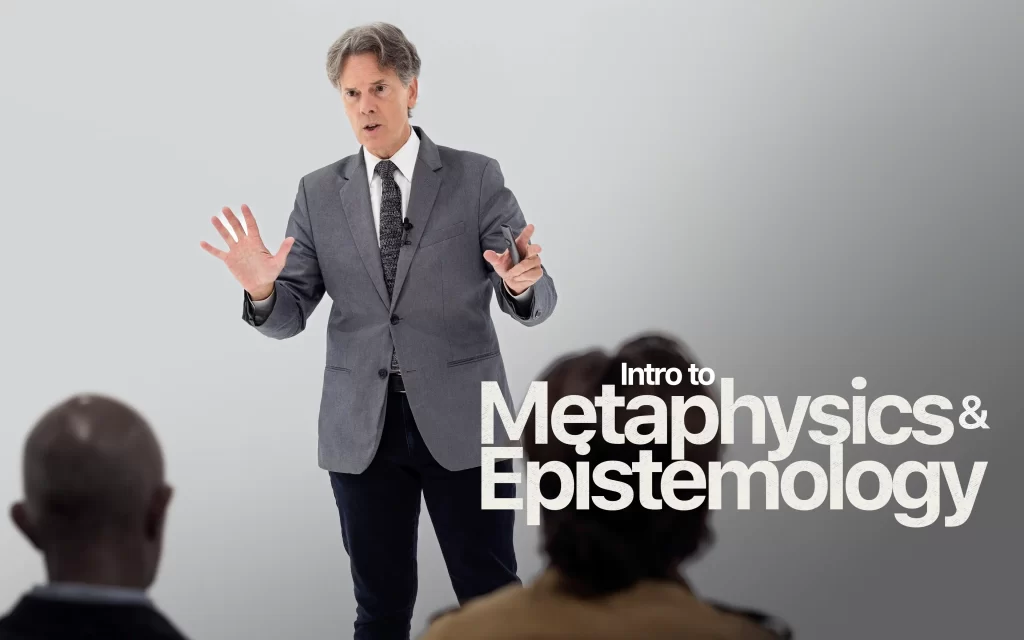
Dr. Hicks is author of Explaining Postmodernism: Skepticism and Socialism from Rousseau to Foucault, Nietzsche and the Nazis, Entrepreneurial Living, Liberalism Pro and Con, and Eight Philosophies of Education. He has published in Business Ethics Quarterly, Review of Metaphysics, and The Wall Street Journal. His writings have been translated into twenty languages.

The course trailer and enrollment options are at the Peterson Academy site. See also Professor Hicks’s other courses — Philosophy of Politics: From the French Revolution to World War II, Philosophy of Politics: From the Cold War to After 9/11, Modern Philosophy, Postmodern Philosophy, Modern Ethics, Philosophy of Education, Introduction to Logic, and Business Leadership Ethics.