I understand the temptation to read Michel Foucault as a kind of Libertarian, with all of his attacks on oppressive powers. Or as a kind of ultra-cynical Public Choice theorist, with all his revelations of the sausage-making processes of culture and politics.
Yet it’s important to recognize that, for Foucault, liberation is an impossibility. We might resist oppressive powers, and we might even succeed in overthrowing them — but that leads only to other forms of power coming to dominance. “Freeing” ourselves from one regime does not and cannot establish freedom.
Careful readers will note the closing line of History of Sexuality, in which Foucault signals the impossibility. No matter how many unmaskings and revealings we deploy, we are never liberated:
“The irony of this deployment is in having us believe that our ‘liberation’ is in the balance.”
Liberation is never in the balance. Power, in all its evolutions and revolutions, is fundamental, and all rhetorics — including rhetorics of liberation — are merely tactical within power strategies. Ultimately then, for Foucault, liberation language must be taken as ironic.
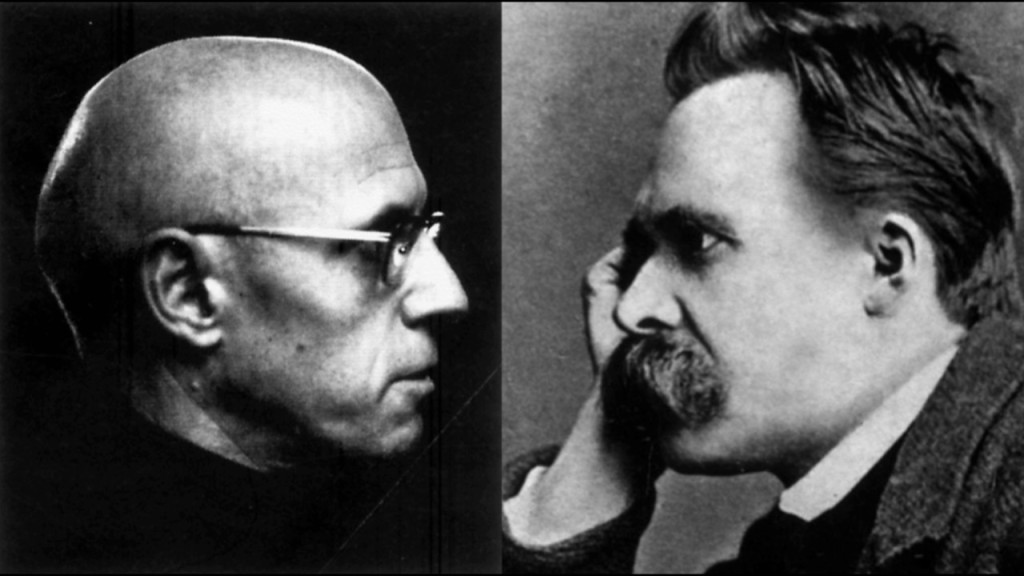
[Side note: I used the Foucault-Nietzsche face-off image above, remembering Foucault’s philosophical self-identification: “I am simply a Nietzschean, and I try as far as possible, on a certain number of issues, to see with the help of Nietzsche’s texts.” Source: Foucault Live (Interviews, 1961-1984). Edited by Sylvère Lotringer. Translated by Lysa Hochroth and John Johnston. New York: Semiotext(e), 1989, p. 471.]
Related: My close reading of Foucault’s History of Sexuality, Volume 1, in the Philosophers, Explained series: