Strong words from Heine’s 1834 History of Religion and Philosophy in Germany:
“The life-history of Immanuel Kant is difficult to write, for he had neither a life nor a history. He lived a mechanical, orderly, almost abstract, bachelor life, in a quiet little side-street of Königsberg, an old city near the north-east boundary of Germany. I believe that the great clock of the cathedral did not perform its daily work more dispassionately, more regularly, than its countryman, Immanuel Kant. Rising, coffee-drinking, writing, collegiate lectures, dining, walking — each had its set time. And when Immanuel Kant, in his grey coat, cane in hand, appeared at the door of his house, and strolled towards the small linden avenue, which is still called ‘the philosopher’s walk,’ the neighbours knew it was exactly half-past four. Eight times he promenaded up and down, during all seasons; and when the weather was gloomy, or the grey clouds threatened rain, his old servant Lampe was seen plodding anxiously after, with a large umbrella under his arm, like a symbol of Providence.
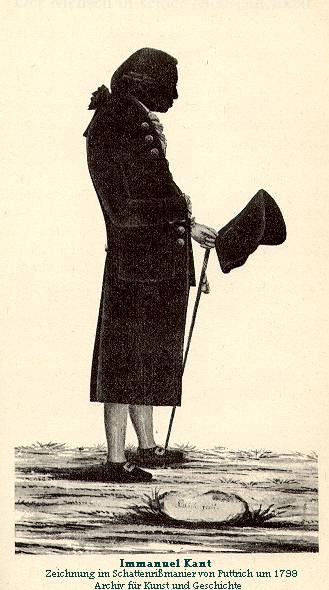
“What a strange contrast between the outer life of the man and his destructive, world-convulsing thoughts! Had the citizens of Königsberg surmised the whole significance of these thoughts, they would have felt a more profound awe in the presence of this man than in that of an executioner, who merely slays human beings. But the good people saw in him nothing but a professor of philosophy; and when at the fixed hour he sauntered by, they nodded a friendly greeting, and regulated their watches.
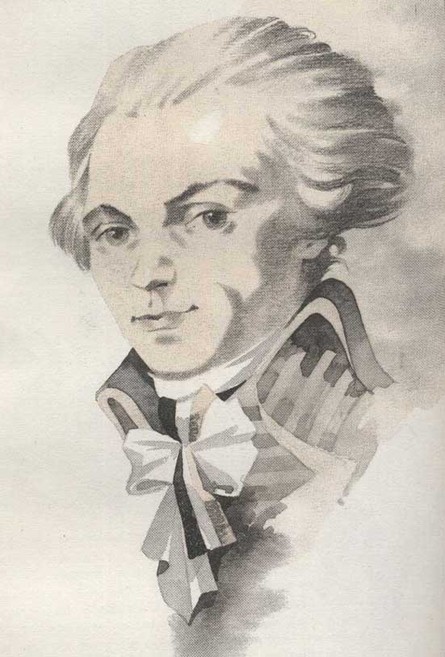
“But if Immanuel Kant, that arch-destroyer in the realms of thought, far surpassed Maximilian Robespierre in terrorism, yet he had certain points of resemblance to the latter that invite a comparison of the two men. In both we find the same inflexible, rigid, prosaic integrity. Then we find in both the same instinct of distrust, — only that the one exercises it against ideas, and names it a critique, while the other applies it to men, and calls it republican virtue. In both, however, the narrow-minded shopkeeper type is markedly manifest. Nature had intended them to weigh out sugar and coffee, but fate willed it otherwise, and into the scales of one it laid a king, into those of the other, a God. And they both weighed correctly.”
Source: Heinrich Heine, History of Religion and Philosophy in Germany (1834), Preface to the Second Edition (1852).
Related: My explanation of Kant’s epistemology in “The Counter-Enlightenment Attack on Reason” [PDF], which is Chapter Two of Explaining Postmodernism: Skepticism and Socialism from Rousseau to Foucault. My discussion of Robespierre’s significance is in Chapter Four, “The Climate of Collectivism” [PDF].
Also: My close reading of the famous 2nd Preface to Kant’s Critique of Pure Reason:
“Rising, coffee-drinking, writing, collegiate lectures, dining, walking — each had its set time.”
It’d be interesting to know whether Kant ever agonized over the provenance of his coffee. I mean, was it Fair Trade coffee? But how could it be? Fair Trade coffee was centuries in the future.
If not, how did Kant universalize the maxim of drinking the coffee they had in Germany in the eighteenth century? The maxim of his action would have to be expressed as follows: “Whenever I need to wake up early in the morning, I shall drink whatever coffee my servant bought yesterday, even if it was produced under exploitative or coercive conditions in a faraway land…”
Now this principle of self-love or personal advantage may well be quite compatible with one’s entire future welfare, but the question is whether it is right. We then transform the requirement of caffeinated self-love into a universal law and put the question thus: how would things stand if one’s maxim were to become a universal law?
Once we wake up and smell the coffee, so to speak, I think we see at once that such a maxim could never hold as a universal law of nature and be consistent with itself, but must necessarily be self-contradictory. Of course, at that point, there would be no coffee to wake up and smell.
So maybe he should have gone straight from “rising” to “writing.”
Reply
Amusing example, Irfan, with an edge.
Reply
I read this account of Kant years ago, and I have always thought Heine nailed it.
Reply
In “The Counter-Enlightenment Attack on Reason” that you refer to above, I think you may have something backwards. You say “One gives political power and
economic freedom to individuals only to the extent one thinks they are capable of using it wisely.” Who is the one giving this? Wouldn’t it be accurate to say “One claims political power and economic freedom for individuals only to the extent he knows himself capable?” Once a man grasps that his reason is the means and capacity for his survival, claiming political power becomes vital for his survival.
The issue prior to and after the Enlightenment is “Who is my authority?” The Enlightenment changed the “who.”
Reply
They resembled each other to a degree. same mien.
Reply
Oh, my! And people think only Objectivists have harsh words for Immanuel Kant. :-0
Reply
Heinrich Heine was quite a good liberal thinker and pretty much a hero. He’s one of my favorite 1800s intellectuals.
Reply