A zinger from Zingales:

“Keynesianism has conquered the hearts and minds of politicians and ordinary people alike because it provides a theoretical justification for irresponsible behavior. Medical science has established that one or two glasses of wine per day are good for your long-term health, but no doctor would recommend a recovering alcoholic to follow this prescription. Unfortunately, Keynesian economists do exactly this. They tell politicians, who are addicted to spending our money, that government expenditures are good. And they tell consumers, who are affected by severe spending problems, that consuming is good, while saving is bad. In medicine, such behaviour would get you expelled from the medical profession; in economics, it gives you a job in Washington.”
Source: Luigi Zingales, “Keynesian principles: The opposition’s opening remarks.” The Economist, March 10, 2009, paragraph 24. More Zingales: A Capitalism for the People.
Related:
The END of LAISSEZ-FAIRE or the ROAD to SERFDOM?
John Maynard KEYNES & Friedrich HAYEK
Lecture 8 of The Philosophy of Politics: From the French Revolution to World War II
Keynes: “It is not true that individuals possess a prescriptive ‘natural liberty’ in their economic activities.”
Or:
Hayek: The economic question is “how to secure the best use of resources known to any of the members of society, for ends whose relative importance only these individuals know.“
About the Course
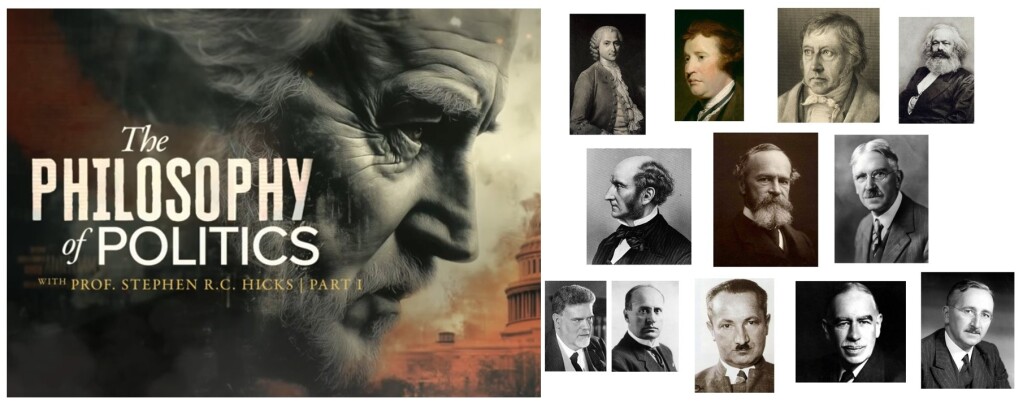
In this eight-lecture course, Professor Stephen Hicks takes us through the development of political philosophy from the late 18th to the early 20th century, focusing on key thinkers and movements that shaped the modern world. We examine the Conservative response to the French Revolution, the rise of German Nationalism and Marxism, the defense of Liberalism in England during and after the Industrial Revolution, and the emergence of Pragmatism in America. The course concludes with an analysis of the philosophical foundations of Fascism and Nazism and the competing economic Interventionist and Free-Market theories that arose in response to the Great Depression.
About the Instructor
Stephen R. C. Hicks, Ph.D., has been Professor of Philosophy at Rockford University, Illinois; Visiting Professor of Business Ethics at Georgetown University, Washington, D.C.; Visiting Professor at the University of Kasimir the Great, Poland; Visiting Fellow at Harris Manchester College of Oxford University; and Visiting Professor at the Jagiellonian University, Poland.
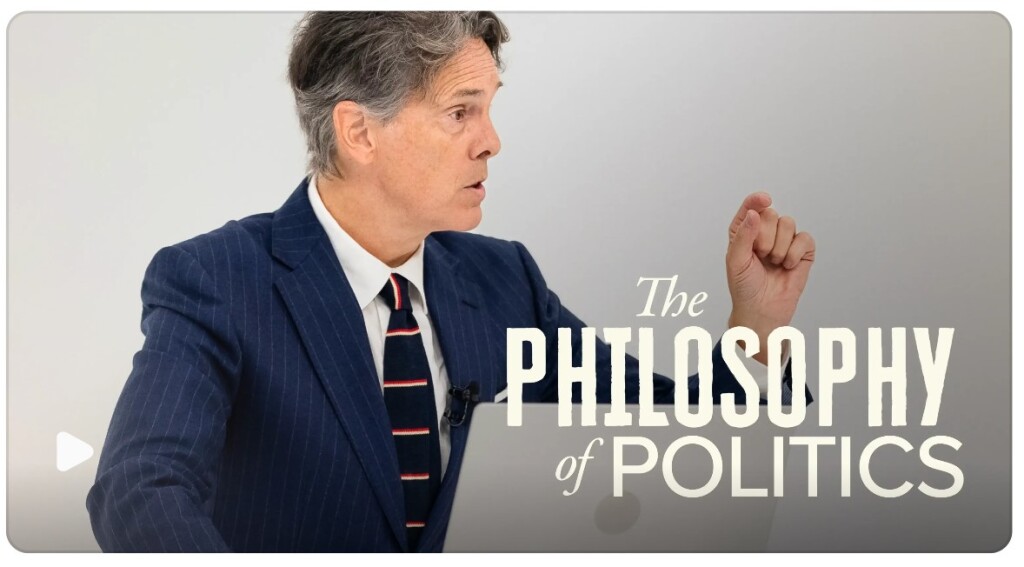
Dr. Hicks is author of Explaining Postmodernism: Skepticism and Socialism from Rousseau to Foucault, Nietzsche and the Nazis, Entrepreneurial Living, Liberalism Pro and Con, and Eight Philosophies of Education. He has published in Business Ethics Quarterly, Review of Metaphysics, and The Wall Street Journal. His writings have been translated into twenty languages.
In 2010, he won his university’s Excellence in Teaching Award.

Course trailer and enrollment options at the Peterson Academy site. Professor Hicks’s other courses — Modern Philosophy, Postmodern Philosophy, Philosophy of Politics: From the Cold War to After 9/11, and Philosophy of Ethics — are available at Peterson Academy.
My understanding of Keynesianism is that the government runs deficits during recessions and surpluses during periods of economic growth. Politicians claiming to be Keynesians, however, advocate deficit spending no matter what. It’s another one of the left’s logical contradictions. On the one hand, they take credit for ending the Great Recession and producing economic growth. On the other hand, they clamor for ever greater levels of government spending, which in a Keynesian model implies a contracting economy. The analogy of a doctor recommending wine to an alcoholic is quite appropriate. In this case, the addiction is political power and the drug is the ability to buy votes.
Well put Eric. First I’ve heard of Luigi Zingales. Really appreciate the recommendation Prof. Hicks and will buy his book.
If one sees recessions as corrections then Keynes’ notion of running deficits then is seen as an incredibly wrong-headed approach.
Here’s one of the best encapsulations of Austrian business cycle theory I’ve come across given by Thomas E. Woods (7:56 min):
http://www.youtube.com/watch?v=5K4Os5eXPw4
Zingales’ book arrived from Amazon yesterday. When I’ll get to it with a truckload of reading to do is another question. But don’t think I can resist shortlisting it.