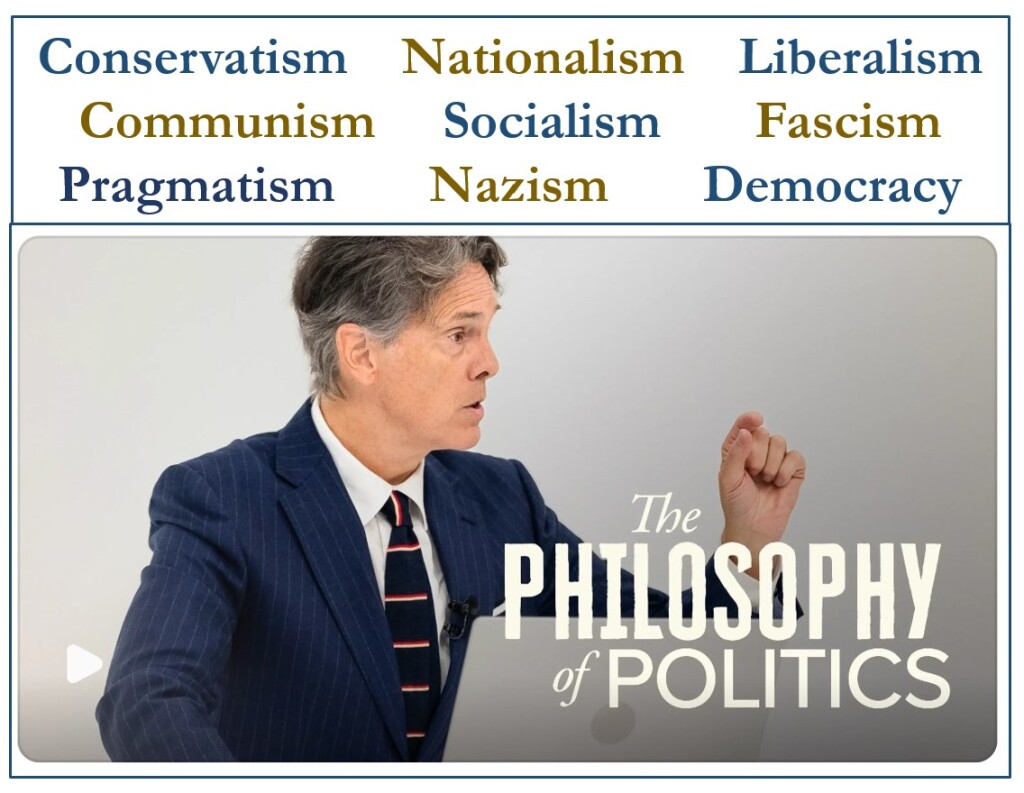
In this eight-lecture course, Professor Hicks takes us on a journey through the evolution of modern political philosophies, from the cataclysm of the French Revolution to the Second World War. Major thinkers covered include: Edmund Burke, Georg Hegel, Friedrich Engels and Karl Marx, John Stuart Mill, William James and John Dewey, Giovanni Gentile and Benito Mussolini, Martin Heidegger, John Maynard Keynes, and Friedrich Hayek.
Lecture One: Revolutionary Danger. Edmund Burke
Themes: Conservatism. Why philosophy of politics? The French Revolution. The Reign of Terror. Rousseau and the Jacobins. Contrasting the American Revolution. Contrasting Britain’s Glorious Revolution. Text: Burke, Reflections on the Revolution in France
Lecture Two: World-Historical Individuals. Georg Hegel
Themes: Nationalism. The Great Men of History. God’s Providence. The place of Germany in particular. “Right” and “Left” Hegelians. Text: Hegel, Philosophy of Right
Lecture Three: Communism and International Socialism. Friedrich Engels and Karl Marx
Themes: Communism. Industrial Revolution. Exploitation. Alienation. “Iron necessity.” Dialectical materialism. Texts: Engels, The Condition of the Working Class in England; Marx, Capital
Lecture Four: Liberalism. John Stuart Mill
Themes: Liberalism. The Enlightenment’s successes and new challenges. The Harm Principle. Freedom of Thought. Eccentrics. Tocqueville. The capitalist peace thesis. Women’s liberty and equality. Texts: Mill, On Liberty and Principles of Political Economy
Lecture Five: Pragmatic Democracy. William James and John Dewey
Themes: Pragmatism and Progressivism. Evolution. Uncertainty. Deep Democracy. Jane Addams. Philosophers and war.
Texts: James, “The Moral Equivalent of War”; Dewey, Reconstruction in Philosophy and Democracy and Education
Lecture Six: Fascism. Benito Mussolini and Giovanni Gentile
Themes: Fascism. Anti-liberalism. Anti-individualism. On varieties of socialism. Ethnic nationalism or internationalism? Materialism or spiritualism? Hegel. Rocco. Text: Mussolini and Gentile, The Doctrine of Fascism
Lecture Seven: National Socialism. Martin Heidegger
Themes: National Socialism. Authenticity. Against capitalist America and against communist Russia. Theory and Practice. Carl Schmitt. Hannah Arendt. Texts: “Reunion Speech” and An Introduction to Metaphysics
The End of Laissez-faire or the Road to Serfdom? John Maynard Keynes and Friedrich Hayek
Themes: Keynesianism. The ‘End of Laissez-faire’? A middle way between socialism and capitalism? Austrianism. The Socialist Calculation problem. Markets as discovery and coordination. Texts: Keynes, The End of Laissez-faire. Hayek, “The Use of Knowledge in Society,” The Road to Serfdom.
About the Instructor

Stephen R. C. Hicks, Ph.D. is Professor of Philosophy and the author of Explaining Postmodernism: Skepticism and Socialism from Rousseau to Foucault, Nietzsche and the Nazis, Entrepreneurial Living, Liberalism Pro and Con, and Eight Philosophies of Education. He has published in Business Ethics Quarterly, Review of Metaphysics, and The Wall Street Journal. His writings have been translated into twenty languages. He has been Visiting Professor of Business Ethics at Georgetown University (Washington, DC), Visiting Professor at the University of Kasimir the Great (Poland), Visiting Fellow at Harris Manchester College (Oxford University), and Visiting Professor at Jagiellonian University (Poland).
Trailer and enrollment options at the Peterson Academy site here.
See also Professor Hicks’s courses on Modern Philosophy, Postmodern Philosophy, and Philosophy of Ethics.

Any PDFs to your courses.
Thanks for asking. All of the course materials are at the PA site.