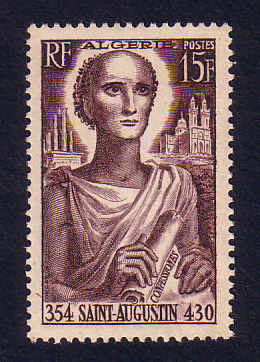
One of my professors in graduate school argued that St. Augustine is the most influential philosopher in history. I’m not convinced, though a good case can be made.
I recently re-opened Confessions and came across Augustine’s strong version of original sin. As he exclaims to his God, “no one is free from sin in your sight, not even an infant whose span of earthly life is but a single day” (Book I).
To explain, Augustine tries to reconstruct his own infancy: “What then was my sin at that age? Was it perhaps that I cried so greedily for those breasts? Certainly if I behaved like that now, greedy not for breasts, of course, but for food suitable to my age, I should provoke derision and be very properly rebuked. My behavior then was equally deserving of rebuke.”
And of course the tantrums. Witness “the actions of a child who begs tearfully for objects that would harm him if given, gets into a tantrum when free persons, older persons and his parents, will not comply with his whims, and tries to hurt many people who know better by hitting out at them as hard as his strength allows, simply because they will not immediately fall in with his wishes or obey his commands, which would damage him if carried out?” The little rotter.
Not to forget what kids do to diapers.
Thus, Augustine concludes, “The only innocent feature in babies is the weakness of their frames; the minds of infants are far from innocent.”
Supposing that babies are wicked, the next question is: How did they come to be so?
Western religions start the sordid story with Adam and Eve, but original sin is a puzzle. How can later generations be held responsible for the mistakes of the earlier? A cross-generational collectivism is necessary, and it needs a method for the guilt to be transmitted from one generation to the next.
Here’s a possibility. On standard religious accounts, a human being is an immaterial soul conjoined to a physical body. So sin originates either in the soul or in the body. But if the soul of each person is made afresh by God, then it can’t be corrupt since God is supposed to be a perfect creator. So the source of sin must be in the body. That could make sense, since the original sin was committed by Adam and Eve and we could inherit it from them by being made by their bodies through sexual reproduction. But above Augustine clearly holds babies’ “frames” to be innocent and to locate the sin in their minds.
So we’re back to sin’s source being in the mind. What feature of the mind could be problematic? Free will, Augustine suggests. But other problems arise, since he is also committed elsewhere to God’s omnipotence and omniscience. If God is omnipotent and we are made weak and powerless, how can we be held responsible? Also, free will is a power; but if omnipotent God has all the power, then humans can’t have any. Further: if God is omniscient, then he knows the future, in which case there are no genuine options and so no free will.
But the philosophical puzzles don’t get babies off the hook for Augustine. Their sinful natures develop for the worse until adolescence generates even more sin. “From the mud of my fleshly desires and my erupting puberty belched out murky clouds that obscured and darkened my heart until I could not distinguish the calm light of love from the fog of lust.”
Greed, anger, lust, and the full panoply of sins thus become the lot of weakling mankind. And we know what awaits the wicked.
(Augustine always reminds me of a line from Nietzsche’s Genealogy of Morals: “The truly great haters in world history have always been priests.”)
Related: C. S. Lewis’s modern defense of Christian ethics, in the Philosophers, Explained series.
Image source:
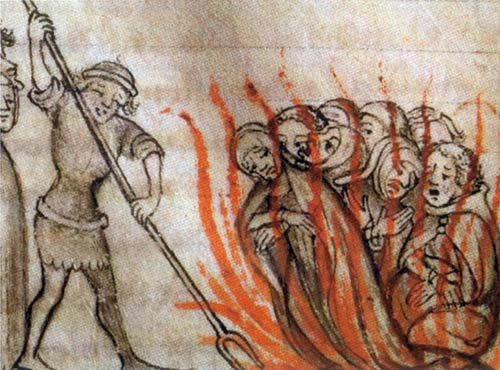
The image of Augustine forking heretic Donatists into the flames was taken from “St. Augustine pt. 2: Hammer of the Donatists, Advocate of Torture, Inquisitor.”
Saint Augustine couldn’t do it. But can you explain what kind of fruit Adam and Eve ate in the story? After thousands of years it’s time to think, read, and give the real explanation based only on the facts in the story. No guesses, opinions, or beliefs. We’ve already had way too many of these. Treat the whole thing as a challenge. You can do it! Or can you? But first, do a quick Google search: First Scandal.
Reply
Allow me to begin by saying I recently watched “Nietzche and the Nazis” and I think it might be one of the best presentations on both subjects I have ever come across. I have recommended it to many of my friends, especially in light of current ideas floating around America. And I intend to buy both the DVD and the book.
I would like to ask a question regarding this article. Is the problem really logic or is it not simply not liking the option? Your questions are common. A matter of fact the apostle Paul anticipated them, “You will say to me then, “Why does he still find fault? For who can resist his will?” But who are you, O man, to answer back to God? Will what is molded say to its molder, “Why have you made me like this?” Has the potter no right over the clay, to make out of the same lump one vessel for honorable use and another for dishonorable use? What if God, desiring to show his wrath and to make known his power, has endured with much patience vessels of wrath prepared for destruction, in order to make known the riches of his glory for vessels of mercy, which he has prepared beforehand for glory..” What if you knowledge on the bible, the glasses in which you read it through are tainted? You have presuppositions (we all do) that might not be quite right?What if there are hard sayings but what if there is also the most magnificant news? What if the bad news is far worse than you imagined (and that’s saying a lot in light over you studies) and the good news is for better than you could even think?
Reply
And I need to add….some of your explanations that you say come from “standard religious accounts”, if are in fact ideas come from “Christians” they are not the best of the ideas presented.
Reply
“From the mud of my fleshly desires and my erupting puberty belched out murky clouds that obscured and darkened my heart until I could not distinguish the calm light of love from the fog of lust.” I always did like that quote, lol.
Reply
The funny thing is developmental psycholgy is proving Augustine right? http://www.psychologicalscience.org/index.php/news/releases/babies-prefer-individuals-who-harm-those-that-arent-like-them.html
Reply
“The only innocent feature in babies is the weakness of their frames; the minds of infants are far from innocent.”
The only innocent feature in babies is that their brains are not mature enough to differentiate the good and evil. They touch everything they see, Put in their mouth everything they see. A wicked minded one do not behave that way
Reply
Poor Augustine. Blaming his sins on his creator and inheriting Adams sin. Why did he not believe that sin is a transgression of God’s Law? Do babies transgression God’s Law? What nonsense !
Reply
Babies are a gift from God. God would not give a tainted gift!
Reply
Babies appear the cutest, sweetest little beings in all creation. They are adorable !
Babies are the most egotistical, self centred little solipsists that I can know
Both these views seem valid …. simultaneously ….
As for sin finding its source in free will and the human mind, “sin”, “free will” and “consciousness”,
Augustine seems to be “partly right” if we look at human history and paleoanthropology
but I am in way over my head to fit it all together coherently. Some days Hobbes view of human nature seems right and other days Stephen Hicks more hopeful approach seems to resonate
Reply
Honestly, I do think Augustine is the most influential philosopher in history. He’s also responsible for more shame and neurosis than anyone else in history through this doctrine of his. He didn’t invent the idea of Original Sin, of course, but he helped codify it. In the Bible, we’ve just been collectively punished for the sins of Adam and Eve. In his version, we are born bad and wicked and bound for Hell as a result. Our human frailties from infancy are the markers for eternal torment, unless we accept God’s sacrifice (of Himself to Himself).
He hated the idea of sex, just like his mother with whom he clearly had an emotional incestuous relationship. So of course he thought sex was the icky mechanism whereby original sin was passed from one generation to the next.
Influential? Yes. Incredibly harmful? Also yes.
Reply
Could the identity of the unknown forbidden fruit in the world’s oldest and greatest mystery story have something to do with procreation and the family Adam and Eve do not have until after their eviction from Eden at the end of Genesis 3? Adam and Eve disobey the Genesis 1:28 commandment–the first commandment–to “be fruitful and multiply [in the Garden]” when they become one flesh incorrectly (Genesis 2:24) by eating from the wrong tree in the allegorical Garden’s center (Genesis 2:9). So they disobey not just one commandment, but two at the same time. Finally, it is interesting that half of Eve’s punishment in Genesis 3:16 is painful childbirth–because she chooses to not have children in the Garden of Eden and God wants to remind her of her decision?
The entire evidence-based exegesis is included in the preceding four sentences. But why was this confusing allegory, whatever its meaning, constructed in the first place, as the original literal story most certainly came first, a story that confused absolutely no one, unlike the allegory into which it evolved? The widely held belief that the forbidden fruit in the Bible story is an apple illustrates among other things how confirmation bias serves as a terrible mechanism that cripples our critical thinking as it prevents discussion, criticism, and evaluation of the validity of the proposed exegesis that begins with Genesis 1:28, continues through Genesis 2 and 3, and concludes with Genesis 4:1.
Reply