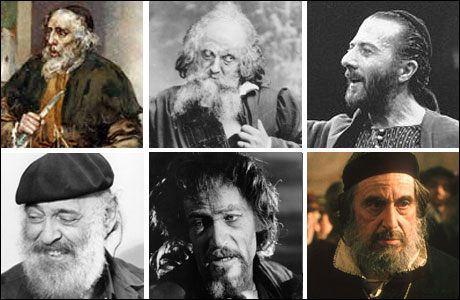
My essay, “Defending Shylock: Productive Work in Financial Markets,” is now available in pamphlet form at Amazon. The essay is also available for free at the Social Science Research Network.
In this essay I discuss the great value that financial markets add to an economy and the nature of the intellectual work that underlays them. In addition, I argue against the usual criticisms of financial markets that those who work in them are zero-sum parasites upon the physical labor and that they make merely “paper profits.”
Along the way, I discuss controversial figures such as Martha Stewart, Michael Milken, Aristotle Onassis, Ivan Boesky, Jesus, Augustus, and Shakespeare’s character Shylock from The Merchant of Venice.
Posted 2 months, 3 weeks ago at 8:43 am. Add a comment
Get thy reeky hide hither, sirrah, and desist with the pewling — beslubbering puttock thou oft art.
(Via John Enright: no mammering lewdster he.)
Posted 5 months, 3 weeks ago at 6:35 am. Add a comment
A formal publication of my “Defending Shylock: Productive Work in Financial Markets” is forthcoming this spring. For now, here is a draft version [pdf] of the sixteen-page essay.
From the Introduction:
“Ambivalent attitudes about financial markets are as old as financial markets themselves. Plato, in The Republic (555e), condemns moneylenders. Jesus threw the money lenders out of the temple, on the grounds that they were defiling a holy place. Roman emperor Augustus, according to Suetonius’ racy biography, was always especially displeased if he discovered any of his knights engaged in interest rate arbitrage (Suetonius, p. 76). Shakespeare, in Hamlet, has Polonius counsel his son ‘neither a lender nor a borrower be,’ and in The Merchant of Venice presents us with the image of the lender as a cunning Shylock hoping to extract his pound of flesh.
“We are, in the twenty-first century, heir to all these views.
“At same time we are committed to financial markets. … ”
From the Conclusion:
“… Judged by these criteria, financial markets are highly virtuous institutions. Obviously this is not to say that everyone who works in financial markets is a moral hero or that mistakes and abuses never happen. But it is to say that injustices are aberrations in the system and that the system is designed to help us be that best we can be. Financial markets do create value, and they do so by encouraging in us the core of moral excellence. We cannot ask more of any institution.”
Comments or corrections very welcome before the formal publication.
Posted 6 months, 1 week ago at 2:39 pm. Add a comment
At the Explaining Postmodernism page, Chapter Six of my book is now available online. This final chapter integrates the epistemological material from chapters two and three with the political material from chapters four and five to show how the distinctive contemporary postmodern strategies follow.
Here are the chapter’s sections and page numbers:
Chapter Six: Postmodern Strategy [pdf]
Connecting epistemology to politics 174
Masks and rhetoric in language 175
When theory clashes with fact 178
Kierkegaardian postmodernism 179
Reversing Thrasymachus 182
Using contradictory discourses as a political strategy 184
Machiavellian postmodernism 186
Machiavellian rhetorical discourses 187
Deconstruction as an educational strategy 188
Ressentiment postmodernism 191
Nietzschean ressentiment 193
Foucault and Derrida on the end of man 195
Ressentiment strategy 198
Post-postmodernism 201
Posted 10 months ago at 11:39 am. Add a comment