One of the major, major pessimists in history. I quoted him last week in the context of contemporary anti-humanism and those calling for human extinction. But lest we think of Arthur as always grim and cranky, here’s a delightful zinger.
Schopenhauer, assessing Kant’s moral philosophy:
“I should liken Kant to a man at a ball, who all evening has been carrying on a love affair with a masked beauty in the vain hope of making a conquest, when at last she throws off her mask and reveals herself to be his wife” (On the Basis of Morality).
Although it is hard to imagine (even if one tries very hard, which I don’t recommend) Professor Immanuel Kant in pursuit of a love affair, Schopenhauer’s simile is on to something. Kant and his followers presents his project as new, modern, and revolutionary, but after doggedly reading through hundreds of pages of dense prose (sample here), one realizes it’s essentially the same old dowdy stuff (apologies to all wives).
Which is why Schiller could say, in a letter to Goethe, “There still remains something in Kant, as in Luther, that makes one think of a monk who has left his monastery, but been unable efface all traces of it.” Indeed.
Posted 1 year, 8 months ago at 9:33 am. Add a comment
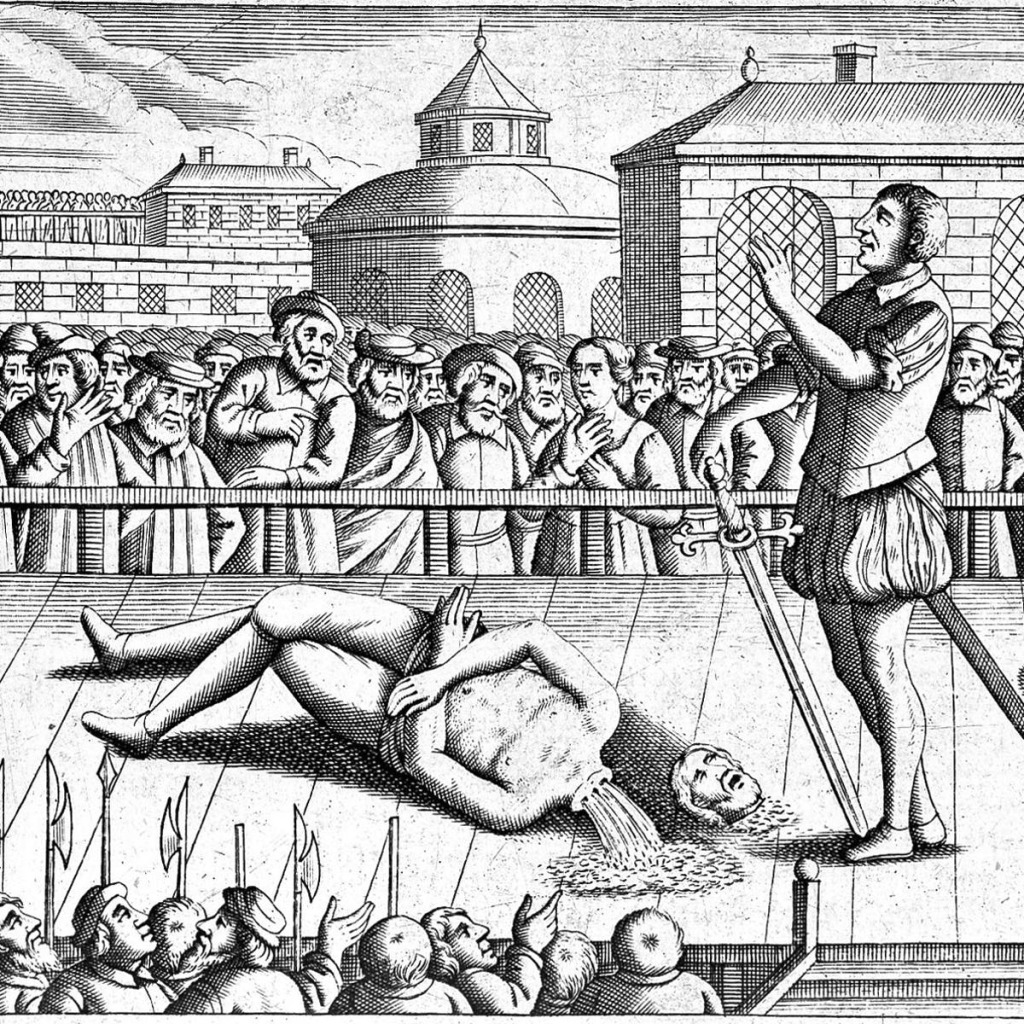
“By the mid-fifteenth century crimes subject to the death penalty … included the following: rebellion, fraud, bigamy, incest, arson, theft, adultery, carrying off a woman against her will, blasphemy, moving signs of property boundaries, attacking someone, high treason, child murder, using dishonest weights and measures, murder, counterfeiting, rape, attempted suicide, striking someone to death, converting to Judaism, treason, having sex with animals, and sorcery.”
That’s quite a list. It comes from pp. 4-5 of Richard Marius’s Martin Luther: The Christian between God and Death (Harvard University Press, 1999). And note the threat of the death penalty for attempted suicide: hmmm ….
The list is in striking contrast to mid-20th century data about the United States, by which time the death penalty was applied almost exclusively to murderers and even then to fewer and fewer of them. Here is Justice William Brennan commenting in the landmark Supreme Court case, Furman v. Georgia from 1972:
“There has been a steady decline in the infliction of this punishment in every decade since the 1930’s, the earliest period for which accurate statistics are available. In the 1930’s, executions averaged 167 per year; in the 1940’s, the average was 128; in the 1950’s, it was 72; and in the years 1960-1962, it was 48. There have been a total of 46 executions since then, 36 of them in 1963-1964. Yet our population and the number of capital crimes committed have increased greatly over the past four decades. The contemporary rarity of the infliction of this punishment is thus the end result of a long-continued decline. That rarity is plainly revealed by an examination of the years 1961-1970, the last 10-year period for which statistics are available. During that time, an average of 106 death sentences was imposed each year. …”
(All of which seems a healthy development — except for that part about letting sorcerers off the hook.)
Posted 1 year, 8 months ago at 11:53 am. 1 comment
Last week and this, we have been reading Descartes’ Meditations, in part using it to introduce the complicated and important set of issues known as the mind-body problem.
The most ancient account of the mind-body relation is dualism, the view that the mind and the body are two different types of stuff that are temporarily joined. The broadest contrast competitor account is physicalism, the view that the mind and the body are both ultimately physical, the mind being a set of dependent capacities that emerge from or are reducible to physical capacities.
On the traditional dualist account (especially traditional religious dualist accounts), human beings are a microcosm of a dualist macrocosm: Reality for dualists is divided into a physical natural world and a non-physical supernatural world. We humans have a metaphysical foot in each camp, so to speak — a physical body attached to the natural world and a temporarily-housed spirit that wants (or should want) to be reunited with the supernatural.
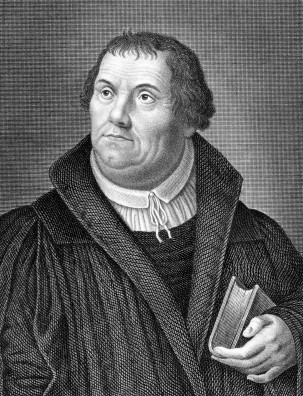
Martin Luther is representative, here writing in 1520: “Man has a twofold nature, a spiritual one and a bodily one. According to the spiritual nature, which men refer to as the soul, he is called a spiritual, inner, or new man. According to the bodily nature, which men refer to as flesh, he is called a carnal, outward, or old man, of whom the Apostle writes in 2 Cor. 4 [:16], ‘Though our outer nature is wasting away, our inner nature is being renewed every day.’ Because of this diversity of nature the Scriptures assert contradictory things concerning the same man, since these two men in the same man contradict each other, ‘for the desires of the flesh are against the spirit, and the desires of the Spirit are against the flesh,’ according to Gal. 5 [:17].”
Descartes (1596-1650) is a dualist, defending it against the rising number of physicalists who want to explain human beings without appealing to immaterial souls, spirits, or substances. Thomas Hobbes (1588-1679) is a contemporary-to-Descartes example:
“For seeing life is but a motion of limbs, the beginning whereof is in some principal part within; why may we not say, that all automata (engines that move themselves by springs and wheels as doth a watch) have an artificial life? For what is the heart, but a spring; and the nerves, but so many strings; and the joints, but so many wheels, giving motion to the whole body … ?” (Leviathan, 1651)
The debate is many-dimensional, and for many dualists the primary issue is not so much whether physicalism is an adequate explanation for the human psyche but rather the value implications. If physicalism is true, won’t that mean that when our bodies die, that’s it, and doesn’t that make life depressingly pointless? If physicalism is true, then doesn’t that undermine our human dignity and reduce us to level of the other beasts? And wouldn’t that mean that there’s no soul to check our lower, animalistic desires for sex, food, and drink? If there’s no soul, then doesn’t that mean that there’s no afterlife to look forward to?
Of course, the value implications also cut the other way. If dualism is true, then doesn’t that divorce love from sex, as in dualistic Platonic love? Doesn’t dualism separate the higher moral realm from practical, real-life concerns? Doesn’t dualism pit the mind against the body rather than expecting that they can and should work together harmoniously? Doesn’t dualism encourage people to waste their lives waiting for an afterlife rather than pursuing the good life here in the natural world? And on the issue of human dignity, my favorite response here comes from Raymond Smullyan:
“Recently I was with a group of mathematicians and philosophers. One philosopher asked me whether I believed man was a machine. I replied, ‘Do you really think it makes any difference?’ He most earnestly replied, ‘Of course! To me it is the most important question in philosophy.’ I had the following afterthoughts: I imagine that if my friend had finally come to the conclusion that he were a machine, he would be infinitely crestfallen. I think he would think: ‘My God! How horrible! I am only a machine!’ But if I should find out I were a machine, my attitude would be totally different. I would say: ‘How amazing! I never before realized that machines could be so marvelous!’”
[Autobiographical sideline: Raymond Smullyan was one of my professors in graduate school at Indiana University. Indiana's philosophy department was then heavily focused on logic, epistemology, and analytic metaphysics, and across the quad the university had a strong and separate History and Philosophy of Science department. Douglas Hofstadter was also at Indiana then, having been lured back from Michigan to head Indiana's Center for Research on Concepts and Cognition. Intellectually exciting times. Coincidentally and unknown to me at the time, Jimmy Wales was then at Indiana pursuing a Ph.D. in business, and Elinor Ostrom, this year's co-Nobelist in economics, was also there in the political science department.]
Posted 2 years, 3 months ago at 1:04 pm. 3 comments
This semester’s major authors and texts will be Plato’s Apology and Crito, Descartes’s Meditations, Freud’s Civilization and Its Discontents, Lewis’s Mere Christianity, and Rand’s The Fountainhead.
We will be covering those authors and their views in their own right and using them as launching points for discussion of issues such as the existence of God, free will and determinism, the mind-body problem, and the meaning of life.
We will also use a number of shorter pieces from Daniel Dennett, Martin Luther, John Steinbeck, Rupert Brooke, and others as supplements.
Here are PDF files of the three-page syllabus and schedule and the seventy-three-page supplemental Readings in Philosophy booklet I put together.
Posted 2 years, 6 months ago at 8:49 am. Add a comment