Stephen Hicks, Ph.D.

Philosopher

Irrationalism from Kierkegaard to Nietzsche [EP]

[This excerpt is from Chapter 2 of Explaining Postmodernism: Skepticism and Socialism from Rousseau to Foucault]

Epistemological solutions to Kant: Irrationalism from Kierkegaard to Nietzsche

The Kantians and the Hegelians represent the pro-reason contingent in nineteenth-century German philosophy.

While the Hegelians pursued metaphysical solutions to Kant’s unbridgeable gap between subject and object, in the process altering reason into something unrecognizable to the Enlightenment, they had competition from the explicitly irrationalist wing of German philosophy. This line of development included major figures such as Friedrich Schleiermacher, Arthur Schopenhauer, Friedrich Nietzsche, and Denmark’s lonely contribution to the history of modern philosophy, Søren Kierkegaard.

The irrationalists divided over whether religion is true—Schleiermacher and Kierkegaard being theists, and Schopenhauer and Nietzsche being atheists—but all shared a contempt for reason. All condemned reason as a totally artificial and limiting faculty, one that must be abandoned in the bold quest to embrace reality. Perhaps Kant had prohibited access to reality—but he had shown only that reason could not get us there. That left other options open to us: faith, feeling, and instinct.

schleiermacher-51x50Schleiermacher (1768-1834) came of age in a Kant-dominated intellectual scene, and he took Kant’s cue for how religion could respond to the threat of the Enlightenment. Intellectually most active from 1799, with the publication of On Religion, Speeches to its Cultural Despisers, Schleiermacher more than anyone made happen the revival of Pietism and orthodox Protestantism over the course of the next generation. So great was Schleiermacher’s influence that, as theologian Richard Niebuhr put it, he “may justifiably be called the Kant of modern Protestantism.”[28]

As someone who came of age in the 1790s in Germany, Schleiermacher was broadly Kantian in his approach and embraced whole-heartedly the Kantian rejection of reason’s access to reality. Schleiermacher, like Kant, was deeply offended by the assault that reason, science, and naturalism had made on the true faith. Following Hamann, Schleiermacher held that feeling, especially religious feeling, is a mode of cognition, one that gives us access to noumenal reality. Except, argued Schleiermacher, these feelings are not so much directed outward as inward. One cannot grasp noumena directly, but one can phenomenologically inspect oneself, one’s deepest feelings, and therein find indirect senses of the divine ultimate.[29] As Hamann had stated, directly confronted religious feeling reveals one’s essential nature.

When one discovers one’s essential nature, the core self-feeling that one is forced to accept is that of absolute dependence. In Schleiermacher’s words, “The essence of religion is the feeling of absolute dependence. I repudiated rational thought in favour of a theology of feeling.”[30] One should strive to realize oneself by exploring and embracing this feeling of absolute dependence. This requires attacking reason, for reason gives one a feeling of independence and confidence. Limiting reason is thus the essence of religious piety—for it makes possible a fully-entered-into feeling of dependence and orientation toward that being upon which one is absolutely dependent. That being is of course God.[31]

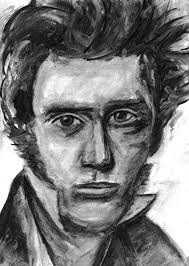
kierkegaard-50x64In the next generation, Kierkegaard (“Hamann’s most brilliant and profound disciple”[32]) gave irrationality an activist twist. Educated in Germany, Kierkegaard was, like Kant, deeply worried by the beating religion had taken during the Enlightenment. So he was cheered—or at least as cheered as Kierkegaard could ever be—to learn from Kant that reason cannot reach the noumena.

The Enlightenment thinkers had said that individuals relate to reality as knowers. On the basis of their acquired knowledge, individuals then act to better themselves and their world. “Knowledge is power,” wrote Bacon. But after Kant we know that knowledge of reality is impossible. So while we still must act in the real world, we do not and cannot have the necessary knowledge upon which to base our choices. And since our entire destinies are at stake in the choices we make, we cannot choose dispassionately between options. We must choose, and choose passionately, all the while knowing that we are choosing in ignorance.

For Kierkegaard, the core lesson from Kant was that one must not try to relate to reality cognitively—what is needed is action, commitment, a leap into that which one cannot know but which one feels is essential to give meaning to one’s life. In accordance with Kierkegaard’s felt religious needs, what is needed is an irrational leap of faith. It must be a leap because after the Enlightenment it is clear that the existence of God cannot be justified rationally, and it must be irrational because the God that Kierkegaard finds compelling is absurd.

But such a leap into the absurd puts one in a crisis. It flies in the face of everything sensible, rational, and moral. So how should one deal with this crisis of both wanting and not wanting to leap into absurdity? In Fear and Trembling we find Kierkegaard’s panegyric to Abraham, a hero of the Hebrew Scriptures who in defiance of all reason and morality was willing turn off his mind and kill his son Isaac. Why? Because God ordered him too. How could that be—would a good God make such a demand of a man? That makes God incomprehensibly cruel. What about God’s promise that through Isaac the future generations of Israel would be born? The demand makes God a promise-breaker. What about the fact that it is killing an innocent? That makes God immoral. What about the immense pain that the loss of their son would cause in Abraham and Sarah? That makes God a sadist. Does Abraham rebel? No. Does he even question? No. He shuts down his mind and obeys. That, said Kierkegaard, is the essence of our cognitive relation to reality. Like Abraham, each of us must learn “to relinquish his understanding and his thinking, and to keep his soul fixed upon the absurd.”

Like Abraham, we do not know and we cannot know. What we must do is jump blindly into the unknown. Kierkegaard revered Abraham as a “knight of faith” for his willingness to “crucify reason” and leap into absurdity.[33]

schopenhauer-blue-50x67Schopenhauer, also of the generation after Kant and a contemporary of Hegel, disagreed violently with the cowardly attempts to return to religion after the rejection of Enlightenment reason. While Hegel populated Kant’s noumenal realm with Dialectical Spirit and Schleiermacher and Kierkegaard felt or hoped desperately that God was out there, Schopenhauer’s feelings had revealed to him that reality is Will—a deeply irrational and conflictual Will, striving always and blindly toward nothing.[34] No wonder then that reason had no chance of comprehending it: Reason’s rigid categories and neat organizational schemes are wholly inadequate for a reality that is the opposite of that. Only like can know like. Only via our own wills, our passionate feelings—especially those evoked in us by music—can we grasp the essence of reality.

But most of us are too cowardly to try, for reality is cruel and frightening. This is why we cling to reason so desperately—reason allows us to tidy things up, to make ourselves feel safe and secure, to escape from the swirling horror that, in our honest moments, we sense reality to be. Only the bravest few have the courage to pierce through the illusions of reason to the irrationality of reality. Only a few individuals of special sensitivity are willing to pierce reason’s veil and intuit passionately the seething flow.

Of course, having intuited the cruel horror of the seething flow, Schopenhauer wished for self-annihilation.[35] This was the weakness that his disciple, Nietzsche urged us to overcome.

nietzsche_50x57Nietzsche began epistemologically by agreeing with Kant: “When Kant says: ‘reason does not derive its laws from nature but prescribes them to nature,’ this is, in regard to the concept of nature, completely true.” All of the problems of philosophy, from the decadent Socrates[36] to that “catastrophic spider” Kant,[37] are caused by their emphasis on reason. The rise of the philosophers meant the fall of man, for once reason took over, men no longer possessed their former guides, their regulating, unconscious and infallible drives: they were reduced to thinking, inferring, reckoning, co-ordinating cause and effect, these unfortunate creatures; they were reduced to their ‘consciousness,’ their weakest and most fallible organ![38]

And: “how pitiful, how shadowy and fleeting, how aimless and capricious the human intellect is.” Being merely a surface phenomenon and dependent upon underlying instinctual drives, the intellect certainly is not autonomous or in control of anything.[39]

What Nietzsche meant, then, with his passionate exhortations to be true to oneself, is to break out of the artificial and constricting categories of reason. Reason is a tool of weaklings who are afraid to be naked in the face of a cruel and conflictual reality and who therefore build fantasy intellectual structures to hide in. What we need to bring out the best possible in us is “the perfect functioning of the regulating unconscious instincts.”[40] The yea-sayer—the man of the future—will not be tempted to play word-games but will embrace conflict. He will tap into his deepest drives, his will to power, and channel all of his instinctual energies in a vital new direction.[41]

References

[28] Niebuhr, in Schleiermacher 1963, ix.

[29] Schleiermacher 1799, 18.

[30] Schleiermacher 1821-22, Section 4.

[31] Schleiermacher 1821-22, 12.

[32] Berlin 1980, 19.

[33] Kierkegaard 1843, 31.

[34] Reality, Schopenhauer wrote, is a “world of constantly needy creatures who continue for a time merely by devouring one another, pass their existence in anxiety and want, and often endure terrible affliction, until they fall at last into the arms of death” (1819/1966, 349).

[35] Schopenhauer: “we have not to be pleased but rather sorry about the existence of the world, that its non-existence would be preferable to its existence” (1819/1966, Vol. 2, 576). As for mankind: “nothing else can be stated as the aim of our existence except the knowledge that it would be better for us not to exist” (1819/1966, Vol. 2, 605).

[36] Nietzsche, Ecce Homo, “Why I Am So Wise,” 1.

[37] Nietzsche, The Antichrist, 11.

[38] Nietzsche, Genealogy of Morals, II:16.

[39] Nietzsche, The Will to Power, 478.

[40] Nietzsche, Genealogy of Morals, I:7.

[41] In Beyond Good and Evil (252), Nietzsche shares the view that the deepest battle is the Enlightenment, with its roots in English philosophy, against the Counter-Enlightenment, with its roots in German philosophy: “They are no philosophical race, these Englishmen: Bacon signifies an attack on the philosophical spirit; Hobbes, Hume, and Locke a debasement and lowering of the value of the concept of ‘philosophy’ for more than a century. It was against Hume that Kant arose, and rose; it was Locke of whom Schelling said, understandably, je méprise Locke [I despise Locke]; in their fight against the English-mechanistic doltification of the world, Hegel and Schopenhauer were of one mind (with Goethe)—these two hostile brother geniuses in philosophy who strove apart toward opposite poles of the German spirit and in the process wronged each other as only brothers wrong each other.” See also Daybreak: “The whole great tendency of the Germans ran counter to the Enlightenment” (Section 197).

Bibliography [pdf] [html]

[The chapter from which this section of Stephen Hicks's Explaining Postmodernism (Scholargy Publishing, 2004) is excerpted can be downloaded as a PDF at the Explaining Postmodernism page. The full book is also available at Amazon.com.]

Posted 6 months, 3 weeks ago at 10:00 pm.

1 comment

After Kant: reality or reason, but not both

[This excerpt is from Chapter 2 of Explaining Postmodernism: Skepticism and Socialism from Rousseau to Foucault]

After Kant: reality or reason, but not both

Kant’s legacy to the next generation is a principled separation of subject and object, of reason and reality. His philosophy is thus a forerunner of postmodernism’s strong anti-realist and anti-reason stances.

After Kant, the story of philosophy is the story of German philosophy. Kant died early in the nineteenth century, just as Germany was beginning to replace France as the world’s leading intellectual nation, and it was German philosophy that set the program for the nineteenth century.

Understanding German philosophy is crucial to understanding the origins of postmodernism. Continental postmodernists such as Foucault and Derrida will cite Heidegger, Nietzsche, and Hegel as their major formative influences—all of them German thinkers. American postmodernists such as Rorty emerged primarily from the collapse of the Logical Positivist tradition, but will also cite Heidegger and pragmatism as major formative influences. When we look to the roots of Logical Positivism we find cultural Germans such as Wittgenstein and the members of the Vienna Circle. And when we look at pragmatism, we find it to be an Americanized version of Kantianism and Hegelianism. Postmodernism is thus the supplanting of the Enlightenment with its roots in seventeenth century English philosophy by the Counter-Enlightenment with its roots in late eighteenth-century German philosophy.

Kant is central to that story. By the time of his death Kant’s philosophy had conquered the German intellectual world,[22] and so the story of German philosophy became the story of extensions and reactions to Kant

Three broad strains of post-Kantian philosophy emerged. What shall we do, members of each strain asked, about the gulf between subject and object that Kant has said cannot be crossed by reason?

1. Kant’s closest followers decided to accept the gulf and live with it. Neo-Kantianism evolved during the nineteenth century, and by the twentieth century two main forms had emerged. One form was Structuralism, of which Ferdinand de Saussure was a prominent exponent, representing the broadly rationalist wing of Kantianism. The other was Phenomenology, of which Edmund Husserl was a prominent representative, representing the broadly empiricist wing of Kantianism. Structuralism was a linguistic version of Kantianism, holding that language is a self-contained, non-referential system, and that the philosophical task was to seek out language’s necessary and universal structural features, those features taken to underlie and be prior to the empirical, contingent features of language. Phenomenology’s focus was upon careful examination of the contingent flow of the experiential given, avoiding any existential inferences or assumptions about what one experiences, and seeking simply to describe experience as neutrally and as clearly as possible. In effect, the Structuralists were seeking subjective noumenal categories, and the Phenomenologists were content with describing the phenomena without asking what connection to an external reality those experiences might have.

Structuralism and Phenomenology came to prominence in the twentieth century, however, and so my focus next will be on the two strains of German philosophy that dominated the nineteenth century. For those two strains, Kant’s philosophy set a problem to be solved—though one to be solved within the constraints of Kant’s most fundamental premises.

2. The speculative metaphysical strain, best represented by Hegel, was dissatisfied with the principled separation of subject and object. This strain granted Kant’s claim that the separation cannot be bridged epistemologically by reason, and so proposed to bridge it metaphysically by identifying the subject with the object.

3. The irrationalist strain, best represented by Kierkegaard, was also dissatisfied by the principled separation of subject and object. It granted Kant’s claim that the separation cannot be bridged epistemologically by reason, and so proposed to bridge it epistemologically by irrational means.

Kantian philosophy thus set the stage for the reign of speculative metaphysics and epistemological irrationalism in the nineteenth century.

References

[22] See, e.g., Wood, in Kant 1996, vi; also Meinecke 1977, 25.

Bibliography

[The chapter from which this section of Stephen Hicks's Explaining Postmodernism (Scholargy Publishing, 2004) is excerpted can be downloaded as a PDF at the Explaining Postmodernism page. The full book is also available at Amazon.com.]

Posted 7 months, 3 weeks ago at 3:44 pm.

Add a comment