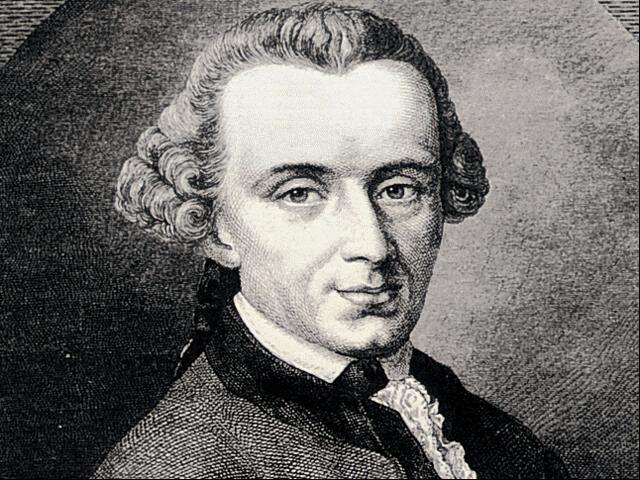
The poet John Enright has a post entitled “Kant and Abstract Art,” in which he takes up the claim Rand made in The Romantic Manifesto that “the father of modern art is Immanuel Kant (see his Critique of Judgment).” Rand does not elaborate, and Enright notes that some people scoff at the claim.
Rand’s claim is a strong one, in part because it makes intellectual-causal connection across centuries. How does one establish a fatherly connection between an uptight eighteenth-century philosopher and a sprawling twentieth-century movement? And in part Rand’s claim is hard to wrap one’s mind around because Kant’s philosophy is known to be turgid, arid, and highly rationalistic while modern art is known to be wild, weird, and wacky. How on earth could the Prussian lead to Pollock?
Is Rand right, and if so what is the connection?
I’ve been working on and off toward an essay on the topic of Kant’s influence on modern and postmodern art. Huge topic, so let me here give only some preliminary scholarly props to Enright’s post in the form of a few quotations from recent thinkers.
What have scholars after Rand said about the connection between Kant and modern art?
In a scholarly collection of essays on Kant’s philosophy, Eva Shaper writes that Kant is “the father of modern aesthetics” (“Taste, Sublimity, and Genius: the Aesthetics of Nature and Art,” in Paul Guyer, ed.,The Cambridge Companion to Kant, Cambridge University Press, 1992, p. 368).
Harold Osborne, longtime editor of the scholarly British Journal of Aesthetics, writes of “Kant, who is rightly regarded as the founder of modern aesthetics” (Aesthetics and Art Theory: An Historical Introduction, E. P. Dutton, 1970, p. 153). And further Osborne claims of Kant’s analysis: “This theory is the most important anticipation of the modern aesthetic outlook in any philosopher before the twentieth century” (p.191).
Without the first part of Critique of Judgment, writes philosopher Roger Scruton, “aesthetics would not exist in its modern form” (Kant, Oxford University Press, 1982, p. 79).
Philosopher Arthur Danto agrees with influential modernist art critic Clement Greenburg on the centrality of Kant’s work to the modernist project:
‘“The essence of Modernism,” [Clement Greenberg in “Modernist Painting” (1960)] wrote, “lies, as I see it, in the use of the characteristic methods of a discipline to criticize the discipline itself, not in order to subvert it but in order to entrench it more firmly in its area of competence.” Interestingly, Greenberg took as his model of modernist thought the philosopher Immanuel Kant: “Because he was the first to criticize the means itself of criticism, I conceive of Kant as the first real Modernist.” […] I suppose the corresponding view of painting would have been not to represent the appearances of things so much as answering the question of how painting was possible”’ (After the End of Art, Princeton University Press, 1998, p. 7).
Kant scholars Ted Cohen and Paul Guyer note that in the Critique of Judgment Kant “is entrenching the assumption of the subjective character of aesthetic judgment so strongly that by our own time it has become virtually an (unargued) commonplace” (Essays in Kant’s Aesthetics, University of Chicago Press, 1985, p. 11).
And more sweepingly, Professor Denis Dutton, philosopher and author of The Art Instinct, writes that Kant’s Critique of Judgment is “the greatest work of philosophical aesthetics ever written” (Dutton’s website).
Enright notes that scholar Roger Kimball makes a point of connecting Kant and modernist art in an essay on Schiller.
So from Kant’s Critique to Christo — an interesting fill-in-the-blanks intellectual-history project awaits.
Posted 1 year, 8 months ago at 10:29 am. Add a comment
Stephen Hicks discusses Immanuel Kant’s emphasis upon obedience and discipline as fundamental in education. This is from Part 7 of his Philosophy of Education course.
Zeev Sternhell is an ally in the battle against the nihilism of the Anti-Enlightenment and its heirs. His book is written for scholars, but note this ringing conclusion:
“To prevent the people of the twenty-first century from sinking into a new ice age of resignation, the Enlightenment vision of the individual as creative of his or her present and hence of his or her future is irreplaceable.”
The modern world’s great battle of Anti-Enlightenment-versus-Enlightenment was launched, in Sternhell’s reading, by Johann Herder’s attack on Immanuel Kant:
“Some ten years after [Herder's] Bückeburg pamphlet, the polemic with Kant began, which symbolically confirmed the great division between the two types of modernity: the one that stood for universal values, the greatness and autonomy of the individual, master of his fate, the one that conceived of society and the state as instruments in the hands of the individual who had set out in conquest of liberty and happiness, and the communitarian, historistic, nationalist modernity, a modernity in which the individual is determined by his ethnic origins, history, language, and culture” (p. 11).
Sternhell takes Rousseau and Kant to be Enlightenment figures, though he is very aware of their being “complex and ambiguous figures in the history of Western political thought.” (By contrast, I take Rousseau and Kant to be Counter-Enlightenment figures, though I agree very much with Sternhell that those are difficult judgment calls. And I laughed out loud at his quoting from Judith Shklar’s Men and Citizens on Rousseau as “the Homer of the losers.” Perfect.)
My thoughts on the Enlightenment, the Counter-Enlightenment and our resulting postmodern intellectual condition are here.
Posted 1 year, 9 months ago at 12:27 am. 1 comment
Immanuel Kant’s famous line from his Critique of Pure Reason is discussed as representative of the change of strategy among religion-friendly thinkers after the widely-perceived failure of natural theology. This is from Part 3 of Professor Hicks’s Philosophy of Education course.
We are now, however, talking about a very different Reason than the Enlightenment one. Hegel’s reason is fundamentally a creative function, not a cognitive one. It does not come to know a pre-existing reality; it brings all of reality into existence.
More notoriously, Hegel’s reason operates by dialectical and contradictory means, and not in accordance with the Aristotelian principle of non-contradiction.
Hegel’s dialectic is driven partly by the fact that by the early nineteenth century evolutionary ideas are in the air. In contrast to Kant’s belief that the subjective categories of reason are necessarily unchanging and universal, Hegel argued that the appropriate categories themselves are changeable. But Hegel’s dialectic is a special kind of evolution, one designed less to be responsive to discoveries in biology than to square with Judeo-Christian cosmology.
Judeo-Christian cosmology had traditionally been plagued by metaphysical assertions that were repugnant to reason. Respect for reason during the Enlightenment had led accordingly to a significant decline in religious belief among the intellectuals. Aristotelian reason cannot countenance a god that creates something out of nothing, that is both three and one, that is perfect but creates a world that contains evil. Accordingly, the thrust of Enlightenment theology had been to alter religion by eliminating its contradictory theses in order to make it compatible with reason. Hegel’s strategy was to accept that Judeo-Christian cosmology is rife with contradictions—but to alter reason in order to make it compatible with contradiction.
Here Hegel made another significant step beyond Kant and further away from the Enlightenment. Kant had come close to the truth, Hegel believed, in developing the antinomies of reason in the first Critique. Kant’s purpose there was to show that reason is out of its depth when it tries to figure out noumenal truths about reality. He did so by developing four pairs of parallel arguments on four metaphysical issues and by showing that in each case reason leads to contradictory conclusions. One can prove that the universe must have had a beginning in time, but one can equally soundly prove that the universe must be eternal. One can prove the world must be made up of simplest parts and also that it cannot be, that we have free will and that strict determinism is true, that God must exist and that He does not exist.[24] These contradictions of reason show, Kant concluded, that reason can never know reality, and that therefore our reason is limited to structuring and manipulating its subjective creations.
Hegel thought that Kant had missed a deep point here. The antinomies are not a problem for reason, contrary to Kant but rather the key to the whole universe. The antinomies of reason are a problem only if one thinks that logical contradictions are a problem. That was Kant’s mistake—he was too trapped in the old Aristotelian logic of non-contradiction. What Kant’s antinomies show is not that reason is limited but rather that we need a new and better kind of reason, one that embraces contradictions and sees the whole of reality as evolving out of contradictory forces.
Such a conception of contradictory evolution is compatible with Judeo-Christian cosmology. That cosmology begins with a creation ex nihilo, posits a perfect being that generates evil, believes in a just being that gives humans independent judgment but punishes them for using it, includes accounts of virgin births and other miracles, says that the infinite becomes finite, the immaterial becomes material, the essentially unitary becomes plural, and so on. Given the primacy of that metaphysics, reason must give way. Reason, for example, must be adapted to the demands of this metaphysics of creation:
“As yet, there is nothing and there is to become something. The beginning is not pure nothing, but a nothing from which something is to proceed; therefore being, too, is already contained in the beginning. The beginning, therefore, contains both, being and nothing, is the unity of being and nothing; or is non-being which is at the same time being, and being which is at the same time non-being.”[25]
While that account of creation is incoherent from the perspective of Aristotelian reason, such a poetically grand-sounding drama of evolution by contradiction is perfectly rational —if one grants that reason contains within itself contradiction, that analysis consists in seeking the implicit contradiction within anything and teasing it out in order to put the contradictory elements explicitly in tension with each other, thus leading to a resolution that both goes beyond the contradiction to another evolutionary stage while at the same time preserving the original contradiction. Whatever that means.
Hegel thus explicitly rejected Aristotle’s law of non-contradiction: Absolutely everything depends on “the identity of identity and non-identity,” Hegel wrote in The Science of Logic.[26]
Hegelian dialectical reason also differs from Enlightenment reason by implying a strong relativism, against the universality of Enlightenment reason. For all of Hegel’s talk of the ultimate Universal perspective of the Absolute, from any other perspective nothing holds for long: dialectic injects contradiction into reality at any given time as well as across eras. If everything is evolving by the clash of contradictions, then what is metaphysically and epistemologically true in one epoch will be contradicted by what is true in the next, and so on.
Finally, Hegel’s reason differs from Enlightenment reason by not only being creative of reality and in embracing contradiction, but also by being a fundamentally collective function rather than an individual one. Here again, Hegel went beyond Kant in rejecting the Enlightenment. While Kant preserved some elements of individual autonomy, Hegel rejected those elements. Just as the Judeo-Christian cosmology sees everything as God working out His plan for the world in, around, and through us, for Hegel individuals’ minds and whole being are a function of the deeper forces of the universe operating upon them and through them. Individuals are constructed by their surrounding cultures, cultures that have an evolutionary life of their own, those cultures themselves being a function of yet still deeper cosmic forces. The individual is a tiny emergent aspect of the largest whole, the collective Subject’s working itself out, and the creation of reality occurs at that level with little or no regard for the individual. The individual is merely along for the ride. Speaking in Philosophy of History of collective reason’s operations, Hegel stated that as “Universal Reason does realize itself, we have indeed nothing to do with the individual empirically regarded”; “This Good, this Reason, in its most concrete form, is God. God governs the world; the actual working of his government—the carrying out of his plan—is the History of the World.”[27]
[This is an excerpt from Stephen Hicks's Explaining Postmodernism: Skepticism and Socialism from Rousseau to Foucault (Scholargy Publishing, 2004, 2011). The full book is available in hardcover or e-book at Amazon.com. See also the Explaining Postmodernism page.]
Beethoven, according to biographer Maynard Solomon’s Beethoven:
“Wegeler tells us that when a series of lectures on Kant was organized in Vienna in the 1790s, ‘Beethoven didn’t want to attend even once, even under my urging.’ Rather, Beethoven preferred self-education through voracious reading in popularizations of the works of the major thinkers; through rich encounters with poetry, drama, and opera; and, most happily, through discourse and conversation with good minds in pleasant surroundings—whether in the salon or the tavern, the palace or the coffeehouse.” (pp. 36-37)
And: “In 1809 [Beethoven] wrote to the Leipzig music publisher Breitkopf & Hä̈rtel: ‘There is hardly any treatise which could be too learned for me. I have not the slightest pretension to what is properly called erudition. Yet from my childhood I have striven to understand what the better and wiser people of every age were driving at in their works.’” (p. 37)
That intense engagement with the great works of the great minds reminds me of Michelangelo’s early and ongoing education.
When Michelangelo was a teen, according to biographer William Wallace, he was exposed to the best of the Florentine intellectual ferment:
“To begin with, the young boy was taken into the famiglia by Lorenzo the Magnificent, who treated him like a son. He spent two of the happiest years of his life in the Medici Palace, surrounded by the members of Lorenzo’s humanist circle and alongside his future patrons, Giovanni and Giulio de’ Medici (respectively popes Leo X and Clement VII).” (The Genius of the Sculptor in Michelangelo’s Work, p. 152)
“Michelangelo venerated Dante throughout his life, and addressed two of his own poems to him. When he stayed in Bologna for about a year after the fall of the Medici in 1494, he is said to have read every evening to his patron Giovan Francesco Aldovrandi passages from Dante, Petrarch and Boccaccio – only stopping when his employer fell asleep.” (p. 21)
Sometimes called the “German Rousseau,”[57] Johann Herder had studied philosophy and theology at Königsberg University. Kant was his professor of philosophy; and while at Königsberg Herder also became a disciple of Johann Hamann.
Herder is Kantian in his disdain for the intellect, though unlike the static and rigid Kant he adds a Hamannian activist and emotionalist component “I am not here to think,” Herder wrote, “but to be, feel, live!”[58]
Herder’s distinctiveness lies not in his epistemology but in his analysis of history and the destiny of humankind. What meaning, he asks, can we discern in history? Is there a plan or is it merely a random happening of chance events?
There is a plan.[59] History, Herder argues, is moved by a necessary dynamic development that pushes man progressively toward victory over nature. This necessary development culminates in the achievements of science, arts, and freedom. So far Herder is not original. Christianity held that God’s plan for the world gives a necessary dynamic to the development of history, that history is going somewhere. And the Enlightenment thinkers projected the victory of civilization over the brutish forces of nature.
But the Enlightenment thinkers had posited a universal human nature, and they had held that human reason could develop equally in all cultures. From this they inferred that all cultures eventually could achieve the same degree of progress, and that when that happened humans would eliminate all of the irrational superstitions and prejudices that had driven them apart, and that mankind would then achieve a cosmopolitan and peaceful liberal social order.[60]
Not so, says Herder. Instead, each Volk is a unique “family writ large.”[61] Each possesses a distinctive culture and is itself an organic community stretching backward and forward in time. Each has its own genius, its own special traits. And, necessarily, these cultures are opposed to each other. As each fulfills its own destiny, its unique developmental path will conflict with other cultures’ developmental paths.
Is this conflict wrong or bad? No. According to Herder, one cannot make such judgments. Judgments of good and bad are defined culturally and internally, in terms of each culture’s own goals and aspirations. Each culture’s standards originate and develop from its particular needs and circumstances, not from a universal set of principles; so, Herder concluded, “let us have no more generalizations about improvement.”[62] Herder thus insisted “on a strictly relativist interpretation of progress and human perfectibility.”[63] Accordingly, each culture can be judged only by its own standards. One cannot judge one culture from the perspective of another; one can only sympathetically immerse oneself in the other’s cultural manifestations and judge them on their own terms.
However, according to Herder, attempting to understand other cultures is not really a good idea. And attempting to incorporate other cultures’ elements into one’s own leads to the decay of one’s own culture: “The moment men start dwelling in wishful dreams of foreign lands from whence they seek hope and salvation they reveal the first symptoms of disease, of flatulence, of unhealthy opulence, of approaching death!”[64] To be vigorous, creative, and alive, Herder argued, one must avoid mixing one’s own culture with those of others, and instead steep oneself in one’s own culture and absorb it into oneself.
For the Germans, accordingly, given their cultural traditions, attempting to graft Enlightenment branches onto German stock has been and would always be a disaster. “Voltaire’s philosophy has spread, but mainly to the detriment of the world.”[65] The German is not suited for sophistication, liberalism, science, and so on, and so the German should stick to his local traditions, language, and sentiments. For the German, low culture is better than high culture; being unspoiled by books and learning is best. Scientific knowledge is artificial; instead Germans should be natural and rooted in the soil. For the German, the parable of the tree of knowledge in the Garden of Eden is true: Don’t eat of that tree! Live! Don’t think! Don’t analyze!
Herder did not argue that the German way is the best and that it is justifiable for the Germans to become imperialistic and impose their culture upon others—that step was taken by his followers. He argued simply as a German in favor of the German people and urged them to go their own way, as opposed to following the Enlightenment.
Herder is relevant because of his enormous influence on the nationalist movements that were shortly to take off all over central and eastern Europe. He is also relevant to understanding how far from Enlightenment thinking the German Counter-Enlightenment was. If Kant is partially attracted to Enlightenment themes, Herder rejects those elements of Kant’s philosophy. While Herder is broadly Kantian epistemologically, he rejects Kant’s universalism: for Herder, how reason shapes and structures is culturally relative. And in contrast to Kant’s vision of an ultimately peaceful, cosmopolitan future, Herder projects a future of multicultural conflict. Thus, in the context of the German intellectual debate, one was offered a choice—Kant at the semi-Enlightenment end of the spectrum and Herder at the other.
[This is an excerpt from Stephen Hicks's Explaining Postmodernism: Skepticism and Socialism from Rousseau to Foucault (Scholargy Publishing, 2004, 2011). The full book is available in hardcover or e-book at Amazon.com. See also the Explaining Postmodernism page.]
Of the major figures in German philosophy in the modern era, Kant is perhaps the one most influenced by Enlightenment social thought.
There is a clear intellectual connection between Rousseau and Kant. Biographers often repeat Heinrich Heine’s anecdote about how Kant always took his afternoon walk at a set time, a time so regular that neighbors could set their clocks by his appearance—except on one occasion he was late for his walk because he had been so caught up in reading Rousseau’s Emile that he lost track of time. Kant had been raised as a Pietist, a version of Lutheranism that emphasized simplicity and eschewed external decoration. Kant therefore had no pictures or paintings hanging anywhere on the walls of his house—with one exception: over his desk in his study hung a picture of Rousseau.[37] Wrote Kant, “I learned to honor mankind from reading Rousseau.”[38]
Neo-Enlightenment thinkers attack Kant for two things: his skeptical and subjectivist epistemology and his ethic of selfless duty. Kant’s account of reason divorces it from cognitive contact with reality, thus destroying knowledge; and his account of ethics divorces morality from happiness, thus destroying the purpose of life. As discussed in Chapter Two, Kant’s powerful arguments were a mighty blow to the Enlightenment.
Politically, however, Kant is sometimes considered to be a liberal, and in the context of eighteenth-century Prussia there is some truth to that. In the context of Enlightenment liberalism, however, Kant diverged from liberalism in two major respects: his collectivism and his advocacy of war as a means to collectivist ends.
In a 1784 essay, “Idea for a Universal History With Cosmopolitan Intent,” Kant asserted that there is a necessary destiny for the human species. Nature has a plan. It is, however, “a hidden plan of nature,”[39] and as such it is one that requires special discernment by philosophers. That destiny is the full development of all of man’s natural capacities, especially man’s reason.[40]
By “man” here, Kant did not mean the individual. Nature’s goal is a collectivist one: the development of the species. Man’s capacities, Kant explained, are “to be completely developed only in the species, not in the individual.”[41] The individual is merely fodder for nature’s goal, as Kant put it in his “Review of Herder”: “nature allows us to see nothing else than that it abandons individuals to complete destruction and only maintains the type.”[4] And again, in his 1786 “Speculative Beginning of Human History,” Kant argued that the “path that for the species leads to progress from the worse to the better does not do so for the individual.”[43] The development of the individual is in conflict with the development of the species, and only the development of the species counts.
But it is also not the case that the species’ development is about happiness or fulfillment. “Nature is utterly unconcerned that man live well.”[44] The individual and even all existing individuals collectively now living are merely a stage in a process, and their suffering is of no account in the light of nature’s ultimate end. In fact, Kant argued, man should suffer, and deservedly so. Man is a sinful creature, a creature that is inclined to follow its own desires and not the demands of duty. Echoing Rousseau, Kant blamed mankind for having chosen to use reason when our instincts could have served us perfectly well.[45] And now that reason has awakened it has combined with self-interest to pursue all sorts of unnecessary and depraved desires. Thus the source of our vaunted freedom, Kant wrote, is also our original sin: “the history of freedom begins with badness, for it is man’s work.”[46]
Accordingly, Kant admonished us, “we are a long way from being able to regard ourselves as moral.”[47] Man is a creature made of “warped wood.”[48] Powerful forces are therefore needed in order to attempt to straighten our warped natures.
One of those forces is morality, a morality of strict and uncompromising duty that opposes man’s animal inclinations. A moral life is one that no rational person would “wish that it should be longer than it actually is,”[49] but one has a duty to live and develop oneself[50] and thereby the species. Inculcating this morality in man is one of nature’s forces.
Another force to straighten the warped wood is political. Man is “an animal that, if he lives among other members of his species, has need of a master.” And that is because “his selfish animal propensities induce him to except himself from [moral rules] wherever he can.” Kant then introduced his version of Rousseau’s general will. Politically, man “thus requires a master who will break his self-will and force him to obey a universally valid will.”[51]
However, strict duty and political masters are not enough. Nature has devised an additional strategy for bringing the species man to higher development. That strategy is war. As Kant wrote in his “Idea for a Universal History”: “The means that nature uses to bring about the development of all of man’s capacities is the antagonism among them in society.”[52] Thus, conflict, antagonism, and war are good. They destroy many lives, but they are nature’s way of bringing forth the higher development of man’s capacities. “At the stage of culture at which the human race still stands,” Kant stated bluntly in “Speculative Beginning,” “war is an indispensable means for bringing it to a still higher stage.”[53] Peace would be a moral disaster, so we are duty-bound not to shrink from war.[54]
Out of this self-sacrifice of individuals and the war of nations, Kant hoped, the species would become fully developed, and an international and cosmopolitan federation of states would live peacefully and harmoniously, making possible within themselves the complete moral development of their members.[55] Then, as Kant concluded in a 1794 essay entitled “The End of All Things,” men would finally be in a position to prepare themselves for the day of “judgment of forgiveness or damnation by the judge of the world.”[56] This is the hidden plan of nature; it is destined to happen; so we know what we have to look forward to.
References
[37] Höffe 1994, 17.
[38] Quoted in Beiser 1992, 43.
[39] Kant 1784/1983, 27/36.
[40] Kant 1784/1983, 18/30 and 27/36.
[41] Kant 1784/1983, 18/30.
[42] Kant 1785/1963, 53/37.
[43] Kant 1786/1983, 115/53.
[44] Kant 1784/1983, 20/31.
[45] Kant 1786/1983, 111/50.
[46] Kant 1786/1983, 115/54.
[47] Kant 1784/1983, 26/36.
[48] Kant 1784/1983, 23/33.
[49] Kant 1786/1983, 122/58.
[50] Kant 1785/1964, 398/65.
[51] Kant 1784/1983, 23/33, italics in original.
[52] Kant 1784/1983, 20/31.
[53] Kant 1786/1983, 121/58; see also 1795/1983, 363/121.
[54] Kant notes a fundamental opposition between human desire and nature’s goals: “Man wills concord; but nature better knows what is good for the species: she wills discord” (1784/1983, 21/ 32).
[This is an excerpt from Stephen Hicks's Explaining Postmodernism: Skepticism and Socialism from Rousseau to Foucault (Scholargy Publishing, 2004, 2011). The full book is available in hardcover or e-book at Amazon.com. See also the Explaining Postmodernism page.]