Stephen Hicks, Ph.D.

Philosopher

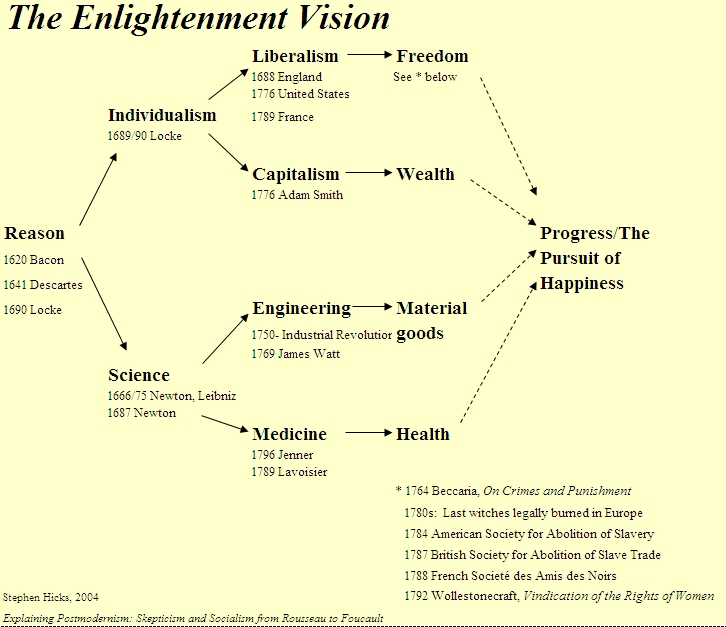
The Enlightenment Vision — updated flowchart

The Enlightenment of the long 18th century was an era of awesome intellectual and cultural transformation.

hickss-enlightenment-vision-flowchart-full

This Enlightenment Vision flowchart is pitched at a high level of abstraction, showing schematically how the philosophical revolution of the 17th century led to the 18th-century revolutions in science, technology, politics, and economics — which in turn led to the dramatic increases in health, wealth, freedom, and goods in the 19th century.

To put it another way, the chronology shows how the ideas played out as philosophy, then as an intellectual movement, then as activism, then as the working technology of culture.

I first develop the chart for my courses in philosophy and intellectual history and published a version of it in Explaining Postmodernism. It’s posted here as a PDF, as a JPEG image, or as an Excel file, in case you’d like to adapt it for your own purposes.

(Thanks to Brian Schwartz for prompting this update.)

Posted 3 months, 3 weeks ago at 8:42 pm.

4 comments

What Peter the Great saw

peter-the-great-104x100I’m browsing Robert K. Massie’s excellent Peter the Great, a book that won the Pulitzer Prize in 1981, and came again across this quotation that struck me on my first reading years ago. The context is Peter’s trip to western Europe—an unheard of thing for Russian czars to do.

His objective was the Europe that had produced Bacon, Descartes, Leibniz, Milton, Rembrandt, Molière, Leeuwenhoek, Newton, and many other immortals. Russia, by contrast, seemed a backwater of feudalism and medieval stagnation.

So in 1697 the twenty-five year old Peter set off, traveling semi-incognito and declaring “I am a pupil and need to be taught.”

Here is Massie’s description of what Peter the Great saw:

europe_1700-128x100“What he saw in the thriving cities and harbors of the West, what he learned from the scientists, inventors, merchants, tradesmen, engineers, printers, soldiers and sailors, confirmed his early belief, formed in the German Suburb, that his Russians were technologically backward—decades, perhaps centuries, behind the West. Asking himself how this had happened and what could be done about it, Peter came to understand that the roots of Western technological achievement lay in the freeing of men’s minds. He grasped that it had been the Renaissance and the Reformation, neither of which had ever come to Russia, which had broken the bonds of the medieval church and created an environment where independent philosophical and scientific enquiry as well as wide-ranging commercial enterprise could flourish. He knew that these bonds of religious orthodoxy still existed in Russia, reinforced by peasant folkways and traditions which had endured for centuries. Grimly, Peter resolved to break these bonds on his return” (p. 232).

Posted 2 years, 3 months ago at 9:56 pm.

Add a comment

The Enlightenment Vision — Flowchart

The Enlightenment of the long 18th century was an era of awesome intellectual and cultural transformation.

hicks-enlightenment-vision-flow-chart-180x100My Enlightenment Vision flowchart [pdf] is pitched at a high level of abstraction, showing schematically how the philosophical revolution of the 17th century led to the 18th-century revolutions in science, technology, politics, and economics — which in turn led to the dramatic increase in health, wealth, freedom, and goods in the 19th century.

To put it another way, the chronology shows how the ideas played out as philosophy, then as an intellectual movement, then as activism, then as the working technology of culture.

I use the chart in my classes and published a version of it in my 2004 Explaining Postmodernism. It’s here as a PDF and as an Excel file, in case you’d like to adapt it for your own purposes.

[This is an excerpt from Stephen Hicks's Explaining Postmodernism: Skepticism and Socialism from Rousseau to Foucault (Scholargy Publishing, 2004, 2011). The full book is available in hardcover or e-book at Amazon.com. See also the Explaining Postmodernism page.]

Posted 2 years, 4 months ago at 6:28 pm.

Add a comment