Stephen Hicks, Ph.D.

Philosopher

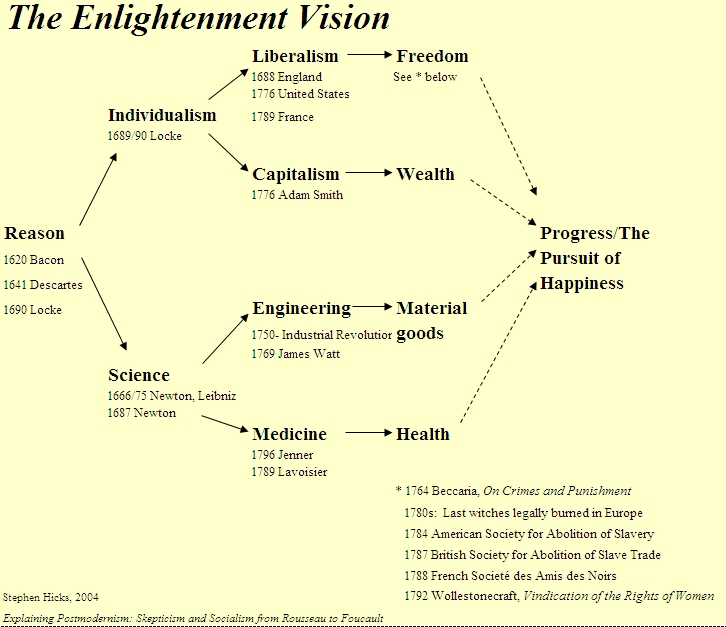
The Enlightenment Vision — updated flowchart

The Enlightenment of the long 18th century was an era of awesome intellectual and cultural transformation.

hickss-enlightenment-vision-flowchart-full

This Enlightenment Vision flowchart is pitched at a high level of abstraction, showing schematically how the philosophical revolution of the 17th century led to the 18th-century revolutions in science, technology, politics, and economics — which in turn led to the dramatic increases in health, wealth, freedom, and goods in the 19th century.

To put it another way, the chronology shows how the ideas played out as philosophy, then as an intellectual movement, then as activism, then as the working technology of culture.

I first develop the chart for my courses in philosophy and intellectual history and published a version of it in Explaining Postmodernism. It’s posted here as a PDF, as a JPEG image, or as an Excel file, in case you’d like to adapt it for your own purposes.

(Thanks to Brian Schwartz for prompting this update.)

Posted 1 year, 7 months ago at 8:42 pm.

4 comments

The French Revolution and the ending of slavery

When did slavery end?

Intellectual historian Zeev Sternhell makes the following observation:

french-revolution-163x100“But it is above all the French Revolution that is overlooked. Slavery was in fact abolished by the French Revolution. The slaves, like the Jews, were liberated, and for the first time in history, all men living within the frontiers of a single country, France, were subject to the same laws and became free citizens with equal rights.”

That’s from page 46 of Sternhell’s The Anti-Enlightenment Tradition (Yale University Press, 2010).

The “first time in history” is striking. Anti-slavery societies had been founded during the Enlightenment in the United States, Great Britain, and France.

But, despite its many sins, the French Revolution should get major credit for being the first to eliminate this ugly, ugly practice.

Posted 3 years ago at 7:16 am.

Add a comment

1789’s importance

While the world watched France’s revolution, an equally important cultural phenomenon was occurring across the Rhine:

kant-silhouette-75x134“In the year 1789 … nothing else was talked of in Germany but the philosophy of Kant, about which were poured forth in abundance commentaries, chrestomathies, interpretations, estimates, apologies, and so forth.” That’s Heinrich Heine, who also wrote, “Our German philosophy is really but the dream of the French Revolution … Kant is our Robespierre.”

More soberly, German historian Friedrich Meinecke connected the philosophical “dream” to politics this way: “In the 1780s the critique of pure reason had conquered all minds, but in the following decade Kant’s thoughts on practical reason became the catalyst for a genuine social movement” (The Age of German Liberation, 25).

we-the-people-150x100Meanwhile, across the Atlantic, a very different kind of intellectual and political revolution had come to fruition in the 1780s.

Kant/Robespierre or Locke/Washington. It’s still our choice.

Posted 3 years, 2 months ago at 7:13 pm.

Add a comment

Hegel on worshipping the state

[This excerpt is from Chapter 4 of Explaining Postmodernism: Skepticism and Socialism from Rousseau to Foucault]

Hegel on worshipping the state

While a student at Tübingen, Hegel’s favorite reading had been Rousseau. “The principle of freedom dawned on the world in Rousseau, and gave infinite strength to man.”[88] As discussed in Chapter Two, Hegel was also engaged deeply with the latest developments of Kantian and Fichtean metaphysics and epistemology and their implications for social and political thought.

The political battle lines were clearly drawn for Hegel: If Rousseau’s account of human freedom is the correct one, then the Enlightenment account of freedom must be a fraud. Disappointed by the outcome of the Revolution in France, where it seemed like the Rousseauians had had their world-historical chance, Hegel also had nothing but disdain for England, then arguably the most developed nation of the Enlightenment: “of institutions characterized by real freedom there are nowhere fewer than in England.” The so-called liberalism of the so-called Enlightenment nations actually represented an “incredible deficiency” of rights and freedom. Only by updating the Rousseauian model dialectically and applying it to the German context could we find “real freedom.”[89]

So what is real freedom to Hegel?

hegel-50x60“It must further be understood that all the worth which the human being possesses—all spiritual reality, he possesses only through the State.”[90]

In the broader context of Hegel’s philosophy, human history is governed by the necessary working out of the Absolute. The Absolute—or God, or Universal Reason, or the Divine Idea—is the actual substance of the universe, and its developmental processes are everything that is. “God governs the world; the actual working of his government—the carrying out of his plan—is the History of the World.”[91]

The State, to the extent that it participates in the Absolute, is God’s instrument for achieving his purposes. “The State,” accordingly, “is the Divine Idea as it exists on Earth.”[92]

Given that the individual’s ultimate purpose in life should be to achieve union with ultimate reality, it follows that the “state in and by itself is the ethical whole, the actualization of freedom.”[93] The consequence of this, morally, is that the individual is of less significance than the state. The individual’s empirical, day-to-day interests are of a lower moral order than the state’s universal, world-historical interests. The state has as its final end the self-realization of the Absolute, and “this final end has supreme right against the individual, whose supreme duty is to be a member of the state.”[94] Duty, as we have learned from Kant and Fichte, always trumps personal interests and inclinations.

Yet mere membership as a matter of duty is not enough for Hegel, given the grandeur of the state’s divine historical purpose: “One must worship the state as a terrestrial divinity.”[95]

In such worship, Hegel believed, we finds our real freedom. For ultimately, we individuals are but aspects of the Absolute Spirit, and in so relating to it we are relating to ourselves. “For Law is the objectivity of Spirit; volition in its true form. Only that will which obeys law, is free; for it obeys itself—it is independent and so free.”[96] Freedom is thus the individual’s absolute submission to and worship of the state.

There is of course the problem of explaining all of this to the average individual. The average individual, in the course of living day-to-day life, often finds that the laws and other manifestations of the state do not seem like real freedom. In most cases, Hegel stated, that is because the average person is ignorant of what true freedom is,[97] and no amount of explaining the higher dialectic to that person will make the laws seem like less of an infringement upon freedom.

Yet it is also true, Hegel granted, that in many cases the individual’s freedoms and interests will genuinely be set aside, overridden, and even smashed. One reason for this is that the state’s general principles are universal and necessary, and so they cannot be expected to apply perfectly to the particular and contingent. As Hegel explained, “universal law is not designed for the units of the mass. These as such may, in fact, find their interests decidedly thrust into the background.”[98]

But the problem is not merely one of applying the universal to the particular. Individuals must recognize that, from the moral perspective, they are not ends in themselves; they are tools for the achievement of higher goals.

“But though we might tolerate the idea that individuals, their desires and the gratification of them, are thus sacrificed, and their happiness given up to the empire of chance, to which it belongs; and that as a general rule, individuals come under the category of means to an ulterior end.”[99]

And again, just in case we have missed Hegel’s point: “A single person, I need hardly say, is something subordinate, and as such he must dedicate himself to the ethical whole.” And again echoing Rousseau: “Hence, if the state claims life, the individual must surrender it.”[100]

Individual life is surrendered rather a lot when very special human beings come along to really shake things up and move God’s plan for the world forward. “World-historical individuals,” as Hegel called them, are those who, usually without knowing so themselves, are agents of the Absolute’s development. Such individuals are energetic and focused, and they are able to amass power and direct social forces in such a way as to achieve something of historical significance. Their achievements, however, exact a high human cost.

“A World-historical individual is not so unwise as to indulge a variety of wishes to divide his regards. He is devoted to the One Aim, regardless of all else. It is even possible that such men may treat other great, even sacred interests, inconsiderately; conduct which is indeed obnoxious to moral reprehension. But so mighty a form must trample down many an innocent flower—crush to pieces many an object in its path.”[101]

The innocent flowers should not object to their destruction. The World-historical individual is acting for the best interests of the whole. In that special individual the state is embodied, and the state is the future of the collective. Even while being destroyed, the innocent flower has worth only through—and so should glory in—his participation in that larger future.

Anticipating Nietzsche, Hegel argued that neither should the innocent flowers raise merely moral objections against the activities of the World-historical individuals. “For the History of the World occupies a higher ground than that on which morality has properly its position.” The needs of historical development are of higher standing than those of morality, and so “the conscience of individuals” should not be an obstacle to the achievement of historical destinies.[102] The trampling of morality is regrettable, but “looked at from this point, moral claims that are irrelevant, must not be brought into collision with world-historical deeds and their accomplishment.”[103]

References

[88] Hegel, in Rousseau 1755, xv.

[89] Hegel 1830-31, 454; see also 1821, §236.

[90] Hegel 1830-31, 39.

[91] Hegel 1830-31, 35-36.

[92] Hegel 1830-31, 39; also 1821, Add., 152, para. 258; p. 279.

[93] Hegel 1821, Add., 152, para. 258; p. 279.

[94] Hegel 1821, §258

[95] Hegel 1821, §272. Otto Braun, age 19, a volunteer who died in WW I, wrote in a letter to his parents: “My inmost yearning, my purest, though most secret flame, my deepest faith and my highest hope—they are still the same as ever, and they all bear one name: the State. One day to build the state like a temple, rising up pure and strong, resting in its own weight, severe and sublime, but also serene like the gods and with bright halls glistening in the dancing brilliance of the sun—this, at bottom, is the end and goal of my aspirations” (in H. Kuhn 1963, 313).

[96] Hegel 1830-31, 39.

[97] Hegel 1821, §301.

[98] Hegel 1830-31, 35.

[99] Hegel 1830-31, 33.

[100] Hegel 1821, Add., 45, para. 70; p. 241.

[101] Hegel 1830-31, 32.

[102] Hegel 1830-31, 66-67.

[103] Hegel 1830-31, 67.

Bibliography [pdf] [html]

[This is an excerpt from Stephen Hicks's Explaining Postmodernism: Skepticism and Socialism from Rousseau to Foucault (Scholargy Publishing, 2004, 2011). The full book is available in hardcover or e-book at Amazon.com. See also the Explaining Postmodernism page.]

Posted 3 years, 2 months ago at 7:40 am.

Add a comment

Rousseau and the French Revolution

[This excerpt is from Chapter 4 of Explaining Postmodernism: Skepticism and Socialism from Rousseau to Foucault]

Rousseau and the French Revolution

rousseau-ramsay-50x61Rousseau died in 1778 when France was at the height of its Enlightenment. At the time of his death, Rousseau’s writings were well known in France, though he had not exerted the influence that he would when France entered its revolution. It was Rousseau’s followers who prevailed in the French Revolution, especially in its destructive third phase.

The revolution had started with the nobility. Spotting the weakness of the French monarchy, the nobles had succeeded in 1789 in forcing a meeting of the Estates-General, an institution that they usually controlled. Some of the nobles had hoped to enhance the power of the nobility at the expense of the monarchy, and some had hoped to institute Enlightenment reforms.

The nobles, however, were unable to form a unified coalition, and they were no match for the vigor of the liberal and radical delegates. Control of events slipped out of the hands of the nobles, and the Revolution entered a second, more liberal phase. The second phase was dominated by broadly Lockean liberals, and it was they who produced the Declaration of the Rights of Man and the Citizen.

The liberals, however, were in their turn no match for the vigor of the most radical members of the Revolution. As the members of the Girondin and Jacobin parties assumed greater power, the Revolution entered its third phase.

marat-j-p-75x94The Jacobin leaders were explicitly disciples of Rousseau. Jean-Paul Marat, who took on a disheveled and unbathed appearance, explained that he did so in order “to live simply and according to the precepts of Rousseau.” Louis de Saint-Just, perhaps the most bloodthirsty of the Jacobins, made his devotion to Rousseau clear in speeches to the National Convention. And speaking for the most radical of the revolutionaries, Maximilien Robespierre expressed the prevailing adoring opinion of the great man: “Rousseau is the one man who, through the loftiness of his soul and the grandeur of his character, showed himself worthy of the role of teacher of mankind.”

Under the Jacobins, the Revolution became more radical and more violent. Now the spokesmen for the general will, and having at their disposal plenty of the “universal compulsory force” that Rousseau had dreamed about with which to combat recalcitrant private wills, the Jacobins found it expedient that many die. The guillotine was busy as the radicals ruthlessly killed nobles, priests, and just about anyone whose politics was suspect. “We must not only punish traitors,” urged Saint-Just, “but all people who are not enthusiastic.” The nation had plunged into a brutal civil war, and in an enormously symbolic act, Louis XVI and Marie Antoinette were executed in 1793. That only made things worse, and all of France declined into the Reign of Terror.

robespierre-78x75The Terror ended with the arrest and execution of Robespierre in 1794, but it was too late for France. Its energies were dissipated, the nation was exhausted, and a power vacuum emerged that Napoleon Bonaparte would fill.

The story of the Counter-Enlightenment then shifts to the German states. Among German intellectuals, there had been some early sympathy for the French Revolution. German intellectuals were not ignorant of the Enlightenment in England and France. Several were attracted by Enlightenment themes, and in the mid-1700s Frederick the Great had attracted to Berlin several Enlightenment-minded scientists and other intellectuals. Berlin for a while was a hotbed of French and English influences.

For the most part, however, the Enlightenment had made a few inroads among intellectuals in the German states. Politically and economically, Germany was a set of feudal states. Serfdom would not be abolished until the nineteenth century. The majority of the population was uneducated and agrarian. Most were deeply religious, dominantly Lutheran. Unthinking obedience to God and to one’s feudal lord had been ingrained for centuries. This was especially true in Prussia, whose people Gotthold Lessing called “the most servile in Europe.”

So among the Germans the reports of the Terror of the French Revolution caused horror: They killed their king and queen. They hunted down priests, cut off their heads, and paraded up and down the streets of Paris with the heads stuck on the ends of pikes.

Yet the lesson most German intellectuals took from the Revolution was not that Rousseauian philosophy was the culprit. To most, the culprit was clearly the Enlightenment philosophy. The Enlightenment was anti-feudal, they noted, and the Revolution was a practical demonstration of what that means—the wholesale slaughtering of one’s sovereign lords and ladies. The Enlightenment was anti-religion, they noted, and the Revolution is a practical demonstration of what that means—killing holy men and burning down churches.

But from the German perspective, the situation became worse, for out of the power vacuum in France arose Napoleon.

bonaparte-dabos-apsley-house-75x98Napoleon was also provided an opportunity by a weakened feudal Europe. Europe’s hundreds of small dynastic units were no match for Napoleon’s new military tactics and his sheer audacity. Napoleon ran roughshod over old feudal Europe, swept into the German states, defeated the Prussians in 1806, and proceeded to change everything.

From the perspective of the Germans, Napoleon was not only a foreign conqueror, he was a product of the Enlightenment. Where he conquered and ruled, he extended equality before the law, opened government offices to the middle class, and guaranteed private property. On matters of religion, he destroyed the ghettoes, gave Jews freedom of religion, and gave them the right to own land and practice all trades. He opened secular public schools, and modernized Europe’s transportation network.

Napoleon outraged many powerful forces in doing so. He abolished guilds. He angered the clergy by abolishing church courts, tithes, monasteries, convents, ecclesiastical states, and he seized much church property. He angered the nobles by abolishing feudal estates and feudal dues, by breaking up large estates, and generally by lessening the power of the nobles over the peasantry. He functioned, in effect from the Enlightenment perspective, as a benevolent dictator, as one who embraced many of the modern ideals but who used the full force of government to impose them.

His dictatorial impositions went further. He enacted censorship wherever he went, conscripted subjugated peoples to fight foreign battles, and taxed subjugated peoples to finance France.

So now most German intellectuals faced a serious crisis. The Enlightenment, as they saw it, was not merely a foreign disaster across the Rhine—it was a dictatorial presence ruling Germany in the person of Napoleon Bonaparte. How, wondered every German, did Napoleon win? What did the Germans do wrong? What was to be done?

kant_50x64The poet Johann Hölderlin, Hegel’s roommate in college, declared: “Kant is the Moses of our nation.” For the story of how the now-dead Kant was to lead Germany out of bondage, we return to Königsberg.
.

[This is an excerpt from Stephen Hicks's Explaining Postmodernism: Skepticism and Socialism from Rousseau to Foucault (Scholargy Publishing, 2004, 2011). The full book is available in hardcover or e-book at Amazon.com. See also the Explaining Postmodernism page.]

Posted 3 years, 4 months ago at 8:39 am.

4 comments

Rousseau’s collectivism and statism

[This excerpt is from Chapter 4 of Explaining Postmodernism: Skepticism and Socialism from Rousseau to Foucault. Previous post: Rousseau’s Counter-Enlightenment.]

Rousseau’s collectivism and statism

Once the corruption is totally swept away, the project of building a moral society can commence. Naturally, the good edifice to be raised must start from a good foundation. The primitive state of nature was good, but unfortunately we cannot return to it. Reason, once awakened, cannot be dulled entirely. But neither can we tolerate anything that would lead us back to contemporary advanced civilization. Fortunately, history provides us with good models, for looking back upon most tribal cultures we find that their societies, maintaining a middle position between the indolence of our primitive state and the petulant activity of our egocentrism, must have been the happiest and most durable epoch. The more one reflects on it, the more one finds that this state was the least subject to upheavals and the best for man.[19]

The best we can do, accordingly, is to try to recreate in modern form a society on that model.

The re-creation must begin from a proper understanding of human nature. Contrary to the claims of the Enlightenment philosophes, man is naturally a passional animal, not a rational one.[20] Man’s deepest passions should set the direction of his life, and reason should always give way before them.

Passions are an appropriate foundation for society, since one of the deepest desires is to believe in religion, and, Rousseau believes, religion is essential to social stability. That desire to believe can and must override all Enlightenment objections. “I believe therefore that the world is governed by a powerful and wise will. I see it or, rather, I sense it.”[21] Rousseau’s feeling that God exists, however, did not provide him with much detailed information about the nature of God. God “is hidden equally from my senses and from my understanding,” so his feeling gave him only the sense that a powerful, intelligent, and good being created the world. The arguments of the philosophers about God not only did not clarify matters, they made things worse: “The more I think about it,” Rousseau wrote, “the more I am confused.”[22] So he resolved to ignore the philosophers—“suffused with the sense of my inadequacy, I shall never reason about the nature of God”[23]—and to let his feelings guide his religious beliefs, holding that feelings are a more reliable guide than reason. “I took another guide, and I said to myself, ‘Let us consult the inner light; it will lead me astray less than they lead me astray.’“[24] Rousseau’s inner light revealed to him an unshakeable feeling that God’s existence is the basis for all explanations, and that feeling was to him immune to revision and counter-argument: “One may very well argue with me about this; but I sense it, and this sentiment that speaks to me is stronger than the reason combating it.”[25]

This feeling was not to be merely one of Rousseau’s personal whims. At the foundation of all civil societies, Rousseau argued, one finds a religious sanction for what its leaders do. The society’s founding leaders may not always genuinely believe in the religious sanctions they invoke, but their invoking them is nonetheless essential. If the people believe that their leaders are acting out the will of the gods, they will obey more freely and “bear with docility the yoke of the public good.”[26] Enlightenment reason, by contrast, leads to disbelief; disbelief leads to disobedience; and disobedience leads to anarchy. This is a further reason why, according to Rousseau, “the state of reflection is a state contrary to nature and the man who meditates is a depraved animal.”[27] Reason, accordingly, is destructive to society, and should be limited and replaced with natural passion.[28]

So important is religion to a society, wrote Rousseau in The Social Contract, that the state cannot be indifferent to religious matters. It cannot pursue a policy of toleration for disbelievers, or even view religion as a matter of individual conscience. It absolutely must, therefore, reject the Enlightenment’s dangerous notions of religious toleration and the separation of church and state. Further: so fundamentally important is religion that the ultimate penalty is appropriate for disbelievers:

rousseau-jj-50x60“While the state can compel no one to believe it can banish not for impiety, but as an antisocial being, incapable of truly loving the laws and justice, and of sacrificing, if needed, his life to his duty. If, after having publicly recognized these dogmas, a person acts as if he does not believe them, he should be put to death.”[29]

A society properly founded on natural passion and religion will override the self-centered individualism that reason leads to, making it possible for individuals to form a new, collectivized social organism. When individuals come together to form the new society, “the individual particularity of each contracting party is surrendered to a new moral and collective body which has its own self, life, body, and will.” The will of each individual is no longer that individual’s own, but becomes common or general, and under the direction of the spokesmen for the whole. In moral society, one “coalesces with all, [and] in this each of us puts in common his person and his whole power under the supreme direction of society’s leaders.”[30]

In the new society, the leadership expresses the “general will” and enacts policies that are best for the whole, thus enabling all individuals to achieve their true interests and their true freedom. The requirements of the “general will” absolutely override all other considerations, so a “citizen should render to the state all the services he can as soon as the sovereign demands them.”[31]

Yet there is something about human nature, corrupted as it is now by reason and individualism, that militates and always will militate against the general will. Individuals rarely see their individual wills as being in harmony with the general will; consequently “the private will acts constantly against the general will.”[32] And so to counteract these socially destructive individualistic tendencies, the state is justified in using compulsion: “whoever refuses to obey the general will will be forced to do so by the entire body; this means merely that he will be forced to be free.”[33] The power of the general will over the individual will is total. “The state … ought to have a universal compulsory force to move and arrange each part in the manner best suited to the whole.”[34] And if the leaders of the state say to the citizen, “‘it is expedient for the state that you should die,’ he should die.”[35]

We thus find in Rousseau an explicitly Counter-Enlightenment set of themes, attacking the Enlightenment’s themes of reason, the arts and sciences, and ethical and political individualism and liberalism. Rousseau was a contemporary of the American revolutionaries of the 1770s, and there is an instructive contrast between the Lockean themes of life, liberty, and pursuit of happiness in the Americans’ Declaration of Independence and Rousseau’s social contract oath for his projected constitution for Corsica: “I join myself—body, goods, will and all my powers—to the Corsican nation, granting to her the full ownership of me—myself and all that depends upon me.”[36]

Lockean Enlightenment politics and Rousseauian Counter-Enlightenment politics will lead to opposite practical applications.

References

[19] Rousseau 1755, 50.

[20] Rousseau 1755, 14.

[21] Rousseau 1762a, 276.

[22] Rousseau 1762a, 277.

[23] Rousseau 1762a, 277.

[24] Rousseau 1762a, 269.

[25] Rousseau 1762a, 280.

[26] Rousseau 1762b, 2:7.

[27] Rousseau 1755, 22.

[28] Rousseau extended the limiting of reason to limiting its tools of expression: “Considering the awful disorders printing has already caused in Europe, and judging the future by the progress that this evil makes day by day, one can easily predict that sovereigns will not delay in taking as many pains to banish this terrible art from their States as they once took to establish it” (1749, 61). And following the examples of Cato the Elder and Fabricius, Rousseau urged: “hasten to tear down these amphitheatres, break these marble statues, burn these paintings, chase out these slaves who subjugate you and whose fatal arts corrupt you” (1749, 46).

[29] Rousseau 1762b, 4:8.

[30] Rousseau 1762b, 1:6.

[31] Rousseau 1762b, 2:4.

[32] Rousseau 1762b, 3:10.

[33] Rousseau 1762b, 1:7.

[34] Rousseau 1762b, 2:4.

[35] Rousseau 1762b, 2:5.

[36] Rousseau 1765, 297, 350. See also 1762b, 1.9.

[This is an excerpt from Stephen Hicks's Explaining Postmodernism: Skepticism and Socialism from Rousseau to Foucault (Scholargy Publishing, 2004, 2011). The full book is available in hardcover or e-book at Amazon.com. See also the Explaining Postmodernism page.]

Posted 3 years, 4 months ago at 1:23 pm.

3 comments

The question of Nazism’s philosophical roots [Section 20 of Nietzsche and the Nazis]

[This is Section 20 of Nietzsche and the Nazis.]

20. The question of Nazism’s philosophical roots

We do not do ourselves any favors by not understanding Nazism thoroughly or by being satisfied with superficial explanations. It took a world war to stop National Socialism in the twentieth century. War is brute force. Brute force rarely changes anyone’s minds about anything, and it alone does not destroy the underlying causes that motivate conflict. To use a crude analogy: If two neighbors are having an ongoing argument about a series of issues, and one neighbor hits the other and knocks him unconscious—that ends the argument but it does not solve their problems. The source of their argument is still there and it will re-surface.

The same holds for the underlying causes of National Socialism and its differences with the liberal democracies. The liberal democracies were able to knock out the Nazis in World War II, though it was a close call—but the underlying arguments are still with us.

The differences between National Socialism and liberal democracies are profound and involve entirely different philosophies of life. National Socialism was the product of a well-thought-out philosophy of life, the main elements of which were originated, crafted, and argued by philosophers and other intellectuals across many generations.

The Nazi intellectuals were not lightweights, and we run the risk of underestimating our enemy if we dismiss their ideology as attractive only to a few cranky weirdos.[43] If your enemy has a machine gun but you believe he only has a pea shooter, then you are setting yourself up for failure. And if we remind ourselves of the list of very heavyweight intellectuals who supported Nazism—Nobel Prize winners, outstanding philosophers and brilliant legal thinkers—then it is clear that these were no pea-shooters and that we need heavyweight intellectual ammunition to defend ourselves.

karl_marx-100pxIn the case of other major historical revolutions, we are more familiar with seeing the significance of philosophy. When we think for example of the causes of the Communist Revolutions in Russia and China, we naturally think back to the philosopher Karl Marx. When we think of the causes of the French Revolution, we think back to Jean-Jacques Rousseau. When we think of the causes of the American Revolution, we naturally think back to the philosopher John Locke. The same holds the causes of National Socialism—although since the Nazi regime went so horribly wrong, there is perhaps some reluctance to name names. Yet naming names is sometimes crucial if we are going to get to the historical heart of the matter. What philosophers can we cite in the case of the Nazis? Several names are candidates: Georg Hegel, Johann Fichte, even elements from Karl Marx.

But in connection with the Nazis, perhaps the biggest and the most controversial name regularly mentioned is that of Friedrich Nietzsche. The Nazis often cited Nietzsche as one of their philosophical precursors, and even though Nietzsche died thirty-three years before the Nazis came to power, references to Nietzsche crop up regularly in Nazi writings and activities. In philosopher Heidegger’s lectures, for example, “Nietzsche was presented as the Nazi philosopher.”[44]

In his study, Adolf Hitler had a bust of Friedrich Nietzsche. In 1935, Hitler attended and participated in the funeral of Nietzsche’s sister Elisabeth. In 1938, the Nazis built a monument to Nietzsche. In 1943, Hitler gave a set of Nietzsche’s writings as a gift to fellow dictator Benito Mussolini.[45]

Hitler’s propaganda minister, Joseph Goebbels, was also a great admirer of Friedrich Nietzsche. In his semi-autobiographical novel, Goebbels has the title character Michael die in a mining accident—afterward three books are found among his belongings: the Bible, Goethe’s Faust, and Nietzsche’s Thus Spake Zarathustra.

So who was Friedrich Nietzsche?

References

[43] Recall Albert Speer on “the event that led me to [Hitler]”—a speech Hitler gave to the College of Engineering in Berlin: Speer expected it to be “a bombastic harangue” but it turned out to be a “reasoned lecture” (quoted in Orlow 1969, p. 199).

[44] Rohkrämer 2005, p. 181.

[45] During WWI, the German government printed 150,000 copies of Nietzsche’s Thus Spake Zarathustra and gave them to soldiers along with a copy of the Bible.

[Bibliography.]

[Return to the Nietzsche and the Nazis page. Go to the StephenHicks.org main page.]

Posted 3 years, 4 months ago at 3:34 pm.

Add a comment

Fascinated by history [Section 1 of Nietzsche and the Nazis]

[This is Section 1 of Nietzsche and the Nazis.]

vitruvian_man-100pxPart 1. Introduction: Philosophy and History

1. Fascinated by history

Think about why we are fascinated by history. All of those outstanding individuals and exotic peoples. The rise and fall of civilizations—and wondering why that happens. How did classical Greece achieve its Golden Age—the age of Socrates and Pericles, Euripides and Hippocrates? What explains the remarkable confluence of so many outstanding individuals in one era?

Why, almost two thousand years later, did the Italian Renaissance happen? Leonardo, Michelangelo, Machiavelli, Raphael—again an incredible outpouring of genius in the arts, sciences, and politics.

Jumping ahead three centuries: What made possible the Industrial Revolution and its awesome outpouring of productivity? The ancient Chinese and the ancient Romans made impressive technological advancements—but nothing on the scale of the Industrial Revolution. Why did the Industrial Revolution first take root initially in England and Scotland? Why not in Burma or Botswana?

Or what, by contrast, explains major historical declines? Why did the Roman Empire collapse? The most powerful civilization of the ancient world imploded and became defenseless before successive waves of barbarian invasion. And before the Romans, the powerful military empires of the Hittites, the Assyrians, and the Babylonians also collapsed. Is there a common pattern at work here?

Why did the French Revolution go so horribly wrong, descending in a reign of paranoia, fratricide, and terror? Why, by contrast, did the American Revolution, in many ways fighting the same kind of battle and subject to the same desperate pressures, not go the same self-destructive route? How, a century and a half later, could the most educated nation in Europe become a Nazi dictatorship?

All these questions raise issues of dramatic historical change, for better or worse. But we can also ask questions about long periods during which no dramatic changes took place. Consider the San people of the Kalahari area in Southern Africa, sometimes called Bushmen. Experts estimate that for 10,000 years the San have lived the same way for generation after generation. Let us put that in perspective. If a generation is twenty-five years or so, then 10,000 years means 400 generations of sameness. By contrast, it has been only about twenty generations since Columbus crossed the Atlantic—and consider how much has changed in Europe and the Americas since then.

Yet even the 10,000 years of the San people is dwarfed by the estimated 35,000 years that the Aborigines of Australia have existed in essentially the same way generation after generation. 35,000 years ago is approximately when Neanderthal Man was becoming extinct. Why did the cultures of the San and the Aborigines not change for such unimaginably long stretches of time?

[Return to the Nietzsche and the Nazis page. Go to the StephenHicks.org main page.]

Posted 3 years, 6 months ago at 4:55 pm.

1 comment