Stephen Hicks, Ph.D.

Philosopher

Three more anti-free-market arguments (UFM seminar)

In this third Socratic seminar on the Best Arguments against Free-market Capitalism, we take up three arguments:
nudgea) the paternalist argument that human beings are incapable of living freely,
b) the collectivist argument that wealth is a social creation (at 11 minutes), and
c) the religious argument that value is not of this world (at 32 minutes).

Related: My full series of UFM lectures, seminars, and interview:
I. Entrepreneurial Ethics.
II. Philosophy and the Evolution of the Mixed Economy.
III. Socratic seminars on the Best Arguments against Free-Market Capitalism:
1. “Capitalism is dog-eat-dog.”
2. “We live in a world of scarce resources.”
3. “Humans are too depraved for freedom” (at 23 minutes).
4. “Humans are too incompetent for freedom.”
5. “Wealth is a social creation” (at 11 minutes).
6. “Value is not of this world” (at 32 minutes).
IV. Interview: Business Ethics and Corporate Social Responsibility.
Post: “Elizabeth Warren and the doulos.”

Posted 1 month, 1 week ago at 9:16 am.

Add a comment

Elizabeth Warren and the doulos

Elizabeth Warren’s recent remarks offer a striking glimpse into a prominent strain of American political thought. Warren is a Harvard law professor and U.S. Senate candidate, and she has been a White House presidential assistant. An excerpt:

“There is nobody in this country who got rich on his own. Nobody.
warrenelizabeth“You built a factory out there? Good for you. But I want to be clear: you moved your goods to market on the roads the rest of us paid for; you hired workers the rest of us paid to educate; you were safe in your factory because of police forces and fire forces that the rest of us paid for. You didn’t have to worry that marauding bands would come and seize everything at your factory, and hire someone to protect against this, because of the work the rest of us did.
“Now look, you built a factory and it turned into something terrific, or a great idea? God bless. Keep a big hunk of it. But part of the underlying social contract is you take a hunk of that and pay forward for the next kid who comes along.”

What gives this argument rhetorical force is its appeal to a principle of economic justice: You should pay for the benefits you get from others. Don’t be a freeloader. Warren combines that principle with a list of benefits an imagined factory builder has received from others to get the implicit conclusion and policy recommendation: The factory builder has unpaid debts that justify increased taxation.

Five observations and questions:

1. On the seriousness of the economic justice claim: If we’re to conclude that the factory owner (let’s call her Jill) has unpaid debts, are we to (a) estimate how much benefit Jill the factory builder has received from others, (b) determine how much she has paid for those benefits (since presumably she paid her employees, truckers, and taxes), so that (c) we can determine whether she has paid too much, too little, or the right amount? Are we to make that serious accounting effort, or is this argument meant to generate an unspecified debt claim and a blank check for politicians and the IRS to fill in as they judge best?

2. On the transfer of debt: Warren points out that, for example, many of the factory’s employees were educated in government schools. The government has taxed its citizens and used that money to educate, say, Jack. Interestingly, Warren does not say that Jack now has a debt to society that he should pay. Instead, the debt seems to shift to Jill when she hires Jack. How does that work?

3. On disingenuous application: Warren targets her argument only against the prosperous. Yet middle and low income people also receive the same benefits as the factory builder—they use the roads, enjoy police and fire protection, use the services of those educated in public schools, and so on. Why is Warren not also hectoring middle and low income people for apparently violating the social contract?

4. On the compatibility of the economic justice principle with the rest of Warren’s political philosophy: Warren here suggests strongly that Jill the factory builder has freeloaded on unpaid benefits from the rest of society and that justice requires that she pay for what she received from others. Does Warren therefore favor abolishing the welfare state? I rather doubt it. So we end up in an odd position: Those who live on or profit from government welfare get a pass in Warren’s system, while those who build factories are considered freeloaders.

5. On the doulos and a historical echo: In Plato’s Crito (50d), Socrates argues that he has no right to escape from prison, even if he is innocent. Socrates imagines himself in conversation with the Laws of the State and has the Laws say to him, ‘”In the first place did we not bring you into existence? Your father married your mother by our aid and begat you. Say whether you have any objection to urge against those of us who regulate marriage?” None, I [Socrates] should reply. “Or against those of us who regulate the system of nurture and education of children in which you were trained? Were not the laws, who have the charge of this, right in commanding your father to train you in music and gymnastic?” Right, I should reply.’

Socrates has agreed that the State made possible his existence and upbringing. Consequently, he is in debt to the State, as the Laws go on to conclude forcefully:

“Well, then, since you were brought into the world and nurtured and educated by us, can you deny in the first place that you are our child and slave, as your fathers were before you?”

Doulos: In ancient Greece, a slave (δοῦλος).” In the above translation of Plato’s text, doulos is translated as either child or slave. Thus we have an argument for paternalism and slavery: Socrates, his ancestors, and presumably his descendants, are creatures and chattels of the State.

Is Warren’s position that different?

Perhaps hers is not meant as a serious argument, though, and only as red meat thrown to the “Tax the rich!” political base. But what if Warren is serious?

Posted 4 months, 1 week ago at 7:11 am.

16 comments

The most dangerous philosophy book (Fall 2010 edition)

For my Introduction to Philosophy course, an optional question on the final exam was:

In your judgment, what is the most dangerous book we read this semester? First give a clear and sympathetic presentation of the book’s most important themes, and then explain why you think the book is dangerous.

We read six major works in the course: Plato’s Apology and Crito, Ayn Rand’s The Fountainhead, Galileo’s “Letter to the Grand Duchess Christina,” Descartes’ Meditations, C. S. Lewis’s Mere Christianity, and Sigmund Freud’s Civilization and Its Discontents.

Nineteen students chose to address this question.

galileoOne chose Galileo’s work as the most dangerous, on the grounds that Galileo’s resulting conflict with the Church was disastrous to him personally and shows how dangerous it can be to question authority.

socrates-50x80One student argued that Plato’s Apology was dangerous because Socrates was too uncompromising and that leads to social harm.

descartes-50x63Three students voted Descartes’ Meditations as most dangerous, two on the grounds that it can lead one to lose all sense of reality and become psychotic and one on the grounds that his reasoning seems circular and leads nowhere leaving one with nothing.

rand_50x66Rand’s The Fountainhead was voted most dangerous by three students. As with the student who chose Socrates in Plato’s Apology, one argued that her view is too uncompromising and leads to social harm; additionally, it is too hard to apply and so sets one up for failure. One argued that her view of egoism challenges the whole tradition of religious ethics. And one argued that Peter Keating’s character materialistic and socially immoral character is too tempting a role model for most.

freudsigmund-50x68Four students voted for Freud’s Civilization and Its Discontents as the most dangerous book. One argued that he undermines free will and moral responsibility. Two took issue with his insulting view of religion and argued that he misses the hope that religion offers. And one argued that his strong pessimism about life itself is dangerously demotivating.

lewis-cs-50x69Six students chose Lewis’s Mere Christianity. One objected to his attack on reason and defense of strong faith. One objected to his attempt to destroy our human sense of worth and self-esteem. One argued that his extreme view of human sinfulness was dangerous. Two argued that Lewis got Christianity wrong in presenting too extreme a version of it. And one argued that the danger of Mere Christianity is that it scares reasonable people away from Christianity.

Finally, one student voted The Fountainhead and Mere Christianity as jointly the most dangerous for the reason that American readers resonate with both given their cultural history and that that leads to paralyzing conundrums about what the right philosophy is.

So with 6.5 votes in total, I hereby declare Mere Christianity to be the Most Dangerous Book in Introduction to Philosophy, Rockford College, Fall Semester 2010.

Related:
The most dangerous philosophy book (Fall 2009 edition).
The most dangerous philosophy book (Spring 2010 edition).

Posted 1 year, 1 month ago at 11:13 am.

2 comments

Reading group on Socrates’ trial and death

At Rockford College this semester, my two colleagues in Philosophy, Shawn Klein and Matt Flamm, will be leading a discussion group on Plato’s four dialogues about the trial and execution of Socrates. I will be participating in the reading group just for fun, though coincidentally my students and I will be covering Apology and Crito in my Introduction to Philosophy course.

From the flyer for the reading group:

socrates-reading-group-100pxIn 399 BCE, Athens executed Socrates for impiety and corrupting the youth. Plato immortalized the trial and death of Socrates in his dialogues: Euthyphro, Apology, Crito, and Phaedo. These are not merely historical dialogues, but philosophical treatises that examine the nature of piety, philosophy, justice, and death. The Reading Group will discuss each of these dialogues and the philosophical issues they raise.

Each meeting will take place at the Center for Ethics and Entrepreneurship office on the second floor of Burpee, from 1-2 pm. There will be light refreshments. A free copy of the book will be provided to participants.

Dates:
September 10: Overview and Introduction
September 17: Euthyphro
October 1: Apology
November 5: Crito
November 19: Phaedo

Related: Two posts of mine about Socrates are here:
Socrates’ two bad arguments for not escaping
Quotations from Apology and Crito on reason and character

Posted 1 year, 5 months ago at 6:35 am.

Add a comment

In class: midterm test

know-thyself-235x100The Midterm Test [pdf] for my Introduction to Philosophy course features questions on Apology, Crito, The Fountainhead, and Meditations.

Makes me want to be an undergraduate all over again.

Posted 2 years, 4 months ago at 4:08 pm.

Add a comment

Socrates’ two bad arguments for not escaping

socrates-lysippus-100x121In the Crito, Socrates is in prison awaiting execution for impiety and corrupting the youth. His impiety was judged to be a matter of questioning and possibly disbelieving the traditional gods, and his corrupting the youth was a matter of his teaching them to do the same.

Crito arrives at the prison having arranged an escape opportunity for Socrates, and they proceed to debate whether it would be just for Socrates to escape.

Socrates argues that while the verdict was wrong, it was nonetheless reached through legitimate procedures — the trial was conducted according to the established rules, he had a chance to make his case, and the voting was done by citizens.

Thus we have to choose whether content justice (getting the right result) or procedural justice (following the right procedures) is more important.

Socrates argues the latter (50b-c), while I argue the former: The most important goal in justice is achieving actual justice; secondarily we establish procedures that we think will achieve actual justice; when those procedures fail to do so, we should alter or override the procedures.

Socrates also points out that, additionally, we have to choose whether the social peace the laws enable is more important than the life of an innocent man (50c). Socrates argues the former, while I argue the latter: we form social groups for the advancement of the interests of the individuals involved, and when the social group makes a mistake it is the social that should take the hit, not the innocent individual. On this proto collective-versus-individual issue, Socrates is more collectivist while I’m individualist.

In support of his position, Socrates makes a strongly paternalistic claim at 50d-51d, arguing that since the laws enabled his father to marry his mother, the laws are as much his parents as they are. He also points out that the laws commanded his parents to educate him. Consequently, he is both the “offspring and slave” of the laws (50e) and owes them the same unconditional obedience that children owe their parents and slaves owe their masters (51b).

Also in support, Socrates makes an early social-contract style claim at 51d-52a, arguing that when he reached the age of majority, he chose voluntarily to stay and live in Athens and that he did so knowing how justice was administered there. He therefore made an at-least implicit contract with Athens to do what the laws say.

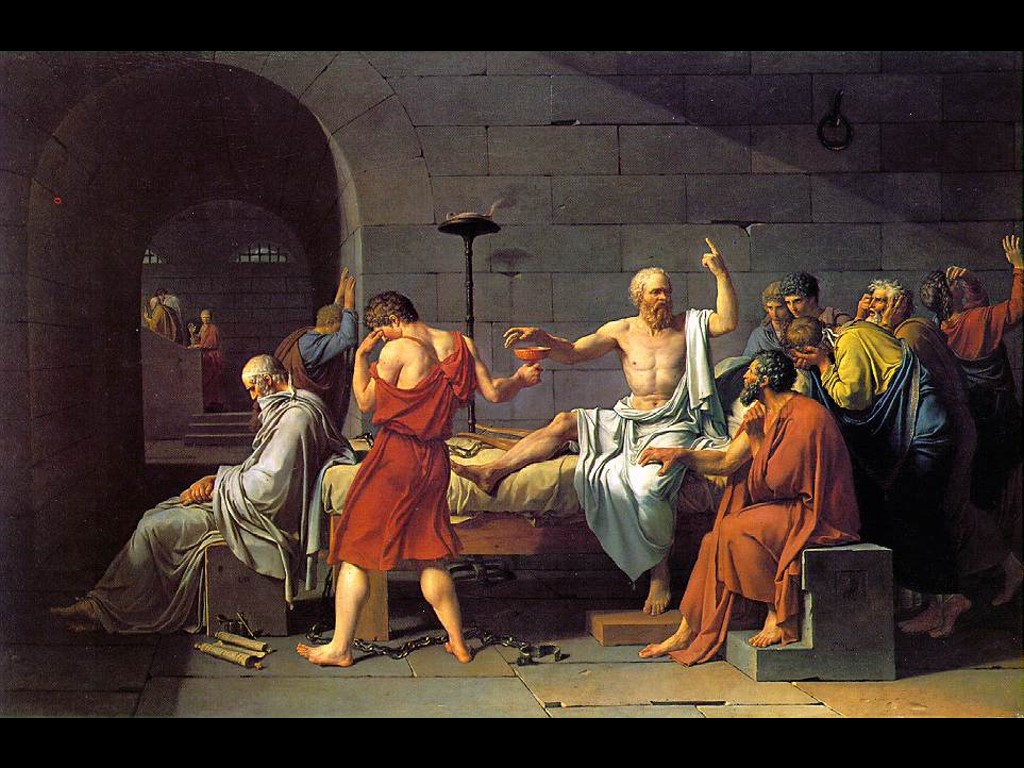
david-the-death-of-socrates-133x100Both arguments support the same ultimate conclusion: In this case the laws are ordering him to die, so he is obligated to obey the order and die. So it is on to the Phaedo and the death scene.

I admire Socrates for his commitment to reason, his courage, and his integrity in acting on his principles, but I disagree with his principles.

We have four issues at hand:

1. Procedural justice or content justice?
2. Collective security or individual life?
3. Legal paternalism or the law as servant?
4. What are the terms of the implicit social compact?

For this post let me just make two quick points about issue 4, which I think is the most interesting one, and leave the rest for follow-up discussion.

A. I think Socrates’ argument in issue 4 contradicts his position in issue 3. In issue 3 he argues that he’s the slave of the laws and owes them unconditional obedience, implying that he has no choice at all in the matter. In issue 4, he argues that he made a decision to stay when he could have left, implying that he was a free agent with a choice in the matter.

Is there a contradiction? If so, why? I don’t think Socrates and/or Plato were too stupid not to have noticed it. So is it a matter of making whatever arguments will appeal to the likely different audiences — the slave/child argument for the more traditionally inclined and the social compact argument for the more modern? And if the arguments being made are driven by such rhetorical considerations, what does this imply for the claim at Socrates’ trial that he was a sophist, given that sophistic strategy is to make whatever argument will work for the audience(s) at hand.

B. If one accepts the premise of the social compact as Socrates lays it out, there’s still the question of the other side of the compact. Citizens may have obligations to the law, but the law in turn has obligations to the citizens. If the law fails to fulfill its obligations, e.g., by threatening to kill an innocent citizen, does this not mean that the law has broken the agreement? And if the agreement is broken by one party, is the other party not then released from its obligations to uphold its side of the agreement? Thus Socrates, an actually-innocent man, is free to escape an injustice, if he so chooses.

Feel welcome to follow up in the comments.

Posted 2 years, 4 months ago at 3:56 pm.

3 comments

In class: Reason, according to Socrates

socrates-100x1331At the beginning of Crito, Socrates is in prison awaiting execution, having been found guilty of impiety and corrupting the youth of Athens.

His good friend Crito arrives, having worked out an escape opportunity for Socrates. Crito rushes through a few reasons why Socrates should escape immediately. Socrates then suggests that the issue is more complicated and requires careful consideration.

“For I am and always have been one of those natures who must be guided by reason, whatever the reason may be which upon reflection appears to me to be the best” (Crito, 46b).

And a little later, in deciding whether life is worth living under any circumstances, Socrates says: “Not living, but living well, is to be regarded as most important.” (48b)

Posted 2 years, 5 months ago at 12:36 pm.

1 comment

My Introduction to Philosophy course

know-thyself-235x100 This semester’s major authors and texts will be Plato’s Apology and Crito, Descartes’s Meditations, Freud’s Civilization and Its Discontents, Lewis’s Mere Christianity, and Rand’s The Fountainhead.

We will be covering those authors and their views in their own right and using them as launching points for discussion of issues such as the existence of God, free will and determinism, the mind-body problem, and the meaning of life.

We will also use a number of shorter pieces from Daniel Dennett, Martin Luther, John Steinbeck, Rupert Brooke, and others as supplements.

Here are PDF files of the three-page syllabus and schedule and the seventy-three-page supplemental Readings in Philosophy booklet I put together.

Posted 2 years, 5 months ago at 8:49 am.

Add a comment