Stephen Hicks, Ph.D.

Philosopher

The great Renaissance medical bloodletting controversy

Why accurate translation and skilled editing are important:

Bloodletting was a common practice in medieval medicine and did not die out until the nineteenth century.

The practice was encouraged by the belief that the excellent Greek physicians Hippocrates and Galen practiced it. Most phelobotomists followed the Persian genius Avicenna’s editions of the Greek texts, which stated that the bloodletting was to be administered from the side of the body opposite to the disease’s location.

Along came Pierre Brissot (1478-1522), whose reading of the Greek texts argued that the bloodletting was to be carried out on the same side as the illness.

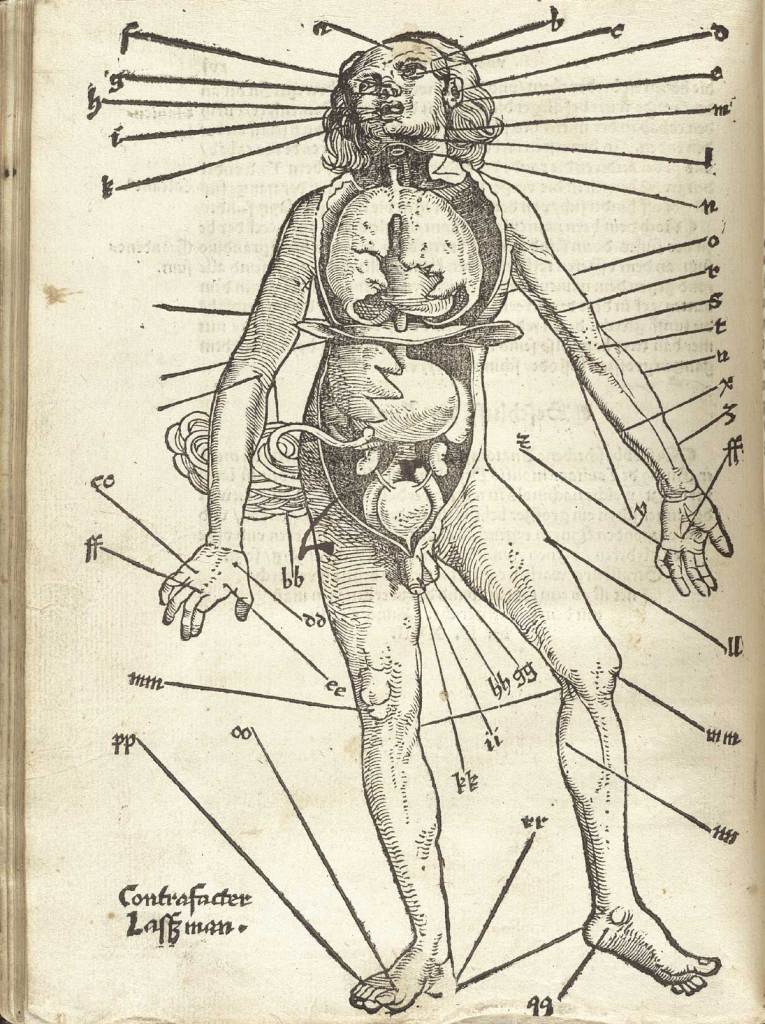
feldbuch-bloodletting-100x134Huge controversy among the phlebotomists! Same side or opposite? This text or that?

The “revulsive” bleeders (opposite side) asked by what right upstarts like Brissot challenged the centuries-old interpretations. The “derivative” bleeders (same side) wondered through what incompetence the original texts were altered.

Name-calling ensued, much of it in the name of the infallibility of the Greeks. Noted Jacobus Sylvius (1478-1555) of Hippocrates and Galen: “they had never written anything in physiology or other parts of medicine that was not entirely true.”

Still, the improved attention to the Greek texts did increase the accuracy of editing and translation and the bitter arguing sharpened logical skills and forced some experimenting.

[The image is Hans von Gersdorff's (ca. 1455-1529) illustration of the appropriate places for phlebotomists to practice their art.]

Posted 1 year, 10 months ago at 4:05 pm.

Add a comment

Iatrochemists: why iron salts cure anemia

A fun anecdote from the history of medicine. (Fun in hindsight, though not necessarily fun for those who lived through the medical history.)

galenhippocratesavicenna-135x100The late-medieval Iatrochemists believed that progress could be made by uniting medicine with alchemy. Their intellectual leader was Paracelsus (1493-1541), a Swiss physician whose goal was to reform medical chemistry by rejecting reliance on traditions based on ancient texts. Symbolically, Paracelsus inaugurated his lecture series at Basel by burning the books of Galen and Avicenna. Alchemy, in turn, was a hybrid practice of experimental chemistry and astrology.

A perfect example of iatrochemical theory in action was the mystery of anemia: Why did iron salts cure it? Practicing physicians knew that it did, but nobody had a good theory explaining why.

iatrochemistry-anemia-126x100So here’s the iatrochemical explanation. Anemia, we believe, is a matter of having weak blood. Clearly, the weak blood needs to be strengthened, which iron salts do, but how? Let’s start with the fact that iron is hard and strong. That is why we use iron to make weapons of war. The Roman god for war is Mars. Mars is also the red planet — and we know that blood is red. Quod erat demonstrandum has been achieved: the strength of iron is astrologically communicated through Mars to the redness of the blood, thereby curing the anemia.

(Up next: How Venus makes those love potions work. Ever notice that Venus and Viagra start with the same letter? Coincidence?)

Posted 2 years, 5 months ago at 12:52 pm.

1 comment