Stephen Hicks, Ph.D.

Philosopher

Courses


econhistthumbBusiness & Economic Ethics (PHIL 325) [pdf]
Of the endeavors that have contributed to the quality of human life, business ranks with science, art, and education. Yet like all human endeavors, business raises its share of difficult ethical questions. We discuss crucial theoretical issues such as the debates over egoism and altruism, and over capitalism and socialism; competing accounts of rights, justice, profits, and competition; and the nature of employer-employee and business-consumer relations. And we discuss the practical applications of the theoretical issues through numerous real-life case studies.
The supplemental Cases and Readings in Business Ethics booklet [pdf].
See also my Business and Economic Ethics page for my publications and posts in this area.
.

michelangelo-1511-100Philosophy of Art (PHIL 349) [pdf]
Great artists probe the central issues of the human condition, yet in a different way than do philosophers, psychologists, and political scientists. How does art do what it does—whether it be a piece of music you play over and over again, a novel you hate to see end, or a movie that makes you laugh and cry? And what is art? Can it be defined? What is the difference between good, mediocre, and incompetent art? Or are no such distinctions valid? Is it possible to say of a given piece of art, “This is great art, but I don’t like it”?
In this course we will raise these and other philosophical questions about art, trying to understand the nature of an enterprise that ranges from music to sculpture to dance to painting to poetry to motion pictures. We will read reflections on art by philosophers, artists, and other commentators.
Art Images page with links to sections on Classical Greece, Renaissance Italy, the Dutch Golden Age, Nineteenth-century France, and Modern and Postmodern.
Plato on censoring the arts [pdf] (from Book 10 of The Republic).
.

pencils-150x100Philosophical Foundations of Education (EDUC 605) [pdf]
In this course we cover the major philosophical issues that bear directly upon education, read the works of philosophers — Plato, Locke, Kant, Dewey, and others — who have influenced education greatly, and we look at several systems of educational philosophy.
My Philosophy of Education course lectures on video.
Supplemental readings booklet: Philosophical Foundations of Education [pdf].
Socratic Seminars materials. Forthcoming.
.

nazistabsbibleFree Speech & Censorship (PHIL 345) [pdf]
Who should decide what books are read? Should pornography be censored? What about politically rebellious pamphlets? Or the advertising of tobacco on television? Or hate language that attacks a person’s sex, race, or ethnic origin? Should church and state be separated? If the government does not fund some artists on the grounds that their work is offensive, is that censorship? In this course, we will study what some of the greatest minds in history have argued about free speech and censorship in Art, Politics, Religion, Business, Science, and Sex.
.

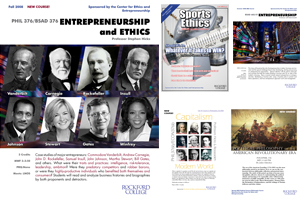
gates-100x122Entrepreneurship and Ethics (ECON/PHIL 376a) [pdf]
This course integrates entrepreneurship, business history, and business ethics. It consists of case studies of major entrepreneurs in modern history, e.g., Commodore Vanderbilt, Andrew Carnegie, John D. Rockefeller, John Johnson, Martha Stewart, Bill Gates, and others. Each case study involves learning the entrepreneur’s business practices and how he or she achieved business success. What traits did they have: intelligence, risk-tolerance, leadership, ambition, ruthlessness? And part of each case study involves learning about the ethical controversies: Were they “predatory competitors,” “monopolists,” “robber barons”—or highly productive individuals who traded with others to win-win advantage? Students read histories and biographies by both proponents and detractors.
.

know-thyself-235x100Introduction to Philosophy (PHIL 103) [pdf]
Philosophy deals with the big questions of human existence: What is it to be a fully developed human being? What kind of world are we living in — for example, does a God exist? How do we know these things? And who really cares? What difference does it make — what is the good life? We will grapple with fundamental philosophical problems and discuss the views of major thinkers in the Western intellectual tradition.
Here also is the supplemental Readings in Philosophy booklet [pdf].
.

wanderer-above-the-mists-friedrichEthics (PHIL 122) [pdf]
This course covers a variety of fascinating moral issues. We will investigate the best arguments on issues such as affirmative action, sex and love, torture, capital punishment, welfare, and legalizing drugs. We will also look at several relevant theoretical issues in ethics—for example, the debates over egoism and altruism, relativism and universalism, rights, virtue, justice.
.

foucault1Contemporary European Philosophy (PHIL 314) [pdf]
In this course we investigate several major European philosophies of the nineteenth and twentieth centuries. Philosophers we will cover include Georg Hegel, Friedrich Nietzsche, Sigmund Freud, Martin Heidegger, Jean-Paul Sartre, Albert Camus, and Michel Foucault.
.

chrysler-100x126Capitalism in the Modern World (ECON/PHIL 376b) [pdf]
This course integrates economics with ethics by focusing on two key questions: What is capitalism? Is capitalism moral? Students discuss major pro-capitalist writers (e.g., Mises, Hayek, Rand, Friedman, Phelps) and major anti-capitalist writers (e.g., Rousseau, Marx, Heidegger, Marcuse, Foucault). We discuss the competing theories about what capitalism is; the moral debates over economic liberty, economic equality, and economic justice; whether capitalism is essentially win-win or zero-sum; and the debates over capitalism’s historical connections with the Industrial Revolution, whether it sped or slowed the elimination of slavery, and whether it improved or made worse race relations and the status of women.
.

org-chart-229x100Organizational Ethics (BSMS 315-1) [pdf]
The purpose of the study of ethics is to develop a set of moral principles to guide individual and social action.
What core values and virtues should individuals embody?
What is the value of organizations?
What core values and virtues should organizations embody?
Who should set the terms of production, consumption, and trade?
How should prices be established?
What counts as a fair trade?
Who should control more abstract values such as information?
In this course we will integrate theoretical debates over ethical principles with controversies over classic and contemporary organizational actions.
.
.

ethics-signpost-109x100Business Ethics [pdf]
(Management 441)
Graduate School of Business
Loyola University Chicago
Of all the endeavors that have contributed to the quality of human life, business ranks with science, art, and education. Yet like all human endeavors, business raises its share of difficult ethical questions and problems. Our task this semester will be to explore those questions and problems.
We will divide our time equally between theory and practice. We will discuss competing accounts of morality, rights, justice, profits, competition, the nature of employer-employee and business-consumer relations, and we will discuss the practical implications of those debates through numerous real-life case studies.

Return to the StephenHicks.org main page.