Philosophy

“Making Life Meaningful Without Religion” republished [Church and State]

My “Making Life Meaningful Without Religion” is now republished at Britain’s Church and State site: “… There’s a half-serious taxonomy that divides Christians into three types: Christmas Christians, Good Friday Christians, and Easter Sunday Christians. Christmas is about celebrating birth, benevolence, and the bounties of life. Good Friday is about suffering, sacrifice, and destruction. Easter […]

“Making Life Meaningful Without Religion” republished [Church and State] Read More »

Individualism, and why I love the Renaissance

From Jacob Burckhardt’s great The Civilization of the Renaissance in Italy (1860): In the Middle Ages, “Man was conscious of himself only as a member of a race, people, party, family, or corporation — only through some general category. In Italy this veil first melted into air; an objective treatment and consideration of the state

Individualism, and why I love the Renaissance Read More »

Brian Medlin in *Explaining Postmodernism*

In 1957 — the decade during which the first generation of postmodern thinkers was arising — philosopher Brian Medlin claimed: “It is now pretty generally accepted by professional philosophers that ultimate ethical principles must be arbitrary.” For more on the context of Medlin’s point and its implications for postmodernism, see p. 87 of my Explaining Postmodernism:

Brian Medlin in *Explaining Postmodernism* Read More »

Foucault as Nietzschean: on knowledge as injustice

Juxtaposing quotations from Michel Foucault (d. 1984) and Friedrich Nietzsche (d. 1900). First, here is Foucault: “All knowledge rests upon injustice; there is no right, not even in the act of knowing, to truth or a foundation for truth; and the instinct for knowledge is malicious (something murderous, opposed to the happiness of mankind).”[1] Friedrich

Foucault as Nietzschean: on knowledge as injustice Read More »

“On Natural Morality and Religious Amoralism” [CHURCH and STATE]

My “On Natural Morality and Religious Amoralism” is now republished at Britain’s Church and State site: “… religious belief is often autobiographical. That is, all religions have many messages and practices — some peaceful, some violent, and so on — and individuals choose among them to put together a personal religion that reflects the morality

“On Natural Morality and Religious Amoralism” [CHURCH and STATE] Read More »

Portugal’s Ricardo Lopes interview with me

My discussion with the well-prepared Ricardo Lopes. Our topics: * What made the moderns revolutionary epistemologically * The broader transformations of the world by exploration, science, religion, trade, and the arts * The postmodernism reaction to/against modernism * Why Kant is important as inheritor of failing empiricist and rationalist traditions * Rousseau’s collectivism and egalitarianism

Portugal’s Ricardo Lopes interview with me Read More »

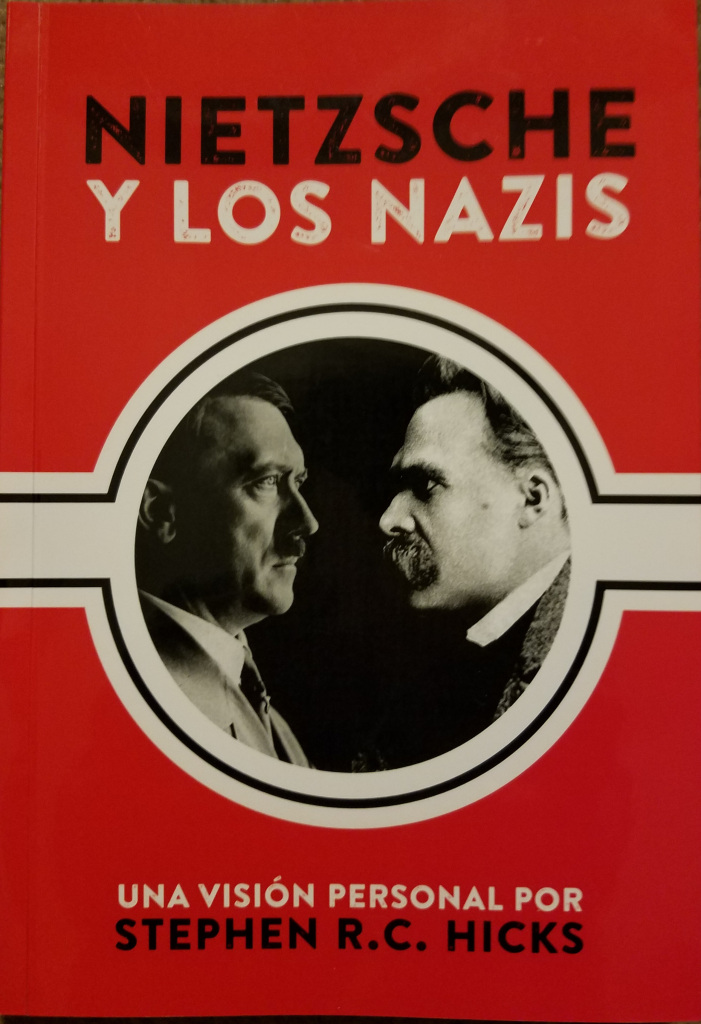
“The Philosophers and the Birth of National Socialism” — Gdańsk lecture

I gave a talk in Gdańsk, Poland, on “The Philosophers and the Birth of National Socialism.” Along the way we discuss Oswald Spengler, Carl Schmitt, Martin Heidegger, Friedrich Nietzsche, and others. The video of the lecture and question period is here (or at YouTube): Thanks to Dr. Marek Szymaniak of the Museum of the Second

“The Philosophers and the Birth of National Socialism” — Gdańsk lecture Read More »