Pavel Jordanowitch and the Disumbrationist School of Art
Great fun: An artworld scam from the 1920s.
Pavel Jordanowitch and the Disumbrationist School of Art Read More »
Great fun: An artworld scam from the 1920s.
Pavel Jordanowitch and the Disumbrationist School of Art Read More »
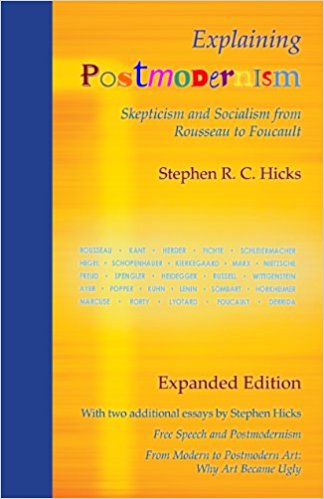
In 1957 — the decade during which the first generation of postmodern thinkers was arising — philosopher Brian Medlin claimed: “It is now pretty generally accepted by professional philosophers that ultimate ethical principles must be arbitrary.” For more on the context of Medlin’s point and its implications for postmodernism, see p. 87 of my Explaining Postmodernism:
Brian Medlin in *Explaining Postmodernism* Read More »
Juxtaposing quotations from Michel Foucault (d. 1984) and Friedrich Nietzsche (d. 1900). First, here is Foucault: “All knowledge rests upon injustice; there is no right, not even in the act of knowing, to truth or a foundation for truth; and the instinct for knowledge is malicious (something murderous, opposed to the happiness of mankind).”[1] Friedrich
Foucault as Nietzschean: on knowledge as injustice Read More »
My “On Natural Morality and Religious Amoralism” is now republished at Britain’s Church and State site: “… religious belief is often autobiographical. That is, all religions have many messages and practices — some peaceful, some violent, and so on — and individuals choose among them to put together a personal religion that reflects the morality
“On Natural Morality and Religious Amoralism” [CHURCH and STATE] Read More »
The postmodern task, states Richard Rorty, is to figure out what to do “now that both the Age of Faith and the Enlightenment seem beyond recovery.” For more on the context of Rorty’s claim and his contributions to postmodernism, see p. 23 of my Explaining Postmodernism: Skepticism from Rousseau to Foucault. Information about other editions
Richard Rorty in *Explaining Postmodernism Read More »
My discussion with the well-prepared Ricardo Lopes. Our topics: * What made the moderns revolutionary epistemologically * The broader transformations of the world by exploration, science, religion, trade, and the arts * The postmodernism reaction to/against modernism * Why Kant is important as inheritor of failing empiricist and rationalist traditions * Rousseau’s collectivism and egalitarianism
Portugal’s Ricardo Lopes interview with me Read More »
I gave a talk in Gdańsk, Poland, on “The Philosophers and the Birth of National Socialism.” Along the way we discuss Oswald Spengler, Carl Schmitt, Martin Heidegger, Friedrich Nietzsche, and others. The video of the lecture and question period is here (or at YouTube): Thanks to Dr. Marek Szymaniak of the Museum of the Second
“The Philosophers and the Birth of National Socialism” — Gdańsk lecture Read More »
Economist Richard Ebeling at FEE: “The Damage Still Done by a Defunct Economist”: “Keynes helped undermine what had been three of the essential institutional ingredients of a free-market economy: the gold standard, balanced government budgets, and open competitive markets. In their place Keynes’s legacy has given us paper-money inflation, government deficit spending, and more political
Keynes’s continuing destructiveness — Ebeling’s and my evaluations Read More »