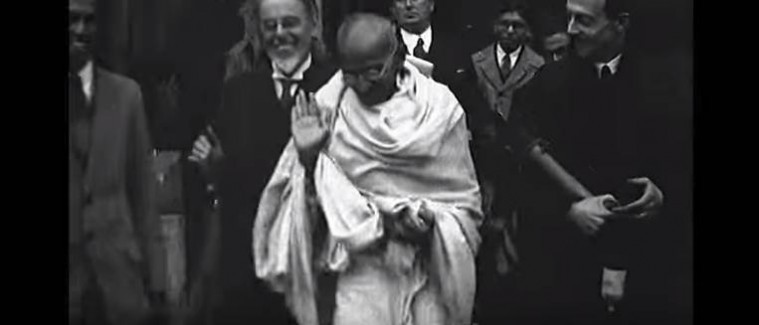
From Alex Von Tunzelmann’s Indian Summer: The Secret History of the End of an Empire:
Gandhi advised the British to give up the fight against Hitler and Mussolini, and he advised Jews in Germany to offer passive resistance to the Nazi regime:
“Gandhi’s position on nonviolence was absolute. Aggression could never be returned. He did not believe that women should resist rape, but preferred that they should ‘defeat’ their assailants by remaining passive and silent. Correspondingly, he did not believe that the victims of war should resist attackers by physical force, but rather ought to offer satyagraha—that is, noncompliance with the invaders. ‘If there ever could be a justifiable war in the name of and for humanity, war against Germany to prevent the wanton persecution of a whole race would be completely justified,’ he wrote. ‘But I do not believe in any war.'”
Further:
“He advised the British to give up the fight against Hitler and Mussolini: ‘Let them take possession of your beautiful island … allow yourself, man, woman and child, to be slaughtered, but you will refuse to owe allegiance to them.’ Furthermore, in one of his most controversial arguments, Gandhi advised the Jews in Germany to offer passive resistance to the Nazi regime—and to give up their own lives as sacrifices. He told the Jews to pray for Adolf Hitler. ‘If even one Jew acted thus,’ he wrote, ‘he would salve his self respect and leave an example which, if it became infectious, would save the whole of Jewry and leave a rich heritage to mankind besides.’
In leading the 1930 Salt March, Gandhi gave a notable example of Satyagraha:
“Gandhi compounded this error of judgment by offering praise to Hitler. ‘I do not consider Herr Hitler to be as bad as he is depicted,’ he wrote in May 1940. ‘He is showing an ability that is amazing and he seems to be gaining his victories without much bloodshed. ‘ Apparently, he saw some parallel between his own efforts to return India to the Indians and Hitler’s invasion of French territory to reclaim that lost to Germany under the terms of the Treaty of Versailles at the end of the First World War. He regretted that Hitler had employed war rather than nonviolence to achieve his aims, but nonetheless averred that the Germans of the future ‘will honour Herr Hitler as a genius, a brave man, a matchless organizer and much more.'”
Even after the war and the exposure of the Holocaust:
“The American journalist Louis Fischer brought up this subject with Gandhi in 1946. By that time, the concentration camps had been discovered, and the true, awful extent of the Holocaust revealed. It might have been expected that the benefit of hindsight would have tempered the old man’s views. It had not. ‘Hitler killed five million Jews,’ Gandhi told Fischer, ‘It is the greatest crime of our time. But the Jews should have offered themselves to the butcher’s knife. They should have thrown themselves into the sea from cliffs … . As it is they succumbed anyway in their millions.'”
(Thanks to Larry Abrams for the Gandhi quotations. Neera Badhwar notes that Gandhi also wrote a letter to Hitler in 1940 urging him to stop the warfare. The top image shows Gandhi visiting London in 1931, two years before the Nazis’s coming to power in 1933.)
“The deformities of the anti-war faction are nonetheless threefold: They underestimate and understate the radical evil of Nazism and fascism, they forget that many “peace-loving” forces did the same at the time, and they are absolutist in their ahistoricism. A war is a war is a war, in their moral universe, and anyone engaging in one is as bad as anyone else.”
…
“Indeed, the little matter of democracy is entirely ignored by the self-satisfied Baker analysis. Not only are Britain and America discussed as if they were little if any better than the dictatorships of the time, but we are never even faced with the question of how much force would ever be justifiable in a war to the finish between the pluralist and the absolutist principle (in which the absolutist principle was, lest we forget, rather convincingly vanquished). In much the same way, London and Washington are reprobated for missing chances for negotiation before 1940 but Berlin doesn’t draw the same standard of criticism for its decision to fight on (and to intensify genocide in the east as well as to prolong the misery of Germany) when all was obviously lost.”
“Just Give Peace A Chance?” (a review of Nicholson Baker’s “Human Smoke) by Christopher Hitchens
https://www.newstatesman.com/books/2008/05/war-baker-churchill-british
“Even if militaries don’t deliberately target innocent bystanders, they almost always wind up recklessly endangering their lives. If a policeman fought crime the way that “civilized” armies wage war, we’d put him in jail.
But isn’t pacifism, in Homer Simpson’s words, one of those views “with all the well-meaning rules that don’t work in real life”? No. Here’s my common-sense case for pacifism:
1. The immediate costs of war are clearly awful. Most wars lead to massive loss of life and wealth on at least one side. If you use a standard value of life of $5M, every 200,000 deaths is equivalent to a trillion dollars of damage.
2. The long-run benefits of war are highly uncertain. Some wars – most obviously the Napoleonic Wars and World War II – at least arguably deserve credit for decades of subsequent peace. But many other wars – like the French Revolution and World War I – just sowed the seeds for new and greater horrors. You could say, “Fine, let’s only fight wars with big long-run benefits.” In practice, however, it’s very difficult to predict a war’s long-run consequences. One of the great lessons of Tetlock’s Expert Political Judgment is that foreign policy experts are much more certain of their predictions than they have any right to be.
3. For a war to be morally justified, its long-run benefits have to be substantially larger than its short-run costs. I call this “the principle of mild deontology.” Almost everyone thinks it’s wrong to murder a random person and use his organs to save the lives of five other people. For a war to be morally justified, then, its (innocent lives saved/innocent lives lost) ratio would have to exceed 5:1. (I personally think that a much higher ratio is morally required, but I don’t need that assumption to make my case).”
“The Common Sense Case for Pacifism” by Byran Caplan
http://econlog.econlib.org/archives/2010/04/the_common-sens.html
It is curious he didn’t expect rape victims to pray for the rapists but he expected European Jews to pray for Hitler. Was that because he believed the world is about suffering and death was an escape or termination of such state? Regardless, he obviously rejected a person as a value to himself. His view of a human being is a spectator of himself and his “condition”, having no value judgement of himself or the world around him. There seems to be some resemblance of Stoicism in Ghandi’s thought.
Why does the ratio of innocent lives saved to innocent lives lost have to be five to one? Why aren’t all the innocent lives weighed equally? I hope that by “innocents” you are referring to civilians and not Wehrmacht soldiers.
I don’t think many people would say that murdering a person for his/her organs would be justified if the number of people saved were more than five. Would YOU justify the murder if the number saved was more than five? Anyway, that’s a silly analogy for something like World War II or Rwanda; those were cases of people resisting violence, not initiating the violence themselves because of some benefit they thought could be gained. A better analogy would be “terrorists have seized dozens of hostages in a building. If you know the terrorists intend to kill every one of those hostages, and you can’t prevent it without violence, do you launch an attack that will kill some hostages, but save many more?” I also don’t agree that the French Revolution “just sowed the seeds for new and greater horrors”. The French Revolution is the reason the world has as much freedom as it has now. The Terror also claimed far fewer lives than the Old Regime did.