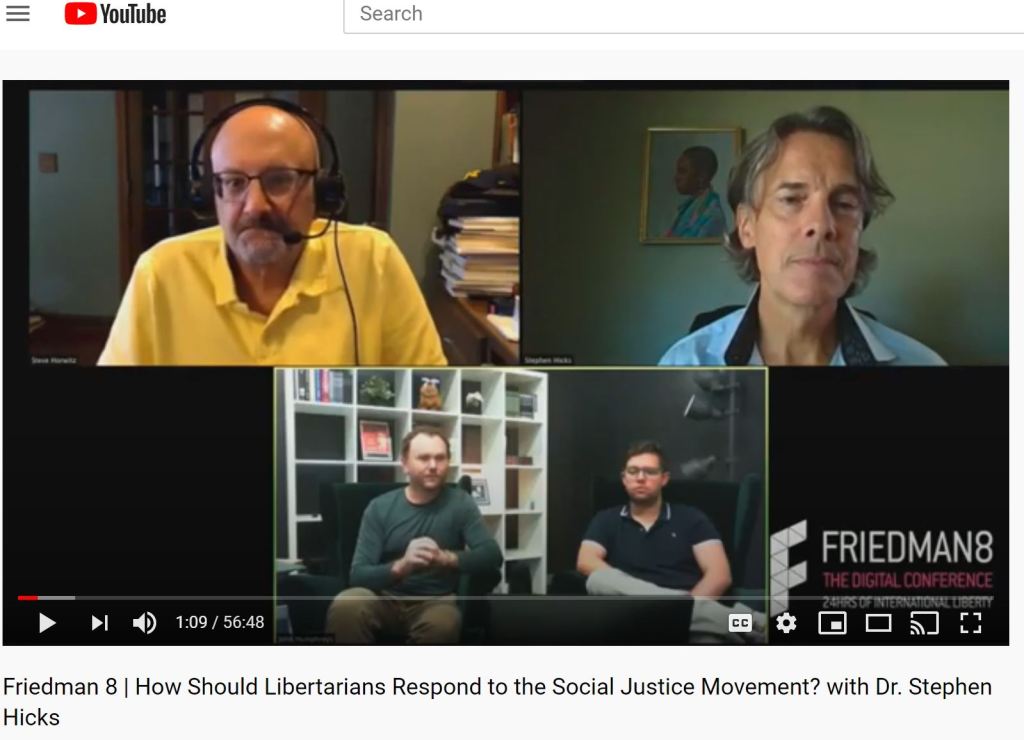
Chair: Stephen Hicks, Ph.D., Rockford College, Illinois
Panelists:
Emily Chamlee-Wright, Ph.D. Elbert Neese Professor of Economics, Beloit College, Wisconsin
Title: “Cultivating the Economic Imagination with Atlas Shrugged”
Abstract: In this paper I describe my use of Ayn Rand’s Atlas Shrugged in an undergraduate comparative economic systems course. I argue that the novel is the ideal vehicle for cultivating what I call the “economic imagination,” by which I mean the ability to see the systematic outcomes that emerge under different political economic rules of the game. Further, I argue that the novel is particularly well-suited to animate discussions of essential comparative systems topics, including Marxism, the various phenomena associated with the soviet-type economy, and fascism. Finally, drawing upon student writing, I argue that though Rand’s view of reason and epistemology are often at odds with Austrian economics, these tensions are productive in conveying Austrian insights regarding the extended order.
Steve Horwitz, Ph.D., Professor of Economics, St. Lawrence University, New York
“Hayek, Rand, and the Ethics of the Micro- and Macro-worlds
Abstract: Hayek and Rand both supported capitalism, but their ethical systems were different. This paper explores the differences and how they apply to the institution of the family. It concludes that Rand’s ethical system matches very well with what Hayek sees as necessary in the “Great Society” of the macro-cosmos, but that our understanding of the institution of the family seems better suited to a more altruistic ethical code. The challenge for a Hayekian ethics that pays attention to institutional contexts is how to ensure that the complex process of making those distinctions is learned as children pass into adulthood.
Edward Hudgins, Ph.D., Director of Advocacy, The Atlas Society, Washington, D.C.
Title: “Is a Moral Foundation Necessary for Spontaneous Order?”
Abstract: F. A. Hayek argued that social order and institutions—markets, money, law—arise spontaneously out of the actions of individuals seeking their own interests but not through specific planning by individuals. Further, because it is impossible in markets for any individual to know what mix of goods and services will best satisfy consumer demands, attempts at central government planning will result in adverse unintended consequences.
But it can be argued that such a system will only operate to protect individual liberty and limit government if enough individuals, reinforced by the culture, accept and live by certain moral principles and the Objectivism provides such a foundation.
William Kline, Ph.D., Assistant Professor of Philosophy, Department of Liberal and Integrative Studies, University of Illinois, Springfield
Title: “Individualism and Interdependence”
Abstract: When do we need other people? Both Hayek and Rand agree on the importance of the division of labor. People need other people to produce what they cannot or will not do themselves. Hayek and Rand also broadly agree on the importance of property rights that make the division of labor, and the market in general, possible. Yet, theses authors deeply disagree on the degree of interdependence necessary for establishing valid property claims. This paper explores Hayek’s use of a Humean conception of property that emphasizes tradition and cannot exist independently of others and contrasts it with Rand’s use of a Lockean/Cartesian approach that argues for the existence of objective, nonconventional property rights. This paper argues that the two authors can be reconciled by distinguishing between what Hume identifies as the need for property rights versus the actual rules that protect them.
“The Great Recession (or the Great Hangover) that began in 2008 did not have to happen. Its causes and consequences are not mysterious. Indeed, this particular and very painful episode affirms what the best nonpartisan economists have tried to tell our politicians and policy-makers for decades, namely, that the more they try to inflate and direct the economy, the more damage the rest of us will suffer sooner or later. Hindsight is always 20-20, but in this instance, good old-fashioned common sense would have provided all the foresight needed to avoid the mess we’re in.
“In this essay, we trace the path of the recession from its origins in the housing market bubble to the policies offered to cure the aftermath.”
Here is a direct link to the PDF of the article at the Foundation for Economic Education’s site.
Duncan continued: “That education system was a disaster, and it took Hurricane Katrina to wake up the community to say that ‘we have to do better.’ And the progress that they’ve made in four years since the hurricane is unbelievable. They have a chance to create a phenomenal school district. Long way to go, but that — that city was not serious about its education. Those children were being desperately underserved prior, and the amount of progress and the amount of reform we’ve seen in a short amount of time has been absolutely amazing.”
So a question: Without hoping for more natural disasters, what can we do to emulate New Orleans’s progress in other dysfunctional school districts? The hurricane shocked the system: Katrina (1) made everyone to focus on essentials, (2) disempowered the entrenched advocates for continued dysfunction, and (3) galvanized everyone else to positive action. In my judgment, we are good at (1) and (3), but we are weak at solving (2) through peaceful methods.
Another question: What else has Katrina taught us about disaster preparedness and how to recover? The Mercatus Center has a excellent ongoing project devoted to Entrepreneurship and Disaster Recovery. The project has published a useful series of articles and working papers by scholars studying the aftermath of the hurricane.
Two of Mercatus’s scholars, Professor Emily Chamlee-Wright and Professor Steven Horwitz, spoke last year at Rockford College on post-Katrina disaster response in the private sector. Their talks were sponsored by the Center for Ethics and Entrepreneurship, and my ten-minute video interviews with them following their talks are available at CEE’s site: Chamlee-Wright on social entrepreneurial activity, and Horwitz on for-profit organizations’ response.
In my capacity as Executive Director of CEE, I have been fortunate to interview several of our expert guest speakers. We began the video interview series at the beginning of the 2008-2009 academic year, and so far we have published interviews with six of our speakers:
Dr. David Mayer on Freedom’s Constitution, his forthcoming book on U.S. Constitutional interpretation.
Forthcoming: Attorney Timothy Sandefur on market entrepreneurs, political entrepreneurs, and the American legal and political landscape.
The videos are also available at the Center for Ethics and Entrepreneurship’s site. Credit also goes to CEE’s Christopher Vaughan, who shoots and edits the interviews. Nice work, Chris.
Posted 2 years, 4 months ago at 8:24 pm. Add a comment