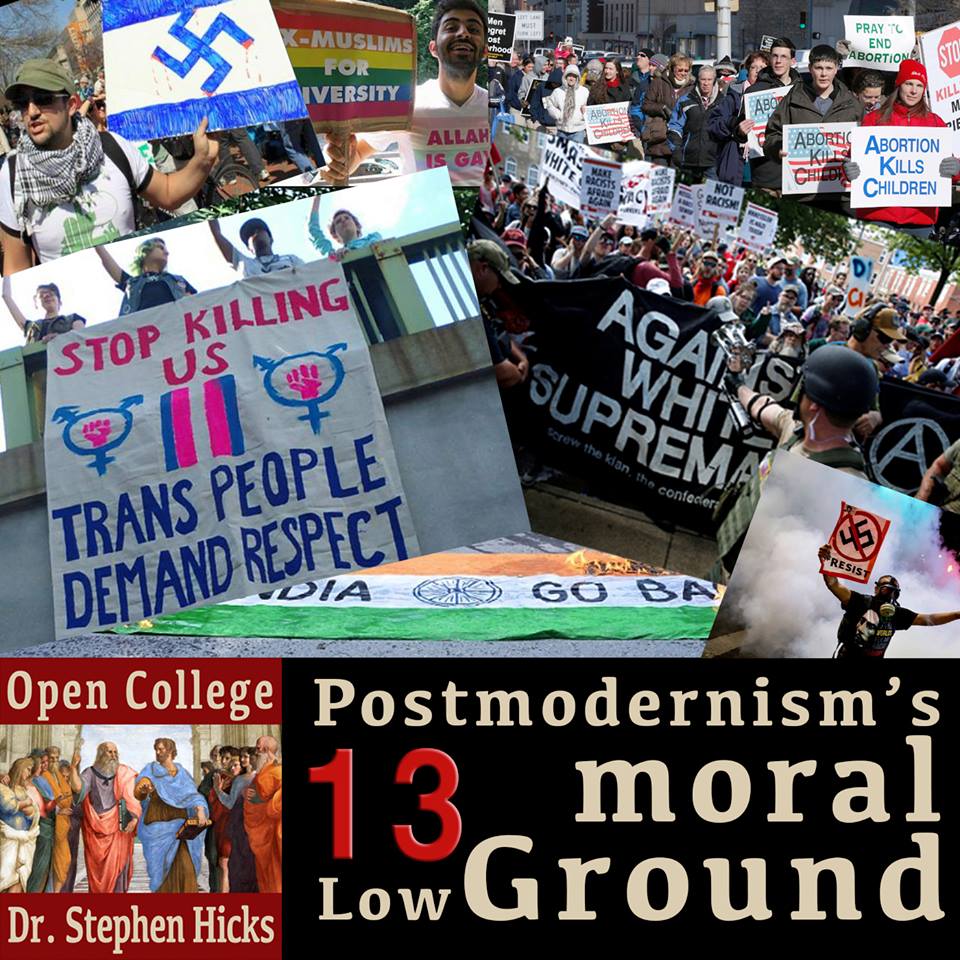
Part of a work-in-progress in philosophy of economics, here is the video of a seminar I led on “Economics as a Value Science.” Part of my argument is that there is a large, problematic gap in economic theory about the relationship between economic facts and economic values. Along the way I discuss Friedrich Hayek, David Hume, Immanuel Kant, Rudolf Carnap, Richard Rorty, Milton Friedman, Joseph Schumpeter, Ludwig von Mises, Aristotle, and Ayn Rand. The table of contents of the seminar are below the video frame.
Seminar contents:
Introduction
Philosophical issues in economics
David Hume
Immanuel Kant
Philosophical dichotomies
Implications for economics
Economic agents
Policy recommendations
Nature of philosophers
Value
Irrational values and biases
Positivism: Rudolf Carnap
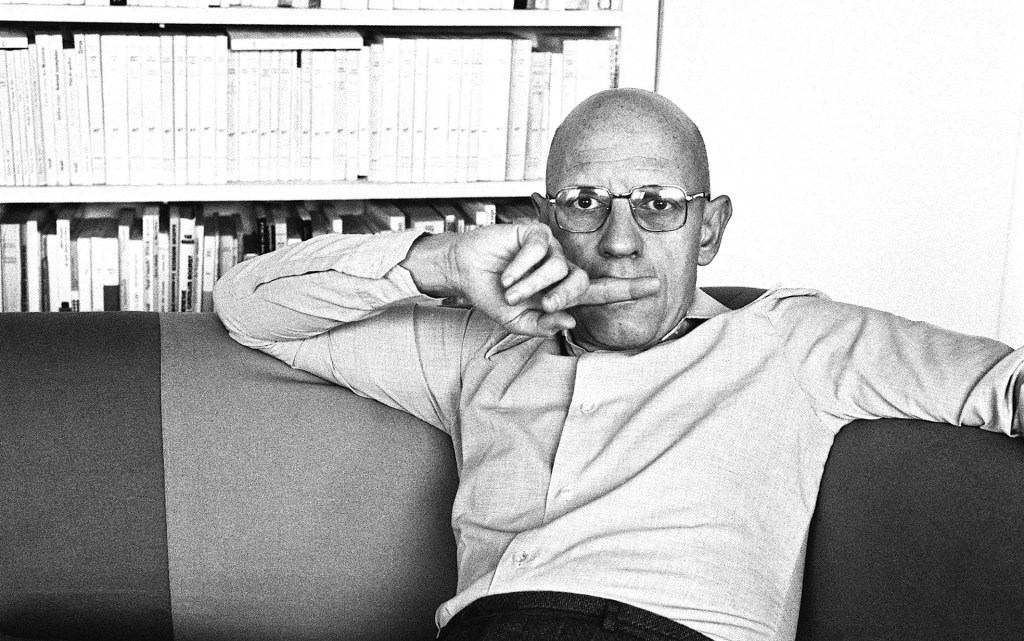
Postmodernism: Richard Rorty
Free-market economists on facts and values:
Quote: Human Action, Ludwig von Mises
Quote: The Methodology of Positive Economics, Milton Friedman
Quote: Rules and Order, Friedrich A. Hayek
Dichotomous problems
Quote: A History of Economic Analysis, Joseph Schumpeter
The Aristotelian approach
Objectivity or subjectivity of values
Objective value thesis
Subjective value thesis
Three-way debate:
Intrinsic value thesis
Subjective thesis
Objective thesis
Values as a species of facts
Biological perspective
Fish example: Facts, Values
Value statements
Human beings: Facts, Values
Value examples
Implications for the subjectivity and objectivity of value
Human valuing
Individuality
Authoritarianism
Free society
Epistemological resources on natural and objective value
Final words
Final credits
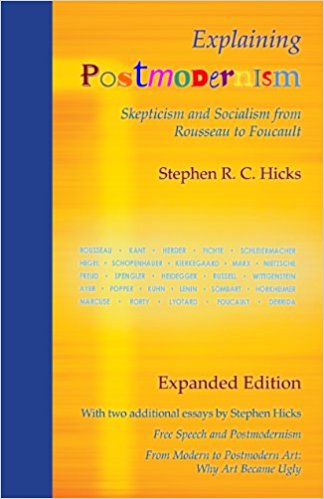
The Kindle version of the new, Expanded Edition of my Explaining Postmodernism: Skepticism and Socialism from Rousseau to Foucault is now available. The hardcover will be out next month.
The expanded edition also includes my Free Speech and Postmodernism and From Modern to Postmodern Art: Why Art Became Ugly essay. Images of the art works discussed and referred to in the latter essay are available at a dedicated page at my website here.
Kant’s legacy to the next generation is a principled separation of subject and object, of reason and reality. His philosophy is thus a forerunner of postmodernism’s strong anti-realist and anti-reason stances.
After Kant, the story of philosophy is the story of German philosophy. Kant died early in the nineteenth century, just as Germany was beginning to replace France as the world’s leading intellectual nation, and it was German philosophy that set the program for the nineteenth century.
Understanding German philosophy is crucial to understanding the origins of postmodernism. Continental postmodernists such as Foucault and Derrida will cite Heidegger, Nietzsche, and Hegel as their major formative influences—all of them German thinkers. American postmodernists such as Rorty emerged primarily from the collapse of the Logical Positivist tradition, but will also cite Heidegger and pragmatism as major formative influences. When we look to the roots of Logical Positivism we find cultural Germans such as Wittgenstein and the members of the Vienna Circle. And when we look at pragmatism, we find it to be an Americanized version of Kantianism and Hegelianism. Postmodernism is thus the supplanting of the Enlightenment with its roots in seventeenth century English philosophy by the Counter-Enlightenment with its roots in late eighteenth-century German philosophy.
Kant is central to that story. By the time of his death Kant’s philosophy had conquered the German intellectual world,[22] and so the story of German philosophy became the story of extensions and reactions to Kant
Three broad strains of post-Kantian philosophy emerged. What shall we do, members of each strain asked, about the gulf between subject and object that Kant has said cannot be crossed by reason?
1. Kant’s closest followers decided to accept the gulf and live with it. Neo-Kantianism evolved during the nineteenth century, and by the twentieth century two main forms had emerged. One form was Structuralism, of which Ferdinand de Saussure was a prominent exponent, representing the broadly rationalist wing of Kantianism. The other was Phenomenology, of which Edmund Husserl was a prominent representative, representing the broadly empiricist wing of Kantianism. Structuralism was a linguistic version of Kantianism, holding that language is a self-contained, non-referential system, and that the philosophical task was to seek out language’s necessary and universal structural features, those features taken to underlie and be prior to the empirical, contingent features of language. Phenomenology’s focus was upon careful examination of the contingent flow of the experiential given, avoiding any existential inferences or assumptions about what one experiences, and seeking simply to describe experience as neutrally and as clearly as possible. In effect, the Structuralists were seeking subjective noumenal categories, and the Phenomenologists were content with describing the phenomena without asking what connection to an external reality those experiences might have.
Structuralism and Phenomenology came to prominence in the twentieth century, however, and so my focus next will be on the two strains of German philosophy that dominated the nineteenth century. For those two strains, Kant’s philosophy set a problem to be solved—though one to be solved within the constraints of Kant’s most fundamental premises.
2. The speculative metaphysical strain, best represented by Hegel, was dissatisfied with the principled separation of subject and object. This strain granted Kant’s claim that the separation cannot be bridged epistemologically by reason, and so proposed to bridge it metaphysically by identifying the subject with the object.
3. The irrationalist strain, best represented by Kierkegaard, was also dissatisfied by the principled separation of subject and object. It granted Kant’s claim that the separation cannot be bridged epistemologically by reason, and so proposed to bridge it epistemologically by irrational means.
Kantian philosophy thus set the stage for the reign of speculative metaphysics and epistemological irrationalism in the nineteenth century.
References
[22] See, e.g., Wood, in Kant 1996, vi; also Meinecke 1977, 25.
[This is an excerpt from Stephen Hicks's Explaining Postmodernism: Skepticism and Socialism from Rousseau to Foucault (Scholargy Publishing, 2004, 2011). The full book is available in hardcover or e-book at Amazon.com. See also the Explaining Postmodernism page.]
At the Explaining Postmodernism page, Chapter Six of my book is now available online. This final chapter integrates the epistemological material from chapters two and three with the political material from chapters four and five to show how the distinctive contemporary postmodern strategies follow.
Connecting epistemology to politics 174
Masks and rhetoric in language 175
When theory clashes with fact 178
Kierkegaardian postmodernism 179
Reversing Thrasymachus 182
Using contradictory discourses as a political strategy 184
Machiavellian postmodernism 186
Machiavellian rhetorical discourses 187
Deconstruction as an educational strategy 188 Ressentiment postmodernism 191
Nietzschean ressentiment 193
Foucault and Derrida on the end of man 195 Ressentiment strategy 198
Post-postmodernism 201
[This is an excerpt from Stephen Hicks's Explaining Postmodernism: Skepticism and Socialism from Rousseau to Foucault (Scholargy Publishing, 2004, 2011). The full book is available in hardcover or e-book at Amazon.com. See also the Explaining Postmodernism page.]
Posted 2 years, 4 months ago at 11:39 am. Add a comment
At the Explaining Postmodernism page, Chapter Three of my book is now available online. This chapter covers Martin Heidegger’s integration of the two main lines of Continental philosophy, the origins and eventual collapse of Logical Positivism, and the resulting mid-20th-century epistemological void that enabled postmodernism.
Heidegger’s synthesis of the Continental tradition 58
Setting aside reason and logic 61
Emotions as revelatory 62
Heidegger and postmodernism 65
Positivism and Analytic philosophy: from Europe to America 67
From Positivism to Analysis 70
Recasting philosophy’s function 72
Perception, concepts, and logic 74
From the collapse of Logical Positivism to Kuhn and Rorty 78
Summary: A vacuum for postmodernism to fill 79
First thesis: Postmodernism as the end result of Kantian
epistemology 80
[This is an excerpt from Stephen Hicks's Explaining Postmodernism: Skepticism and Socialism from Rousseau to Foucault (Scholargy Publishing, 2004, 2011). The full book is available in hardcover or e-book at Amazon.com. See also the Explaining Postmodernism page.]
Posted 2 years, 4 months ago at 12:13 pm. Add a comment
My Explaining Postmodernism: Skepticism and Socialism from Rousseau to Foucault has, gratifyingly, had two hardcover printings and eight softcover printings from 2004-2009.
Over the next while I will be making portions of the book available online at this new Explaining Postmodernism page here at my site.
[Stephen Hicks's Explaining Postmodernism: Skepticism and Socialism from Rousseau to Foucault (Scholargy Publishing, 2004, 2011). The full book is available in hardcover or e-book at Amazon.com. See also the Explaining Postmodernism page.]
Posted 2 years, 4 months ago at 10:56 am. Add a comment