Stephen Hicks, Ph.D.

Philosopher

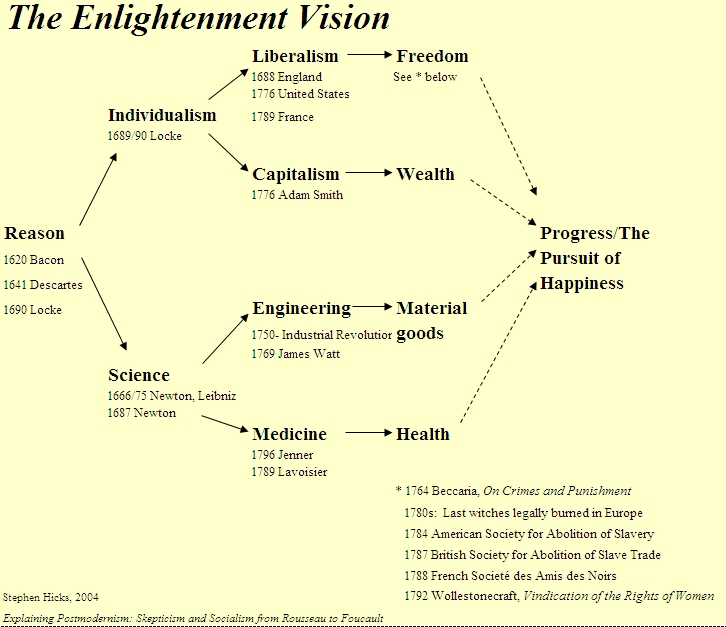
The Enlightenment Vision — updated flowchart

The Enlightenment of the long 18th century was an era of awesome intellectual and cultural transformation.

hickss-enlightenment-vision-flowchart-full

This Enlightenment Vision flowchart is pitched at a high level of abstraction, showing schematically how the philosophical revolution of the 17th century led to the 18th-century revolutions in science, technology, politics, and economics — which in turn led to the dramatic increases in health, wealth, freedom, and goods in the 19th century.

To put it another way, the chronology shows how the ideas played out as philosophy, then as an intellectual movement, then as activism, then as the working technology of culture.

I first develop the chart for my courses in philosophy and intellectual history and published a version of it in Explaining Postmodernism. It’s posted here as a PDF, as a JPEG image, or as an Excel file, in case you’d like to adapt it for your own purposes.

(Thanks to Brian Schwartz for prompting this update.)

Posted 3 months, 3 weeks ago at 8:42 pm.

4 comments

Most dangerous philosophy book? (Spring 2011 edition)

For my Introduction to Philosophy course, a question on the final exam [pdf] was:

know-thyself-235x100In your judgment, what is the most dangerous book we read this semester? First give a clear and sympathetic presentation of the book’s most important themes; second, state your criterion/criteria of dangerousness; finally, explain why you think the book is dangerous.

This semester we read Plato’s Apology, Ayn Rand’s The Fountainhead, Galileo’s “Letter to the Grand Duchess Christina,” Descartes’ Meditations, C. S. Lewis’s Mere Christianity, and Sigmund Freud’s Civilization and Its Discontents. My twelve students’ responses:
* One voted for Socrates as most dangerous
* Two voted for Lewis and two voted for Galileo
* Three voted for Descartes
* Four voted for Freud.

freudsigmund-50x68Three students took issue with Freud’s dismissing religion as a childish illusion. One disagreed with Freud’s argument that religion illusion plays an important civilizing and palliative role for the common man, holding that encouraging society’s leaders to promote falsehoods is politically dangerous.

I hereby declare Civilization and Its Discontents to be the Most Dangerous Book in Introduction to Philosophy, Rockford College, Spring Semester 2011.

Related:
The most dangerous philosophy book (Fall 2009 edition).
The most dangerous philosophy book (Spring 2010 edition).
The most dangerous philosophy book (Fall 2010 edition).

Posted 9 months, 1 week ago at 3:06 pm.

1 comment

A stolen Descartes manuscript

This week we are starting Descartes’s Meditations in my Introduction to Philosophy course.

One of the wonderful things about the Internet is its enabling us easily to see things like Descartes’s original handwriting. Here is a letter he wrote, dated 27 May 1641:

descartes-handwritten-472x300

The letter is in French and was written to Marin Mersenne about the soon-to-be-published Meditations. The letter has had some mysterious travels, having been stolen in the 1840s and ending up across the Atlantic in the library collection of Haverford College. More information here.

A related post of mine: Who is the real father of modern philosophy?

Posted 1 year, 4 months ago at 11:49 am.

Add a comment

Who is the real father of modern philosophy? [repost]

[We are reading Descartes' Meditations this week in my Introduction to Philosophy course, so this is a re-post for new readers this semester.]

francis-bacon
I vote for Francis Bacon.
.
.

descartes-50x63 The standard answer gives the honor to René Descartes.

Descartes’s claim to the title is based primarily on his epistemology — specifically his method of doubt. The method of doubt is both a challenge to previous, more authoritarian epistemologies and a re-invigoration of a skepticism that exercises philosophers to this day.

Bacon’s reputation is also based in epistemology — his re-introduction and expansion of inductive methods. His empiricism is also a challenge to authoritarian epistemologies and grounds much of the scientific method used by investigators to this day.

How do we decide matters such as who should be considered the founder or father of modern philosophy? Let me propose four criteria.

1. Influence on academic philosophy. Descartes’s skeptical challenges have generated a huge literature in academic philosophy. Yet a huge literature has also been generated developing empirical methods in philosophy of science along lines established by Bacon. My call: a tie between Descartes and Bacon, absent a quantitative measure of the literature.

2. Influence on philosophy as used by all thinkers. Baconian epistemology has been internalized by most modern intellectuals (especially in the sciences and social sciences) and is part of their normal professional practice, and the more sophisticated inductive methods are explicitly used as guiding principles. The hardcore Cartesian skeptical challenges are rarely used outside academic philosophical discussions. My call: Bacon.

3. The positive and the negative. Descartes’s legacy is essentially negative. He digs philosophy into a skeptical hole from which many haven’t escaped. Bacon’s legacy is essentially positive. He provides tools many have used to develop new knowledge. Clearly there is still much truth to C. P. Snow’s “two cultures” thesis, in which much of the humanities is skeptical and pessimistic while much of the sciences is progressive and optimistic. My call: Absent a quantitative measure of the literature, a tie between Descartes and Bacon.

4. Chronology. Bacon’s key works were published in the first quarter of the 17th century: The Proficience and Advancement of Learning (1605), The Wisdom of the Ancients (1619), Novum Organum (1620), and The New Atlantis (1626). Descartes’s key works were written in the second quarter of the 17th century, and some were not published until the third quarter: Rules for the Direction of the Mind (1628; published posthumously in 1684), Discourse on Method (1637), Meditations on First Philosophy (written in 1641, published in 1647), and Principles of Philosophy (1644). My call: Bacon.

So by simple philosophy math, Bacon wins by two.

Before we revise the textbooks, let me ask: Are there other criteria we should consider?

Posted 1 year, 11 months ago at 3:04 pm.

1 comment

Past posts for the new semester

know-thyself-235x100
A collection of posts relevant to my courses this semester:

Before Philosophy: Homer’s world

Why does philosophy begin with Thales?
Philosophy begins: Thales’ revolution

Socrates’ two bad arguments for not escaping
Quotations from Apology and Crito on reason and character

Who is the real father of modern philosophy? [Descartes versus Bacon]

Education: Locke versus Kant

Freud and original sin
Herbert Marcuse and the Frankfurt School [on the usefulness of Freud's theories to the Frankfurt School's social psychology and politics]
The best footnote ever [on micturation]

John Dewey on education as socialization

Why C. S. Lewis gives me the creeps
Freud and original sin [with a comparison of Lewis's and Freud's views on human nature]

Ayn Rand [at The Internet Encyclopedia of Philosophy]
Ayn Rand and Contemporary Business Ethics [pdf]

Roark and Keating: First meetings
Toohey’s five strategies of altruism
Gordon Prescott: Heidegger’s disciple?

Posted 2 years ago at 9:06 am.

Add a comment

What is the most dangerous philosophy book?

For my Introduction to Philosophy course, the final question on the final exam was:

In your judgment, what is the most dangerous book we read this semester? Present the book’s most important themes and explain why you think it is dangerous.

socrates-50x80We read five major authors in the course: Plato’s Apology and Crito, Ayn Rand’s The Fountainhead, Descartes’ Meditations, C. S. Lewis’s Mere Christianity, and Sigmund Freud’s Civilization and Its Discontents.

The fifteen students in the course responded this way:

None chose Socrates as the most dangerous.

descartes-50x63One student voted Descartes’ Meditations as most dangerous, on the grounds that his radical doubt could be too unsettling to an unprepared mind, especially for those raised in conventional religious families.

freudsigmund-50x68Four students voted for Freud’s Civilization and Its Discontents as the most dangerous book. Three cited his insulting dismissal of religion and one focused on his gloomy assessment of the human condition and his recommendation that we not aim for happiness in life but rather lower our sights.

lewis-cs-50x69Lewis’s Mere Christianity got four votes as most dangerous book. Three of the four students objected to Lewis’s relentlessly negative view of human nature, and the fourth added that he/she felt like Lewis was too bossily trying to impose his religious views on the rest of us.

rand_50x66Finally, Rand’s The Fountainhead was voted most dangerous by six students, for three different reasons. Three argued that the bad characters were presented so realistically that it would be too easy for readers to take the book the wrong way, i.e., as commending Keating’s or Wynand’s or Toohey’s paths as being the way of the world and so one might as well go along with it. Two argued that Rand’s insistence on independence, taken consistently, conflicts with religion. And one made a very brief argument that I didn’t understand and so don’t know how to state coherently here.

So I hereby declare The Fountainhead to be the Most Dangerous Book in Introduction to Philosophy, Rockford College, Fall Semester 2009.

Posted 2 years, 1 month ago at 3:06 pm.

3 comments

What Peter the Great saw

peter-the-great-104x100I’m browsing Robert K. Massie’s excellent Peter the Great, a book that won the Pulitzer Prize in 1981, and came again across this quotation that struck me on my first reading years ago. The context is Peter’s trip to western Europe—an unheard of thing for Russian czars to do.

His objective was the Europe that had produced Bacon, Descartes, Leibniz, Milton, Rembrandt, Molière, Leeuwenhoek, Newton, and many other immortals. Russia, by contrast, seemed a backwater of feudalism and medieval stagnation.

So in 1697 the twenty-five year old Peter set off, traveling semi-incognito and declaring “I am a pupil and need to be taught.”

Here is Massie’s description of what Peter the Great saw:

europe_1700-128x100“What he saw in the thriving cities and harbors of the West, what he learned from the scientists, inventors, merchants, tradesmen, engineers, printers, soldiers and sailors, confirmed his early belief, formed in the German Suburb, that his Russians were technologically backward—decades, perhaps centuries, behind the West. Asking himself how this had happened and what could be done about it, Peter came to understand that the roots of Western technological achievement lay in the freeing of men’s minds. He grasped that it had been the Renaissance and the Reformation, neither of which had ever come to Russia, which had broken the bonds of the medieval church and created an environment where independent philosophical and scientific enquiry as well as wide-ranging commercial enterprise could flourish. He knew that these bonds of religious orthodoxy still existed in Russia, reinforced by peasant folkways and traditions which had endured for centuries. Grimly, Peter resolved to break these bonds on his return” (p. 232).

Posted 2 years, 3 months ago at 9:56 pm.

Add a comment

In class: mind-body dualism or physicalism?

descartes-50x63Last week and this, we have been reading Descartes’ Meditations, in part using it to introduce the complicated and important set of issues known as the mind-body problem.

The most ancient account of the mind-body relation is dualism, the view that the mind and the body are two different types of stuff that are temporarily joined. The broadest contrast competitor account is physicalism, the view that the mind and the body are both ultimately physical, the mind being a set of dependent capacities that emerge from or are reducible to physical capacities.

On the traditional dualist account (especially traditional religious dualist accounts), human beings are a microcosm of a dualist macrocosm: Reality for dualists is divided into a physical natural world and a non-physical supernatural world. We humans have a metaphysical foot in each camp, so to speak — a physical body attached to the natural world and a temporarily-housed spirit that wants (or should want) to be reunited with the supernatural.

luther-martin-50x56Martin Luther is representative, here writing in 1520: “Man has a twofold nature, a spiritual one and a bodily one. According to the spiritual nature, which men refer to as the soul, he is called a spiritual, inner, or new man. According to the bodily nature, which men refer to as flesh, he is called a carnal, outward, or old man, of whom the Apostle writes in 2 Cor. 4 [:16], ‘Though our outer nature is wasting away, our inner nature is being renewed every day.’ Because of this diversity of nature the Scriptures assert contradictory things concerning the same man, since these two men in the same man contradict each other, ‘for the desires of the flesh are against the spirit, and the desires of the Spirit are against the flesh,’ according to Gal. 5 [:17].”

Descartes (1596-1650) is a dualist, defending it against the rising number of physicalists who want to explain human beings without appealing to immaterial souls, spirits, or substances. Thomas Hobbes (1588-1679) is a contemporary-to-Descartes example:

hobbes-thomas-50x53“For seeing life is but a motion of limbs, the beginning whereof is in some principal part within; why may we not say, that all automata (engines that move themselves by springs and wheels as doth a watch) have an artificial life? For what is the heart, but a spring; and the nerves, but so many strings; and the joints, but so many wheels, giving motion to the whole body … ?” (Leviathan, 1651)

The debate is many-dimensional, and for many dualists the primary issue is not so much whether physicalism is an adequate explanation for the human psyche but rather the value implications. If physicalism is true, won’t that mean that when our bodies die, that’s it, and doesn’t that make life depressingly pointless? If physicalism is true, then doesn’t that undermine our human dignity and reduce us to level of the other beasts? And wouldn’t that mean that there’s no soul to check our lower, animalistic desires for sex, food, and drink? If there’s no soul, then doesn’t that mean that there’s no afterlife to look forward to?

Of course, the value implications also cut the other way. If dualism is true, then doesn’t that divorce love from sex, as in dualistic Platonic love? Doesn’t dualism separate the higher moral realm from practical, real-life concerns? Doesn’t dualism pit the mind against the body rather than expecting that they can and should work together harmoniously? Doesn’t dualism encourage people to waste their lives waiting for an afterlife rather than pursuing the good life here in the natural world? And on the issue of human dignity, my favorite response here comes from Raymond Smullyan:

smullyan-50x67“Recently I was with a group of mathematicians and philosophers. One philosopher asked me whether I believed man was a machine. I replied, ‘Do you really think it makes any difference?’ He most earnestly replied, ‘Of course! To me it is the most important question in philosophy.’ I had the following afterthoughts: I imagine that if my friend had finally come to the conclusion that he were a machine, he would be infinitely crestfallen. I think he would think: ‘My God! How horrible! I am only a machine!’ But if I should find out I were a machine, my attitude would be totally different. I would say: ‘How amazing! I never before realized that machines could be so marvelous!’”

[Autobiographical sideline: Raymond Smullyan was one of my professors in graduate school at Indiana University. Indiana's philosophy department was then heavily focused on logic, epistemology, and analytic metaphysics, and across the quad the university had a strong and separate History and Philosophy of Science department. Douglas Hofstadter was also at Indiana then, having been lured back from Michigan to head Indiana's Center for Research on Concepts and Cognition. Intellectually exciting times. Coincidentally and unknown to me at the time, Jimmy Wales was then at Indiana pursuing a Ph.D. in business, and Elinor Ostrom, this year's co-Nobelist in economics, was also there in the political science department.]

Posted 2 years, 3 months ago at 1:04 pm.

3 comments