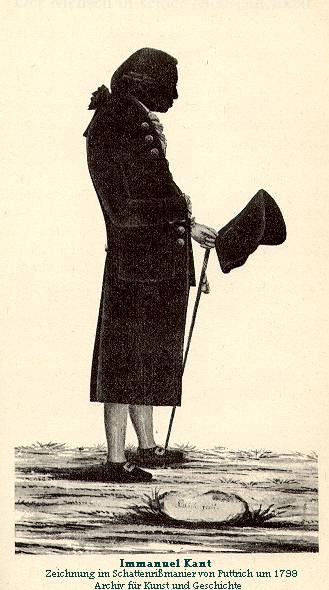
Some readers of Explaining Postmodernism object that I over-interpret Kant’s skepticism. Some prefer a gentler, more objectivity-friendly Kant. So while I quote Kant a lot in making the argument that Kant’s philosophy is radically subjectivist and the critical step down the road to postmodernism, not everyone is convinced.
So I am grateful to Quee Nelson for the following fine collection of quotations from various of Kant’s works, all supporting the Kant-as-subjectivist thesis. The quotations are included in the Appendix to Nelson’s (recommended) The Slightest Philosophy.
“It still remains a scandal to philosophy and to human reason in general that the existence of things outside us … must be accepted merely on faith, and that if anyone thinks good to doubt their existence, we are unable to counter his doubts by any satisfactory proof.” Critique of Pure Reason, B519.
“All objects of an experience possible for us are nothing but appearances, i.e., mere representations, which … have outside our thoughts no existence grounded in itself. … The realist … makes these modifications of our sensibility into things subsisting in themselves, and hence makes mere representations into things in themselves.” Kant, Prolegomena to Any Future Metaphysics, 13, Note II.
“The senses … never and in no single instance enable us to know things in themselves.” Kant, Critique of Practical Reason, Part I, Book I, Chap. I, sec. II, 55.
“Things in themselves … cannot be objects of experience.” Critique of Pure Reason, A385.
“Matter … is nothing other than a mere form or a certain mode of representation of an unknown object.” Critique of Pure Reason, B45.
“Nothing intuited in space is a thing in itself … what we call outer objects are nothing but representations of our sensibility the form of which is space. The true correlate of sensibility, the thing in itself, is not known, and cannot be known, through these representations; and in experience no question is ever asked regarding it.” Critique of Pure Reason, A370.
“External objects (bodies) are merely appearances, hence also nothing other than a species of my representations.” Critique of Practical Reason, Part I, Book I, Chap. I, sec. II, 54.
“The objects with which we have to do in experience are by no means things in themselves but only appearances.” Critique of Pure Reason, B520.
“Appearances are not things, but rather nothing but representations, and they cannot exist at all outside our minds.” Critique of Pure Reason, B235.
“Phenomena are not things in themselves, and are yet the only thing that can be given to us to know.” Prolegomena to Any Future Metaphysics, Part One, Remark II, 288-289.
“The non-sensible cause of these representations is entirely unknown to us.” Critique of Pure Reason, A494/B522.
“As we have just shown that the senses never and in no manner enable us to know things in themselves, but only their appearances…we conclude that all bodies together with the space in which they are, must be considered nothing but mere representations in us, and exist nowhere but in our thoughts.” Prolegomena to Any Future Metaphysics, Part One, Remark II, 288-289.
“Your object is merely in your brain.” Critique of Pure Reason, A484/B512.
“It is also false that the world (the sum total of all appearances) is a whole existing in itself … appearances in general are nothing outside our representations.” Critique of Pure Reason, A507/B535.
“Since space is a form of that intuition we call outer … we can and must regard the beings in it as real; and the same is true of time. But this space and this time, and with them all appearances, are not in themselves things; they are nothing but representations and cannot exist at all outside our minds.” Critique of Pure Reason, A492/B520.
“The understanding itself is the lawgiver of Nature; save through it, Nature would not exist at all.” Critique of Pure Reason, A126.
“If I remove the thinking subject, the whole corporeal world must at once vanish.” Critique of Pure Reason, A383. [See: Primacy of Consciousness]
“If then, as this critical argument obviously compels us to do, we hold fast to the rule above established, and do not push our questions beyond the limits within which possible experience can present us with its object, we shall never dream of seeking to inform ourselves about the objects of our senses as they are in themselves.” Critique of Pure Reason, A380.
“I had to deny knowledge in order to make room for faith.” Critique of Pure Reason, Bxxx.
Rockford College provided a research grant that enabled the writing of the first draft of the script. Virginia Murr researched the Nazi eugenics movement and proofread the manuscript. Quee Nelson shared several new-to-me quotations from key figures in the National Socialist movement. Anja Hartleb-Parson provided valuable editing and reference checking. And Christopher Vaughan designed the monograph edition.
1/31 A good post from Robert Bruner, Dean of Virginia’s Darden School of Business. A key quotation: “Artists in business are visionaries, inventors, entrepreneurs, and general managers, people who create something larger out of the assembly of resources, 2+2=5. They are quick learners; they recognize problems and opportunities ahead of the crowd; they shape large visions and enlist others in support; they communicate well and are socially-aware (in the ‘macro’ sense of understanding big issues in the world and in the ‘micro’ sense of reading a room full of people to understand their issues); they serve with integrity; and leaders have a bias for action.”
(Via Mark Lerner.)
1/28 I contributed a blurb to the back cover of Professor Jerry Kirkpatrick’s new book: Montessori, Dewey, and Capitalism. I recommend it to anyone interested in the important connections between philosophy and educational policy and practice.
1/23 A new tutorial from Michael Newberry on warping negative space. An intriguing hypothesis from novelist Lee Child, creator of the Jack Reacher character, about the origin of the thriller. (Thanks to Bob H. for the link.) And at the Atlasphere, John Enright’s review of Quee Nelson’s The Slightest Philosophy.
1/18 Freak show round-up: David Thompson reports on the extraordinary leftist bias of recent French school textbooks: “Economic growth imposes a hectic form of life, producing overwork, stress, nervous depression, cardiovascular disease and, according to some, even the development of cancer,” asserts the three-volume Histoire du XXe siècle, a set of texts memorized by countless French high school students as they prepare for entrance exams to… prestigious French universities. The past 20 years have ‘doubled wealth, doubled unemployment, poverty, and exclusion, whose ill effects constitute the background for a profound social malaise,’ the text continues. Because the 21st century begins with ‘an awareness of the limits to growth and the risks posed to humanity [by economic growth],’ any future prosperity ‘depends on the regulation of capitalism on a planetary scale.’ Capitalism itself is described at various points in the text as ‘brutal,’ ‘savage,’ ‘neoliberal,’ and ‘American.’ This agitprop was published in 2005, not in 1972. “… And just in case they missed it in history class, students are reminded that ‘cultural globalization’ leads to violence and armed resistance, ultimately necessitating a new system of global governance.” A recent extreme anti-humanist manifesto published by Oxford University Press—David Benatar’s Better Never To Have Been: The Harm Of Coming Into Existence: “Most people believe that they were either benefited or at least not harmed by being brought into existence. Thus, if they ever do reflect on whether they should bring others into existence—rather than having children without even thinking about whether they should—they presume that they do them no harm. Better Never to Have Been challenges these assumptions. David Benatar argues that coming into existence is always a serious harm. Although the good things in one’s life make one’s life go better than it otherwise would have gone, one could not have been deprived by their absence if one had not existed. Those who never exist cannot be deprived. However, by coming into existence one does suffer quite serious harms that could not have befallen one had one not come into existence. Drawing on the relevant psychological literature, the author shows that there are a number of well-documented features of human psychology that explain why people systematically overestimate the quality of their lives and why they are thus resistant to the suggestion that they were seriously harmed by being brought into existence. The author then argues for the ‘anti-natal’ view—that it is always wrong to have children—and he shows that combining the anti-natal view with common pro-choice views about foetal moral status yield a ‘pro-death’ view about abortion (at the earlier stages of gestation). Anti-natalism also implies that it would be better if humanity became extinct. Although counter-intuitive for many, that implication is defended, not least by showing that it solves many conundrums of moral theory about population.” And here is Carlin Romano’s fine take-down of John Gray in the Chronicle. (Thanks to Bob H. for the link.)
1/13 Munira Mirza asks: Is modern art a left-wing conspiracy?And here’s a fascinating piece on How Curators Saved Afghanistan’s Treasures. A key quotation: “In 1988, they secretly moved the highlights of the collection to a vault in the Central Bank at the presidential palace. Seven men had keys to the vault. All seven keys were needed to open it, so by spreading them around and keeping their locations secret (in case of death, a key reverted to the keeper’s eldest son), they were able to preserve the treasures.” (Via ArtCyclopedia.com.)
1/11 Ronald Radosh reviews Jonah Goldberg’s new book Liberal Fascism. A key historical quotation: “the very term ‘liberal fascism’ came from the pen of H. G. Wells, the famed socialist author who delivered a speech at Oxford University in 1932 that included hosannas to both Stalin’s Russia and Hitler’s Germany. ‘I am asking,’ Wells told the students, ‘for a Liberal Fascisti, for enlightened Nazis.’ Democracy, he argued, had to be replaced with new forms of government that would save mankind, producing a ‘Phoenix Rebirth of liberalism’ that would be called ‘Liberal Fascism.’ Like the activism, experimentation, and discipline that made the Soviet Union and Nazi Germany new dynamic societies, the West too could reach such a plateau by adopting the new soft fascism that suited it best.”
1/10 The excellent Ayaan Hirsi Ali has a must-read piece in The New York Times. (Via TIA Daily.)
1/9 Historian Paul Johnson draws lessons on leadership from several key twentieth-century events. And some things haven’t changed: then- ambassadors Thomas Jefferson and John Adams report to Congress what they heard in their meeting with the Tripolitan ambassador. A key quotation:“… it was founded on the Laws of their Prophet, that it was written in their [Qur’an], that all nations who should not have acknowledged their authority were sinners, that it was their right and duty to make war upon them wherever they could be found, and to make slaves of all they could take as prisoners, and that every [Muslim] who should be slain in battle was sure to go to Paradise.”
Maybe I should re-think my strategy. And here’s a humorous dialogue on the metaphysics and epistemology of the Identity Principle:
(Thanks (?) to Jules for the link.)
1/7 I’m back from a break over Christmas. Some art links to start the new year off: Lester Hunt reflects on the enduring significance of the cave painters.
An unknown Michelangelo sketch has been identified. Meanwhile, Donald Pittenger reflects on James Elkins’s Why Art Cannot be Taught and offers this saddening observation: “art students reflect their own times (and influences) to such a degree that, after a period of years, one student’s work seems indistinguishable from all the others. And this is likely to be true for all the presumed inventiveness of today’s art school; in 50 years the probability is that the stuff will look pretty similar. Moreover, almost no student currently enrolled is likely to ever be self-supporting by art sales, and even fewer will be ‘known’ even locally. Nevertheless, cohorts of students continue to pass through the educational system and faculty members congregate time and again to conduct critiques that, in the long run, are likely to be meaningless in the history of art.”