Stephen Hicks, Ph.D.

Philosopher

Five differences between Nietzsche and the Nazis

[This is Section 27 of Nietzsche and the Nazis.]

lion-100-pxPart 6. Nietzsche against the Nazis

27. Five differences

Now we can ask the big pay-off question. After surveying National Socialist theory and practice and engaging with Friedrich Nietzsche’s philosophy, we can ask: How much do Nietzsche and the Nazis have in common? Or to put it another way: To what extent were the Nazis justified in seeing Nietzsche as a precursor of their movement?

We know that Adolf Hitler, Joseph Goebbels, and most of the major intellectuals of National Socialism were admirers of Nietzsche’s philosophy. They read him avidly during their formative years, recommended him to their peers, and incorporated themes and sayings from Nietzsche into their own writings, speeches, and policies. To what extent were they accurate and justified in doing so?

In my judgment on this complicated question, a split decision is called for. In several very important respects, the Nazis were perfectly justified in seeing Nietzsche as a forerunner and as an intellectual ally. And in several important respects, Nietzsche would properly have been horrified at the misuse of his philosophy by the Nazis.

Let us start with the key differences between Nietzsche and the Nazis. Here I want to focus on five important points.

[Return to the Nietzsche and the Nazis page. Go to the StephenHicks.org main page.]

Posted 2 years ago at 8:31 am.

Add a comment

The Holocaust [Section 19 of Nietzsche and the Nazis]

[This is Section 19 of Nietzsche and the Nazis.]

19. The Holocaust

In 1821, the German poet Heinrich Heine wrote, “Where books are burnt, in the end people are also burnt.” Heine was evoking the terrible era of the Reformation and Counter-Reformation in which both people and books were burned regularly. But he was also making a philosophical point about the importance of ideas: books are about ideas, and ideas matter. We humans live what we believe, and if history teaches us anything it is that people can believe an incredible variety of things about themselves and the world they live in. Books store and transmit ideas, but it is in the minds of actual human beings that ideas live and are put into practice. Burning a book has some stopping power for an idea, but the only way to eliminate an idea fully is to eliminate the individuals who believe it. Dictators know this and they have no compunction about eliminating individuals.

The Nazis were not historically unique in this way—where they were unique is in the huge scale upon which they operated and the cold-bloodedly efficient ruthlessness with which they destroyed, killed, and burned human beings.

Eleven to twelve million human beings were exterminated during the Holocaust; approximately six million of them were Jews. We have all heard the numbers and the terrible stories before, and sometimes it is hard for them not to become just abstract statistics in our minds.

But just think of one person you know who lives a real life, has dreams, works hard, loves his or her family, has a quirky sense of humor, wants to travel the world. And then imagine that person taken away in the middle of the night, herded into a cattle car, stripped naked, experimented upon without anesthesia, slowly starved, gassed, shoved into an oven and burned to cinders. That is what the Nazis did to millions of human beings.

All of the theoretical ingredients of the National Socialist program that contributed to the Holocaust were announced publicly twenty years before the Holocaust began:

That human beings are divided into collective groups that shape their identity.

That those collective groups are in a life and death competitive struggle with each other.

That any tactic is legitimate in the war of competing groups.

That human beings are not individuals with their own lives to live but are servants of the state.

That the state should have total power over both the minds and bodies of its citizens and may dispose of them as it wishes.

That citizens should obey a higher authority and be willing to make the ultimate sacrifice for the good of their group, as defined by higher authority.

Additionally, during the 1930s the Nazis had experimented with most of the practical techniques that would be used in the Holocaust. In the 1930s, basic human rights to liberty, property, the pursuit of happiness were denied to millions as a matter of official policy. Many of those deemed undesirable had been forced to leave their homes and country. Those who stayed were subject to officially tolerated vandalism, beatings, and occasional murders. Some of those deemed unfit to reproduce had been sterilized. Some of those deemed unfit to live had been euthanized. As early as 1933, concentration camps had been established north of Berlin at Oranienburg and at Dachau in the south of Germany. More camps were added as the decade progressed.

And of course the vicious anti-Semitism of the Nazis and their sympathizers among millions of Germans had been common knowledge and common practice. It is appropriate that the classically-educated Dr. Joseph Goebbels, Reich Minister of Culture, would express it most bluntly and clearly: “Certainly the Jew is also a Man, but the Flea is also an Animal.”[42]

So I return to our early question: How could Nazism happen?

References

[42] “Sicher ist der Jude auch ein Mann, aber der Floh ist auch ein Tier.”

[Bibliography.]

[Return to the Nietzsche and the Nazis page. Go to the StephenHicks.org main page.]

Posted 2 years, 1 month ago at 3:37 pm.

1 comment

The question of Nazism’s philosophical roots [Section 20 of Nietzsche and the Nazis]

[This is Section 20 of Nietzsche and the Nazis.]

20. The question of Nazism’s philosophical roots

We do not do ourselves any favors by not understanding Nazism thoroughly or by being satisfied with superficial explanations. It took a world war to stop National Socialism in the twentieth century. War is brute force. Brute force rarely changes anyone’s minds about anything, and it alone does not destroy the underlying causes that motivate conflict. To use a crude analogy: If two neighbors are having an ongoing argument about a series of issues, and one neighbor hits the other and knocks him unconscious—that ends the argument but it does not solve their problems. The source of their argument is still there and it will re-surface.

The same holds for the underlying causes of National Socialism and its differences with the liberal democracies. The liberal democracies were able to knock out the Nazis in World War II, though it was a close call—but the underlying arguments are still with us.

The differences between National Socialism and liberal democracies are profound and involve entirely different philosophies of life. National Socialism was the product of a well-thought-out philosophy of life, the main elements of which were originated, crafted, and argued by philosophers and other intellectuals across many generations.

The Nazi intellectuals were not lightweights, and we run the risk of underestimating our enemy if we dismiss their ideology as attractive only to a few cranky weirdos.[43] If your enemy has a machine gun but you believe he only has a pea shooter, then you are setting yourself up for failure. And if we remind ourselves of the list of very heavyweight intellectuals who supported Nazism—Nobel Prize winners, outstanding philosophers and brilliant legal thinkers—then it is clear that these were no pea-shooters and that we need heavyweight intellectual ammunition to defend ourselves.

karl_marx-100pxIn the case of other major historical revolutions, we are more familiar with seeing the significance of philosophy. When we think for example of the causes of the Communist Revolutions in Russia and China, we naturally think back to the philosopher Karl Marx. When we think of the causes of the French Revolution, we think back to Jean-Jacques Rousseau. When we think of the causes of the American Revolution, we naturally think back to the philosopher John Locke. The same holds the causes of National Socialism—although since the Nazi regime went so horribly wrong, there is perhaps some reluctance to name names. Yet naming names is sometimes crucial if we are going to get to the historical heart of the matter. What philosophers can we cite in the case of the Nazis? Several names are candidates: Georg Hegel, Johann Fichte, even elements from Karl Marx.

But in connection with the Nazis, perhaps the biggest and the most controversial name regularly mentioned is that of Friedrich Nietzsche. The Nazis often cited Nietzsche as one of their philosophical precursors, and even though Nietzsche died thirty-three years before the Nazis came to power, references to Nietzsche crop up regularly in Nazi writings and activities. In philosopher Heidegger’s lectures, for example, “Nietzsche was presented as the Nazi philosopher.”[44]

In his study, Adolf Hitler had a bust of Friedrich Nietzsche. In 1935, Hitler attended and participated in the funeral of Nietzsche’s sister Elisabeth. In 1938, the Nazis built a monument to Nietzsche. In 1943, Hitler gave a set of Nietzsche’s writings as a gift to fellow dictator Benito Mussolini.[45]

Hitler’s propaganda minister, Joseph Goebbels, was also a great admirer of Friedrich Nietzsche. In his semi-autobiographical novel, Goebbels has the title character Michael die in a mining accident—afterward three books are found among his belongings: the Bible, Goethe’s Faust, and Nietzsche’s Thus Spake Zarathustra.

So who was Friedrich Nietzsche?

References

[43] Recall Albert Speer on “the event that led me to [Hitler]”—a speech Hitler gave to the College of Engineering in Berlin: Speer expected it to be “a bombastic harangue” but it turned out to be a “reasoned lecture” (quoted in Orlow 1969, p. 199).

[44] Rohkrämer 2005, p. 181.

[45] During WWI, the German government printed 150,000 copies of Nietzsche’s Thus Spake Zarathustra and gave them to soldiers along with a copy of the Bible.

[Bibliography.]

[Return to the Nietzsche and the Nazis page. Go to the StephenHicks.org main page.]

Posted 2 years, 1 month ago at 3:34 pm.

Add a comment

Economic controls [Section 17 of Nietzsche and the Nazis]

[This is Section 17 of Nietzsche and the Nazis.]

17. Economic controls

Through education and censorship, the Nazis attempted to socialize the German mind. Through public health measures and eugenics, they attempted to socialize the German body. A natural extension of both policies was to socialize German economic production.

As would be expected by the socialist part of National Socialism, the guiding principle of Nazi economics was that all property belongs to the people, the Volk, and was to be used only for the good of the people. Just as one’s body is no longer one’s private possession but rather belongs to the whole community, economic property was no longer anyone’s private possession but to be used by State permission and only for the good of the people.

Upon coming to power, the Nazi government nationalized Jewish property and in 1934 passed a law allowing the expropriation of property owned by communists.

Another early policy given high priority by the Nazi government was the organizing of all German businesses into cartels. The argument was that—in contrast to the disorderliness and egoism of free market capitalism—centralization and state control would increase efficiency and a sense of German unity. In July of 1933, membership in a cartel became compulsory for businesses, and by early 1934 the cartel structure was re-organized and placed firmly under the direction of the German government.

By 1937, small businesses with capital under $40,000 were dissolved by the State; labor unions had been dissolved, as were the rights to strike and collective bargaining. Unemployment was dealt with by public works programs of road-building and so on.

All property and labor power was now either owned by the State or, if still owned by private parties, subject to almost-total control. Businesses were told by the State what to produce and in what quantities. Prices and wages were set by the State.

And if anyone complained, a commonly used Nazi slogan put them on the defensive: “The common interest before self interest.”[36] The argument was quite clear: You are not a private individual seeking profit or higher wages in a capitalist economy. You and your property belong in trust to the German people, and you have a duty to serve the public interest, even if it involves a personal sacrifice.

There is an important sub-point worth dwelling upon, for there is a lively debate about just how committed to socialism the Nazis were. After all, they did not outright nationalize all businesses as pure socialism would require; rather they allowed several important businesses to remain in private hands.

A 1935 official statement put the National Socialist policy this way: “The power economy will not be run by the state, but by (private) entrepreneurs acting under their own free and unrestricted responsibility. … The state limits itself to the function of control, which is, of course, all-inclusive. It further reserves the right of intervention … in order to enforce the supremacy of considerations of public interest.”[37]

The issue about how socialist the Nazis were is, in part, a judgment call about long-term principles and short-term pragmatism.

Here is a related example: Clearly the Nazis were strongly committed to racism. But we could point out that they formed alliances with the Italians and the Japanese, neither of whom are Aryans racially. Yet obviously it would be a mistake to infer from these alliances that the Nazis were not really racist. They were racist, but as a matter of short-term strategy and political compromise they were willing to form alliances with those whom they would otherwise despise. Since the Italians and Japanese were powers, it made strategic sense to overlook the racial issue in the short run.[38]

The same holds for the economic socialism: allowing some major businesses to remain officially in private hands made pragmatic economic sense in the short run. The Nazis knew they needed productive businesses to fuel the economy and their developing war machine, so it would have been foolish to interfere too much with smoothly-running enterprises. Additionally, the Nazis knew they could count on the German nationalism of many business owners to go along with what the Nazi government asked of them. And if push came to shove, the Nazis could and did pass precise regulations to direct production as they saw fit.[39]

So while the Nazi government imposed many regulations upon German businesses, the Nazis counted on and received much voluntary commitment and enthusiasm. Most business owners, managers, and workers believed in the cause and devoted their economic energies to it. They saw the personal sacrifices demanded of them as their duty, and they obediently and willingly bore the sacrifices for the good of the cause.

As a result, from 1932 to 1936 Germany underwent an economic boom, lifting itself out of the stagnation of the 1920s and early 1930s. Unemployment fell from six million to one million, national production rose 102% and national income doubled.[40]

By 1936, the same year the Germans hosted the Olympic Games in Berlin, the German economy was again a powerhouse. A national vote was held in March to gauge popular support for Hitler’s regime. “Adolf Hitler” was the only name on the ballot, and voters had a choice to vote for Hitler or not. As dubious as the vote was, the numbers do tell us something: 98.6% of the voting population voted, and of those 98.7% voted for Hitler. That means that over 44 million adult Germans expressed approval and only about half a million did not.

References

[36] “Gemeinnutz geht vor Eigennutz!” (quoted in Meinecke 1950, p. 51); cf. the 1920 Nazi Program.

[37] Quoted in Pipes 1999, p. 221.

[38] Hitler’s pragmatism in foreign policy: “In political life there is no such thing as principles of foreign policy. The programmatic principles of my party are its doctrine on the racial problem and its fight against pacifism and internationalism. But foreign policy is merely a means to an end. In questions of foreign policy I shall never admit that I am tied by anything” (quoted in Heiden, p. xx).

[39] “Buried under mountains of red tape, directed by the State as to what they could produce, how much, and at what price, burdened by increasing taxation and milked by steep and never ending ‘special contributions’ to the party, the businessmen, who had welcomed Hitler’s regime so enthusiastically because they expected it to destroy organized labor and allow an entrepreneur to practice untrammeled free enterprise, became greatly disillusioned. One of them was Fritz Thyssen, one of the earliest and biggest contributors to the party. Fleeing Germany at the outbreak of the war, he recognized that the ‘Nazi regime has ruined German industry.’ And to all he met abroad he proclaimed, ‘What a fool [Dummkopf] I was!’” (Shirer 1962, p. 261).

[40] Shirer 1962, p. 258-259.

[Bibliography.]

[Return to the Nietzsche and the Nazis page. Go to the StephenHicks.org main page.]

Posted 2 years, 1 month ago at 11:15 am.

1 comment

Education [Section 14 of Nietzsche and the Nazis]

[This is Section 14 of Nietzsche and the Nazis.]

14. Education

Political tools such as physical force and authoritarian laws are necessary tools for a dictatorship, but long-term control of a people also requires control of their minds. The Nazis recognized this and made re-shaping Germany’s educational system a priority. They already had a good head-start.

When the National Socialists came to power in 1933, about 2.5 million Germans were members of the Nazi Party. Seven percent of the Party’s members were from the upper class, seven percent were peasants, thirty-five percent were industrial workers, and fifty-one percent were from the professional and middle class. Surprisingly, in the latter group, the professional and middle class, the largest occupational group represented was elementary school teachers. Hitler and the Nazis thus already had a core group of committed followers in a position to help them shape the minds of the next generation.

The general purpose of education

The Nazis had a particular kind of youth in mind. As early as 1925, Hitler had written in Mein Kampf: “the folkish state must not adjust its entire educational work primarily to the inoculation of mere knowledge, but to the breeding of absolutely healthy bodies. The training of mental abilities is only secondary.”[28]

Come 1933 and power, Hitler repeatedly made it even clearer what kind of healthy bodies he wanted the educational system to produce:

“My program for educating youth is hard. Weakness must be hammered away. In my castles of the Teutonic Order a youth will grow up before which the world will tremble. I want a brutal, domineering, fearless, cruel youth. Youth must be all that. It must bear pain. There must be nothing weak and gentle about it. The free, splendid beast of prey must once again flash from its eyes … That is how I will eradicate thousands of years of human domestication … That is how I will create the New Order.”

Intellectual training was less emphasized than physical training, but it was not omitted. Students were trained in Nazi ideology, studied German history from a National Socialist perspective, learned political activism, and trained themselves to develop a selfless, obedient, duty-oriented moral character. The curriculum was revised, textbooks re-written, and teachers trained as servants of the cause. Early in the Nazi reign, teachers were declared to be civil servants and required to join the National Socialist Teachers League, swearing an oath of absolute fidelity to Adolf Hitler.

The Hitler Youth

hitler-andyouth-100pxIn addition to transforming the formal school system, the Nazis put great emphasis on the Hitler Youth organization. The Nazi Party’s youth organization had been formed in 1922, early in the party’s history, and acquired its Hitler Youth name in 1926. The purpose of the Hitler Youth was to train a cadre of devoted young followers outside the formal school system. Once the Nazis came to power, the formal German school system and the Hitler Youth became complementary training and indoctrination programs.

Boys could enter the program when they were age six, though official training began at age ten. All members of the Hitler Youth swore this oath: “In the presence of this blood-banner, which represents our Führer, I swear to devote all my energies and my strength to the savior of our country, Adolf Hitler. I am ready and willing to give up my life for him, so help me God.”[29]

Full membership and systematic training began at age fourteen and included the ability to take a physical beating without whining. Brutal fighting sessions among the boys were common and encouraged. As Hitler had put it in Mein Kampf, “But above all, the young, healthy body must also learn to suffer blows.”[30] If a boy was unable to withstand the pain or pressure, he was embarrassed in front of his peers. Those who succeeded, though, received accolades, a sense of belonging to a great cause, and useful symbols of their status, such as a special dagger.

Parallel programs existed for girls. The League of Young Girls was established for girls ten to fourteen years of age. The fourteen-to-eighteen-year-old girls’ group of the Hitler Youth was the Bund Deutscher Mädel, or League of German Girls. From seventeen to twenty-one years of age, young Aryan women were members of Faith and Beauty. Instruction focused on home, family, and the duty to bear children. The girls’ training was similar to the boys’, including wearing military-style uniforms, engaging in soldier-like activities, and learning Nazi ideology and activism.

Although the youth were encouraged to question their parents and their non-Nazi teachers, within the Hitler Youth absolute obedience was demanded. Despite this, membership in the Hitler Youth was appealing to many young Germans. Summer camps and parades were regular activities for the Hitler Youth. There was also the feeling of camaraderie and the sense of developing a sense of self-discipline, loyalty, and honor. Membership came to be considered to be a badge of honor—and, as the Nazi Party came closer to achieving power, membership even became a status symbol.

In 1932, the year before the Nazis came to power, the Hitler Youth had 107,956 members—or five percent of the German youth population. Within a year, membership had swollen to well over two million members.

In 1936, membership in the Hitler Youth became mandatory. All other youth groups had ceased to exist, been absorbed into the Hitler Youth, or abolished. And by 1939, the year that World War II was to begin, membership in the Hitler Youth reached almost eight million members.

The universities

The Nazis had also achieved great success with older students, those of university age.

Well before Hitler came to power, Nazi student groups existed at universities all over Germany. Before 1933, it was common for students to come to classes wearing brown shirts and swastika armbands, and in many cases it was the most intelligent and idealistic university students who were the most activist and outspoken supporters of National Socialism.

The students also had many allies among their professors.

When the National Socialists took power, they prohibited all Jews from holding academic positions—this resulted in the firing of hundreds of tenured Jewish professors, including several Nobel Laureates. To their credit, many other professors resigned in protest or emigrated. But such professors were in the small minority.[31]

A large majority of university professors remained on the job, either silently accepting the new regime or even actively supporting it. In 1933, for example, 960 professors, including prominent figures such as philosopher Martin Heidegger, made a public proclamation of their support for Adolf Hitler and the National Socialist regime.[32]

References

[28] Hitler 1925, p. 408.

[29] Quoted in Shirer 1962, p. 253.

[30] Hitler 1925, p. 410.

[31] “But in numbers the émigrés were not to be compared with the leading figures in every field of intellectual endeavour who hailed the advent of National Socialism and pledged support to its Führer with every evidence of enthusiasm” (Craig 1978, p. 639).

[32] Shirer 1962, p. 251. Rohkrämer notes the following: “Association with National Socialism was also widespread among philosophers. While twenty philosophy professors were forced out of their positions, about thirty joined the Nazi Party in 1933 and almost half became party members by 1940” (Rohkrämer 2005, p. 171). On Heidegger in particular, given his high profile in the landscape of 20th-century philosophy, “‘Martin Heidegger? A Nazi, of course a Nazi!’ On a purely factual level, this exclamation by Jürgen Habermas is fully correct. Contrary to what Heidegger and Heideggerians have long maintained, historical research has demonstrated beyond doubt Heidegger’s early enthusiasm for National Socialism. Heidegger sympathized with the Nazis before 1933, he actively maneuvered to become rector, he publicly joined the Nazi Party on May Day, and the ceremony around his Rectoral Address included Nazi flags and the singing of the ‘Horst Wessel Song.’ While Jews and political opponents were removed from the university (like his teacher Edmund Husserl) or even forced to flee the country (like his intimate friend Hannah Arendt), Heidegger showed his enthusiastic support for the destruction of the Weimar Republic and for the new regime. He praised the Führer principle for the university sector, while striving to attain such a position for himself. In speeches and newspaper articles he identified himself with Hitler’s rule, going so far as to state in autumn 1933 that ‘the Führer himself and alone is and will be Germany’s only reality and its law.’ He not only approved in principle of the Nazi cleansing, but also tried to use the new regime to destroy the academic careers of colleagues, for example by initiating a Gestapo investigation” (Rohkrämer 2005, p. 172-173).

[Bibliography.]

[Return to the Nietzsche and the Nazis page. Go to the StephenHicks.org main page.]

Posted 2 years, 1 month ago at 2:46 pm.

1 comment

Nationalism, not internationalism or cosmopolitanism [Section 9 of Nietzsche and the Nazis]

[This is Section 9 of Nietzsche and the Nazis.]

9. Nationalism, not internationalism or cosmopolitanism

This raises a question. So far the Nazi Program emphasizes that collectivism and socialism take priority over the individual—but which collective or social grouping has priority? Here the Nazi Program emphatically defines its collectivism and socialism in nationalistic terms. Individuals belong primarily to their ethnic and racial groups, those ethnic and racial groups giving them their core identities.

In the 1920 Program, seven of the twenty-five points speak directly to this issue. This issue is moderately complicated, because the Nazis have three enemies in mind against whom they want to distinguish themselves.

First they reject Marxist socialism or any socialism that puts economic groupings first. As much as the Nazis hate capitalism, they do not see the world as a battle between economic groups. The Marxists, as they see it, are obsessed with and too narrowly focused on money. To the Nazis money is only part of the battle—the major battle is between different racial and cultural groups with different biological histories, languages, values, laws, and religions. The battle is between Germans—with their particular biological inheritance and cultural history—against all other racial cultures.

Second, the Nazis reject cosmopolitanism, an ideal of Western liberals who believe that all humans are essentially the same wherever one travels in the world, and who believe that one should strive to be a citizen of the world, someone who can be at home anywhere.

The Nazis are nationalists, by contrast, and they reject any form of internationalism or cosmopolitanism.[16]

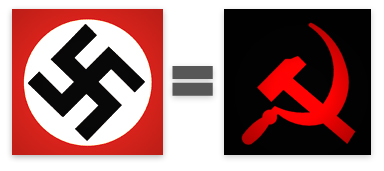
These themes explain the design of the Nazis’ swastika flag, as a symbolic integration of the socialism and the nationalism. Red is symbolic of socialism, white is symbolic of Nationalism, and the swastika is, according to Hitler, representative of the Aryan struggle for racial and cultural supremacy against those who are trying to destroy the Germans.

Consequently, in the Nazi Program of 1920 we find many points about German national identity and asserting German needs and goals.

Point 1 demands the unification of all ethnic Germans into a greater Germany.

Point 8 demands that immigration by non-Germans be halted and that all those who have immigrated recently be expelled from the country.

Public offices can be open only to citizens, and Point 3 defines citizenship in terms of the possession of German blood.

And the possession of German blood is defined carefully to reject a third target of the Nazis, those whom they hate even more than the Marxists or the liberal capitalists—and that is the Jews.[17]

Point 3 of the Program denies that Jews can be racial comrades of Germans, and this in combination with the other points in the Program effectively shuts the Jews out of German life.

A widely-used Nazi propaganda poster displayed a dragon with three heads wearing hats representing the communist, the international capitalist, and the Jew—the enemies the pure German warrior must defeat.

From the beginning of the Party in 1920, then, the pro-German nationalism and the strong anti-Semitic themes are, like the collectivism and the socialism, core Nazi themes.

mein-kampf-cover-100pxWhile the 1920 Program only mentions the Jews twice and seems to advocate only that the Jews be forced to leave Germany, within a few years the Nazi leadership had clearly begun to consider harsher measures. In 1925, for example, Hitler published Mein Kampf, a book that sold increasingly well as the Nazis rose to power. Hitler variously describes the Jews as an “octopus,” as “a parasite on the body of other nations,” as a “vampire,” as a “spider” that was “suck[ing] the blood out of the people’s pores,” and as having taken over the German state. To free the German Volk, consequently, Hitler calls for the “elimination of the existing Jewish one” and “the end of this parasite upon the nations.”[18]

References

[16] As Goebbels put it in his 1929 Michael, which sold well and went through seventeen editions: “Race is the matrix of all creative forces. Humanity—that is a mere supposition. Reality is only the Volk. Humanity is nothing but a multitude of peoples. A people is an organic entity” (Goebbels 1929, in Mosse ed., 1966, p. 106).

[17] Michael Mack’s German Idealism and the Jew (University of Chicago Press, 2003) is a study of the role German philosophers, historians, and other intellectuals, including Kant, Hegel, Marx, and others, played in developing and promoting anti-Semitism. See Appendix 3 for further quotations.

[18] Hitler 1925, pp. 623, 305, 327, 193, 453, and 327.

[Bibliography.]

[Return to the Nietzsche and the Nazis page. Go to the StephenHicks.org main page.]

Posted 2 years, 2 months ago at 10:01 am.

Add a comment

Idealism, not politics as usual [Section 11 of Nietzsche and the Nazis]

[This is Section 11 of Nietzsche and the Nazis.]

11. Idealism, not politics as usual

It is important to emphasize that the Nazis put their program forward forthrightly and as a noble—even spiritual—ideal to achieve. They promised not merely another political platform, but a whole philosophy of life that, as they and their followers believed, promised renewal. And they called upon Germans to exercise the highest virtues of altruism and self-sacrifice for the good of society to bring about that renewal.

Program point 10 urges individuals to put the common good of Germany before their self interest. Point 24 repeats it. Hitler and Goebbels repeatedly urge Nazism as a spiritual and ideal vision in contrast to the usual power-grubbing politics of the day.

In Mein Kampf, Hitler insisted that “All force which does not spring from a firm spiritual foundation will be hesitating and uncertain. It lacks the stability which can only rest on a fanatical view of life.”[22]

He called upon individuals not to be egoistic but be willing to sacrifice: “the preservation of the existence of a species presupposes a spirit of sacrifice in the individual.”[23]

michael-100pxIn Goebbels’s autobiographical novel, Michael, a book that sold out of seventeen editions, the leading character is explicitly likened to Jesus Christ: Michael is the ‘Christ-socialist’ who sacrifices himself out of love for mankind—and Goebbels urges that noble Germans be willing to do the same.[24] A widely-used Nazi poster featured a religiously spiritual figure with its arm encircling a young Nazi soldier.

Hitler regularly praised Germans for their spirit of altruism: “this state of mind, which subordinates the interests of the ego to the conservation of the community, is really the first premise for every truly human culture.”[25] Altruism, he believed, is a trait more pronounced in Germans than in any other culture, which is why he claimed to be so optimistic about Germany’s future.

This message of National Socialism as a moral ideal and a spiritual crusade was appealing to many, many Germans—and especially the young. By 1925 the party membership in the north was mostly young: two-thirds of the members were under thirty years of age, and in a few years the Nazis had attracted a large following among university students.

Goebbels especially called out to the idealistic young to be the heart of the Nazi future in Germany:

“The old ones don’t even want to understand that we young people even exist. They defend their power to the last. But one day they will be defeated after all. Youth finally must be victorious. We young ones, we shall attack. The attacker is always stronger than the defender. If we free ourselves, we can also liberate the whole working class. And the liberated working class will release the Fatherland from its chains.”[26]

References

[22] Hitler 1925, p. 222.

[23] Hitler 1925, p. 151.

[24] Goebbels 1929, in Mosse ed., 1966, p. 108.

[25] Hitler 1925, 298. Hitler distinguishes altruism from “egoism and selfishness” and also labels it “Idealism. By this we understand only the individual’s capacity to make sacrifices for the community” (1925, p. 28). Egoism and the pursuit of happiness he sees as the great threat: “As soon as egoism becomes the ruler of a people, the bonds of order are loosened and in the chase after their own happiness men fall from heaven into a real hell” (1925, p. 300).

[26] Goebbels 1929, p. 111.

[Bibliography.]

[Return to the Nietzsche and the Nazis page. Go to the StephenHicks.org main page.]

Posted 2 years, 2 months ago at 9:58 am.

Add a comment

Nazi democratic success [Section 12 of Nietzsche and the Nazis]

[This is Section 12 of Nietzsche and the Nazis.]

12. Nazi democratic success

For the Nazis, the clear, firm, and passionate advocacy of their political goals, along with efficient organization and propaganda, brought them increasing democratic success in Germany.

After years of work, by 1928 the party had only twelve seats in the Reichstag, Germany’s national parliament. But in the election of September 1930, they increased that number to 107 seats. Less than two years later, in the election of July 1932, they increased that number dramatically to 230 seats. A few months later they lost thirty-four seats in a November election and now had 196. But in January of 1933, Hitler was appointed Chancellor of Germany, one of the two highest positions in the land, and the Nazis were in a position to consolidate their power. In March of 1933 they called yet another election in order to get a clear mandate from the German people about their plans for Germany. The election had a huge turnout and the Nazis scored huge gains, winning 43.9% of the popular vote and 288 seats in the Reichstag. 288 seats are more seats than their next three competitors combined.

Table 1. Germany: March 5, 1933 election. Seats in the Reichstag[27]:

NSDAP (National Socialist) 288

SPD (Socialist) 120

KPD (Communist) 81

Zentrum (Center, Catholic) 73

Kampfront SWR (Nationalist) 52

Bayerische Volkspartei 19

Deutsche Staatspartei 5

Christlich-Sozialer Volksdienst 4

Deutsche Volkspartei (Nationalist) 2

Deutsche Bauernpartei 2

Württembergerische Landbund 1

By early 1933, the National Socialist German Workers’ Party was in control. early-leaders-of-the-nazi-party-100px

References

[27] Craig 1978, p. 576.

[Bibliography.]

[Return to the Nietzsche and the Nazis page. Go to the StephenHicks.org main page.]

Posted 2 years, 2 months ago at 9:58 am.

Add a comment