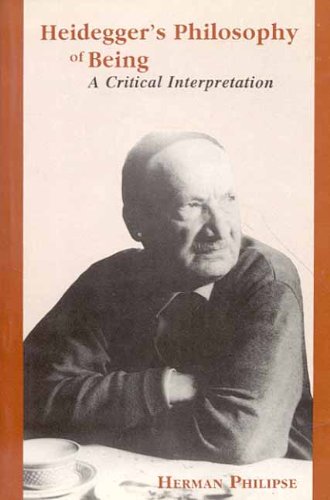
Tim Black, a senior writer at spiked, has a good review discussion of “Why they’re really scared of Heidegger.” The “they’re” refers to many contemporary academics, and Black’s review is of Emmanuel Faye’s wave-making Heidegger: The Introduction of Nazism into Philosophy in Light of the Unpublished Seminars of 1933-1935 (Yale, 2009).
Some key quotations from Black’s essay with some commentary from me:
“The philosopher still makes some academics feel itchily uncomfortable, not because they truly believe his Nazism will leap from the pages of his works, but because his deeply anti-humanist arguments sound a little too familiar.”
Indeed. In the academic world, especially in the Humanities, we are surrounded by anti-humanists postmodernists, left environmentalists, extreme animal activists, and various other sub-species. (I sometimes wonder whether—for the sake of truth in advertising—we should rename the “Humanities” divisions in our colleges the “Anti-Humanities.” Not that I am bitter or anything.)
Yet there is a bit of a puzzle for some commentators given that, on the usual (ridiculous) Left-Right political spectrum, Heidegger and the Nazis are often place on the “Right” while most of Heidegger’s contemporary fellow-travelers are on the “Left.” Tim Black notes: “Heidegger’s influence is such that any attempt to see the fascist thread loses itself in the weave and weft of an immense, largely leftish legacy.”
So we have to go up a level of abstraction to see the connections. Just as “left” Communism and “right” Nazism are two particular applications of a broader collectivist and authoritarian political vision, Heidegger’s particular philosophy and contemporary postmodernists’ particular philosophy share essentially the same anti-reason and anti-human vision.
Black puts it this way: “The discomfort Heidegger’s Nazism repeatedly causes is revealing. … Heidegger prompts discomfort precisely because he was a Nazi propagating a non-Nazi philosophy. He is just not alien enough. His is a philosophical vision that sits too comfortably with many mainstream attitudes, whether it’s an environmentalist assault upon human hubris or a snobbish disdain for consumerism.”
And of Heidegger’s more abstract philosophical commitments, i.e., his stance against reason and modernity, Black says: “what remained consistent throughout, from the Letter on Humanism to the Question Concerning Technology, was that veiled, abstracted, but nonetheless, resonant critique of modernity, and the human-centred rationality he discerned at its fallen heart … . His thought resonates not because he was a Nazi, but because his criticism of modernity echoes many of today’s anti-modern trends.”
Exactly right. Heidegger’s Nazism is a particular application of his broader anti-humanism, and his philosophical influence has to be understood from that level of abstraction and generality. Heideggerian anti-humanism can be applied particularly in a number of ways, so that is why we find his continued resonance with today’s postmodernists, left environmentalists, neo-Luddites, and man-hating animal activists, and the rest.
My own discussion of Heidegger appears in Chapter Three (pp. 58-67) of my Explaining Postmodernism. Four sections of that chapter are devoted to Heidegger:
* “Heidegger’s synthesis of the Continental tradition”
* “Setting aside reason and logic”
* “Emotions as revelatory”
* “Heidegger and postmodernism”
That chapter is also available at the Explaining Postmodernism page.
Posted 2 years, 2 months ago at 1:59 pm. Add a comment
[This excerpt is from Chapter 3 of Explaining Postmodernism: Skepticism and Socialism from Rousseau to Foucault]
Heidegger’s synthesis of the Continental tradition
Martin Heidegger took Hegelian philosophy and gave it a personal, phenomenological twist.
Heidegger is notorious for the obscurity of his prose and for his actions and inactions on behalf of the National Socialists during the 1930s, and he is unquestionably the leading twentieth-century philosopher for the postmodernists. Derrida and Foucault identify themselves as followers of Heidegger.[1] Rorty cites Heidegger as one of the three major influences on his thinking, the other two being Dewey and Wittgenstein.[2]
Heidegger absorbed and modified the tradition of German philosophy. Like Kant, Heidegger believed reason to be a superficial phenomenon, and he adopted the Kantian view of words and concepts as obstacles to our coming to know reality, or Being. However, like Hegel, Heidegger believed that we can get closer to Being than Kant allowed, though not by adopting Hegel’s abstracted third-person pretense of Reason. Setting aside both reason and Reason, Heidegger agreed with Kierkegaard and Schopenhauer that by exploring his feelings—especially his dark and anguished feelings of dread and guilt—he could approach Being. And like all good German philosophers, Heidegger agreed that when we get to the core of Being we will find conflict and contradiction at the heart of things.
So what is new? Heidegger’s distinctiveness was his use of phenomenology to get us there.
Phenomenology becomes philosophically important once we accept the Kantian conclusion that we cannot start as realists and scientists do by assuming that we are aware of an external, independent reality that is made up of objects that we are trying to understand. But, from the phenomenological standpoint, we must also realize that Kant took only a timid half-step. While Kant was willing to give up the noumenal object, he held onto the belief in an underlying, noumenal self with a specific nature available to us for our investigation. But a noumenal self underlying the flow of phenomena is just as problematic a notion as the notion of noumenal objects underlying the flow. Recognizing this, Heidegger therefore wanted to start, following Nietzsche’s occasional but undeveloped suggestions, without making the assumption of the existence of either an object or a subject.
So we start phenomenologically—that is, by simply and clearly describing the phenomena of experience and change.
On Heidegger’s account, what one finds when starting so is a sense of projection into a field of experience and change. Do not think objects, Heidegger counseled, think fields. Do not think subject, think experience. We start small and local, with Da-sein’s being projected into reality.
“Da-sein” is Heidegger’s substitute concept for “self,” “subject,” or “human being,” all of which he thought carried undesirable baggage from earlier philosophy. Heidegger explained his choice of “Da-sein” by defining it as follows: “Da-sein means being projected into Nothing.”[3] Ignoring the “Nothing” for now, it is the being projected that is Da-sein—not that, if anything, which is projected or does the projecting. The emphasis is on activity, thus avoiding assumptions that there are two things, a subject and an object, that enter into a relationship. There is simply action, the action of being out there, being thrust into.
The being projected reveals and clothes successively over time various semi-stable fields or “beings”—what we would call “objects” if we had not already shed our naïve realism.
Yet the long process of describing the phenomena of beings, Heidegger found, led him inexorably to a question—the question that has haunted all of philosophy: What is the Being of the various beings? The beings differ and change, come and go, yet for all their changeability and difference they still manifest a oneness, a commonality: They all are. What is that Being underlying or behind or common to all beings? What makes the beings Be? Or, raising the stakes to the Heideggerian Question of all questions: Why is there even Being at all? Why is there not rather Nothing?[4]
This is no ordinary question. With a question like this, Heidegger pointed out, reason quickly finds itself in trouble—the same kind of trouble that Kant had pointed out with his antinomies: reason always reaches contradictions whenever it attempts to explore deep metaphysical issues. A question such as “Why is there Being and not rather Nothing?” is therefore repugnant to reason. For Heidegger, this meant that if we are to explore the question, then reason—the “most stiff-necked adversary of thought”[5]—was an obstacle that had to be discarded.
Setting aside reason and logic
The Question is repugnant to reason, as Heidegger wrote in An Introduction to Metaphysics, because we reach logical absurdity whichever way we go in attempting to answer it.[6] If we say, on the one hand, that there is no answer to the question of why there is Being—if Being just is for no reason—then that makes Being absurd: something that cannot be explained is an absurdity to reason. But if, on the other hand, we say that Being is for a reason, then what could that reason be? We would have to say that that reason, whatever it is, is outside of Being. But outside of Being is nothing—which means that we would have to try to explain Being from nothingness, which is also absurd. So either way we go in trying to answer the Question, we are deeply into absurdity.
Logic wants at this point to forbid the Question. Logic wants to say that the absurdity shows that the question is ill-formed and so should be set aside: Logic wants instead to make the existence of reality its axiom, and to proceed from there with discovering the identities of the various existents.[7]
On the other hand, switching back to a Heideggerian perspective, the questions spawned by the Question strike very deep feelings in Da-sein. What about the Nothingness that Being would have come from? Could Being not have been? Could Being return once again to the Nothing? Such questions are compellingly awesome, and yet at the same time they fill Da-sein with a sense of disease and anxiety. So here Da-sein has a conflict: Logic and reason say that the question is contradictory and so should be set aside, but Da-sein’s feelings urge Da-sein to explore the question in a non-verbal, emotional way. So which does Da-sein choose: contradiction and feeling—or logic and reason?
Fortunately, as we have learned from Hegel, Schopenhauer, Kierkegaard, and Nietzsche, this contradiction and conflict is yet another sign that logic and reason are impotent. As we all know by now, we should expect to find conflict and contradiction at the heart of things—contradiction is the sign that we are on to something important.[8] So mere logic, Heidegger concluded—an “invention of schoolteachers, not of philosophers”[9]—cannot and should not get in the way of probing the ultimate mystery that is Being. We must reject entirely the assumption “that in this enquiry ‘logic’ is the highest court of appeal, that reason is the means and thinking the way to an original comprehension of Nothing and its possible revelation.” Again:
“If this [contradiction] breaks the sovereignty of reason in the field of enquiry into Nothing and Being, then the fate of the rule of ‘logic’ is also decided. The very idea of ‘logic’ disintegrates in the vortex of a more original questioning.”[10]
And again, in case we have missed the point: “Authentic speaking about nothing always remains extraordinary. It cannot be vulgarized. It dissolves if it is placed in the cheap acid of merely logical intelligence.”[11] Deep feeling about Nothing trumps logic any day.
Emotions as revelatory
Having subjected reason and logic to Destruktion and then set them aside as merely one superficial way of thinking—one that the Greeks had established fatefully for all subsequent Western thought[12]—we need another route to Being and Nothing. We can try to explore language without the presuppositions of reason and logic, but even the elements of language, words, have evolved over time and become so twisted and crusted over with layers of meaning that they almost entirely hide Being from us. Their original force and contact with reality has been lost. We can therefore try to strip away from our language the encrusted layers to reveal the ur-words that had original and genuine connective force to Being, but that will require special efforts.
For Heidegger, the special effort that is required is emotional, an exploratory letting oneself go into the revelatory emotions of boredom, fear, guilt, and dread.
Boredom is a good mood to start with. When we are bored—really, really, really bored—we are no longer engaged with the ordinary, trivial, day-to-day things that occupy most of our time. When we are bored, “drifting hither and thither in the abysses of existence like a mute fog,”[13] all beings become a matter of indifference, undifferentiated from one another. Everything merges or dissolves into an un-distinguished unity.
Progress has thus been made: “This boredom reveals what-is in totality.”[14] Real boredom takes one away from one’s normal focus on particular beings and one’s cares for them and diffuses one’s awareness into a sense of Being-as-a-whole’s being revealed to one.
But this revelation also brings with it anxiety and dread. For part of the process of the dissolution of particular beings into a state of undifferentiation is the dissolution of one’s own sense of being a unique, individual being. One has the feeling of beings being dissolved into an undifferentiated Being—but at the same time one has the feeling of one’s self-identity as also slipping into a state of being nothing-in-particular—that is, of becoming nothing. This is distressing.
In dread we are ‘in suspense’ (wir schweben). Or, to put it more precisely, dread holds us in suspense because it makes what-is-in-totality slip away from us. Hence we too, as existents in the midst of what-is, slip away from ourselves along with it. For this reason it is not ‘you’ or ‘I’ that has the uncanny feeling, but ‘one.’[15]
This sense of dread that comes with a sense of the dissolution of all beings along with oneself was for Heidegger a metaphysically potent state, for in effect one gets a foretaste of one’s own death, a sense of one’s being annihilated, a sense of going into nothingness—and thus a sense of getting to the metaphysical center of Being.
One must absolutely not, therefore, give into one’s overpowering sense of distress and run away from dread and back to the safety of one’s petty, day-to-day life. One must embrace one’s dread and surrender to it, for “the dread felt by the courageous”[16] is the emotional state that prepares one for the ultimate revelation. That ultimate revelation is of the truth of Judeo-Christian and Hegelian metaphysics.
In dread we come to feel that Being and Nothing are identical. This is what all philosophy based on the Greek model had missed, and what all philosophies not based on the Greek model had been struggling toward.
“Nothing,” wrote Heidegger, “not merely provides the conceptual opposite of what-is but is also an original part of essence.”[17] Heidegger credited Hegel with having reclaimed this lost insight for the Western tradition: “‘Pure Being and pure Nothing are thus one and the same.’ This proposition of Hegel’s (‘The Science of Logic,’ I, WW III, p. 74) is correct.” Hegel of course got it from trying to resuscitate the Judeo-Christian account of creation, in which God created the world out of nothing. As Heidegger put it in re-affirming that Judeo-Christian claim, “every being, so far as it is a being, is made out of nothing.”[18]
So after abandoning reason and logic, after experiencing real boredom and terrifying dread, we unveil the final mystery of mysteries: Nothing. In the end, all is nothing and nothing is all. With Heidegger, we reach metaphysical nihilism.
Heidegger and postmodernism
Heidegger’s philosophy is the integration of the two main lines of German philosophy, the speculative metaphysical and the irrationalist epistemological. After Kant, the Continental tradition quickly and gleefully abandoned reason, putting wild speculation, clashing wills, and troubled emotion at the forefront. In Heidegger’s synthesis of the Continental tradition, we can see clearly many of the ingredients of postmodernism. Heidegger offered to his followers the following conclusions, all of which are accepted by the mainstream of postmodernism with slight modifications:
1. Conflict and contradiction are the deepest truths of reality;
2. Reason is subjective and impotent to reach truths about reality;
3. Reason’s elements—words and concepts—are obstacles that must be un-crusted, subjected to Destruktion, or otherwise unmasked;
4. Logical contradiction is neither a sign of failure nor of anything particularly significant at all;
5. Feelings, especially morbid feelings of anxiety and dread, are a deeper guide than reason;
6. The entire Western tradition of philosophy—whether Platonic, Aristotelian, Lockean, or Cartesian—based as it is on the law of non-contradiction and the subject/object distinction, is the enemy to be overcome.
This is not yet to introduce Heidegger’s strong social and political collectivism, which is also part of his inheritance from the main lines of German philosophy. Nor is it to make explicit, as Heidegger did, his strong anti-science and anti-technology views.[19] Nor is it yet to discuss his anti-humanism,[20] with his regular calls for us to be obedient to Being, to feel guilty before Being, to pay homage to Being, and even to “sacrifice man for the truth of Being”[21]—which, if we are still allowed to be logical, means sacrificing ourselves to Nothing. (Those elements in Heidegger’s philosophy will arise in Chapter Four, in the context of discussing the political background to postmodernism.)
What the postmodernists will do in the next generation is abandon the remnants of metaphysics in Heidegger’s philosophy, along with his occasional streaks of mysticism. Heidegger was still doing metaphysics, and he spoke of there being a truth out there about the world that we must seek or let find us. The postmodernists, by contrast, are anti-realists, holding that it is meaningless to speak of truths out there or of a language that could capture them. As anti-realists, accordingly, they will reject the formulation of (1) above as a metaphysical assertion, and instead reformulate its assertion of the reign of conflict and contradiction as descriptive merely of the flow of empirical phenomena; and while they will accept (3) above, they will accept it while abandoning Heidegger’s faint hope that ultimate ur-concepts connecting us to reality may be revealed at the end of the unmasking.
The postmodernists will effect a compromise between Heidegger and Nietzsche. Common to Heidegger and Nietzsche epistemologically is a contemptuous rejection of reason. Metaphysically, though, the postmodernists will drop the remnants of Heidegger’s metaphysical quest for Being, and put Nietzschean power struggles at the core of our being. And especially in the cases of Foucault and Derrida, most major postmodernists will abandon Nietzsche’s sense of the exalted potential of man and embrace Heidegger’s anti-humanism.
References
[1] Foucault 1989, 326.
[2] Rorty 1979, 368.
[3] Heidegger 1929/1975, 251.
[4] Heidegger 1953, 1.
[5] Heidegger 1949, 112.
[6] Heidegger 1953, 23, 25.
[7] E.g., Rand 1957, 1015-ff.
[8] See, for example, Heidegger 1929/1975, 245-246.
[9] Heidegger 1953, 121.
[10] Heidegger 1929/1975, 245, 253.
[11] Heidegger 1953, 26.
[12] Heidegger 1929/1975, 261.
[13] Heidegger 1929/1975, 247.
[14] Heidegger 1929/1975, 247.
[15] Heidegger 1929/1975, 249.
[16] Heidegger 1929/1975, 253.
[17] Heidegger 1929/1975, 251.
[18] Heidegger 1929/1975, 254-255.
[19] Heidegger 1949.
[20] Heidegger 1947.
[21] Heidegger 1929/1975, 263.
Bibliography [pdf] [html]
[This is an excerpt from Stephen Hicks's Explaining Postmodernism: Skepticism and Socialism from Rousseau to Foucault (Scholargy Publishing, 2004, 2011). The full book is available in hardcover or e-book at Amazon.com. See also the Explaining Postmodernism page.]
Posted 2 years, 2 months ago at 1:53 am. 4 comments
[This is Section 4 of Nietzsche and the Nazis.]
4. Five weak explanations for National Socialism
a) A common explanation is that the Germans lost World War I. They were bitter over the loss and the harsh punitive measures the victors imposed in the Versailles Treaty. There is a grain of truth here, but this is a very weak explanation. One reason why it is weak is that many countries lose bitter wars, but they do not respond by electing Adolf Hitlers to power. Another reason is that Germany’s losing the war does not explain Italy. In the 1920s Italy turned to Benito Mussolini and his fascist version of National Socialism. But Italy was on the winning side of World War I. So if one of the winners of World War I became fascist, and one of the losers also became fascist, then whether one lost or won the war is not the significant factor here.
b) Another explanation holds that Germany’s economic troubles of the 1920s were the cause of National Socialism. Here again there is a grain of truth, but again this is a weak explanation. Many countries suffer economic malaise, but they do not turn to National Socialism for the solution. There is also the phenomenon of Nazi and neo-Nazi movements throughout the twentieth century in relatively prosperous countries. Very few countries suffering economic difficulties go Nazi, and there are plenty of Nazi-sympathizers in prosperous nations.
c) Another weak explanation suggests that there is something innately wrong with Germans, that history shows that they are inherently militaristic, bloodthirsty, and genocidal—and the Nazis merely tapped into and exaggerated innate German tendencies. This kind of explanation is an insult of course to the many Germans who were appalled by National Socialism, who opposed it and fought it vigorously. And it does not explain how National Socialism has appealed to people of many races and ethnicities. In 2005, Mein Kampf was a bestseller in the country of Turkey.[2] Do we want to suggest that the Turks are inherently bloodthirsty and genocidal? I do not think so.
d) Another weak explanation holds that Nazism is explained by the personal neuroses and psychoses of the Nazi leadership. The argument here is that Hitler was bitterly disappointed by being rejected for art school—or that he was a repressed homosexual—or that his right-hand man, Josef Goebbels was compensating for his below-average height and having a club foot. Again, this is a poor explanation. How many art-school rejects become Nazis? How many repressed homosexuals or handicapped men become Nazis? This explanation also ignores the large number of powerful Nazis who were neither homosexual nor short nor particularly interested in art.
e) Any of the above explanations can works together with a suggestion that the Nazis were a product of modern communications technologies—that as masters of rhetoric and propaganda the Nazis succeeded in fooling millions of Germans about their agenda and manipulated their way into power.
I have some sympathy for this way of thinking, for it is the kind of explanation that comes naturally to those of us raised in liberal democracies. When I first started learning about the Nazis, I thought they must have been insane. It is hard to imagine that such horror could be anything but the products of deranged minds manipulating the masses. But here I want to suggest two reasons why I think it is not a good idea to dismiss the Nazis merely as manipulators.
The first is that the Nazis achieved power though democratic and constitutional methods. When the party was formed in 1920, it was a small, fringe party. But it spoke to the beliefs and aspirations of millions of Germans. And in the 1920s, the Germans were, arguably, the most educated nation in the world with the highest levels of literacy, numbers of years of schooling, newspaper readership, political awareness, and so on. It was in an educated nation that the Nazis achieved increasing success in elections through the 1920s, spreading their message far and wide, until they made their major breakthroughs in the early 1930s. Millions of voters in a democracy may be wrong, but it is unlikely that they were all deluded. A better explanation is that they knew what they were voting for and thought it the best course of action. And that is what I will be arguing.
But millions of people do not decide spontaneously to vote for this party or that. A mass political movement requires that much cultural groundwork be done over the course of many years. And this is where intellectuals do their work. A culture’s intellectuals develop and articulate a culture’s ideals, its goals, its aspirations. In books, speeches, sermons, and radio broadcasts, intellectuals are a culture’s opinion-shapers. It is intellectuals who write the opinion pieces in the mass newspapers, who are the professors at the universities, the universities where teachers and preachers are trained, where politicians and lawyers and scientists and physicians get their education.
This leads us to the other reason why it is a weak explanation to say the Nazis were simply deranged and lucked or manipulated their way into political power. Consider the following list of intellectuals who supported the Nazis long before they came to power. These intellectuals represent a “Who’s Who” list of powerful minds and cultural leaders:
Philipp Lenard won the Nobel Prize for Physics in 1905.
Gerhart Hauptmann won the Nobel Prize for Literature in 1912. Hauptmann once met Hitler and described their brief handshake as “the greatest moment of my life.”
Johannes Stark won the Nobel Prize for Physics in 1919.
That is three Nobel Prize winners.
Then there is Dr. Oswald Spengler, author of the historical bestseller The Decline of the West (1918). Spengler’s books sold in the millions, and he was perhaps the most famous intellectual in Germany in the 1920s.
Then there is Moeller van den Bruck, another famous public intellectual of the 1920s. His book The Third Reich (1923) provided a theoretical rationale for National Socialism and was, like Spengler’s books, a consistent best-seller throughout the 1920s.
Then there is Dr. Carl Schmitt (1888-1985), probably the sharpest legal and political mind of his generation. Schmitt’s books are still widely read and discussed by political theoreticians of all stripes and are recognized as twentieth century classics.
And to round out this initial list, there is philosopher Martin Heidegger. Already in the 1920s Heidegger was being hailed as the brightest philosopher of his generation, which is especially significant in a philosophical nation such as Germany. That assessment has held over the course of the twentieth century. Ask professional philosophers of today to name the five most significant philosophers of the twentieth century and, whether they love him or loathe him, most will include Heidegger on the list.
These seven men are among the most intelligent and powerful minds in Germany in the decade before the Nazis came to power. They are leading figures in German intellectual culture, spanning the arts, science, history, law, politics, and philosophy.[3] All of them, to one degree or another, supported National Socialism. Was Hitler smart enough to fool all of these highly intelligent men? Or is it more likely that they knew what they believed and supported National Socialism because they thought it was true?[4]
References
[2] “Mein Kampf a Bestseller in Turkey,” April 20, 2005. Windsofchange.net. Viewed August 24, 2009.
[3] Weinreich 1999 (pp. 13-16) gives a wide-ranging list of professors and intellectuals who supported Hitler prior to 1933. See also Rohkrämer 2005 for a clear discussion of the role of Heidegger and the many other philosophers who gave enthusiastic support to the Nazis. Earl Shorris (2007) describes Germany of the time as “a society richer in the knowledge of the humanities than perhaps any other in modern times. Among those people who rose to the top of the Nazi government were students of humanities, former scholars. Joseph Goebbels had studied history and literature at the University of Heidelberg. Reinhard (Hangman) Heydrich was the child of a pianist and an opera singer who founded a conservatory. Ernst Kaltenbrunner studied law at the University of Prague. More than a third of the members of the Vienna Philharmonic belonged to the Nazi Party. Albert Speer, who ran the business side of the Nazi war machine, was an architect.” Gottlob Frege (1848-1925), the great logician and philosopher of mathematics, can be added to this list. Frege was an anti-Semite and later in life named Adolf Hitler as one of his heroes; see Reuben Hersh, What Is Mathematics, Really? (Oxford University Press, 1997), p. 241.
[4] Albert Speer described “the event that led me to [Hitler],” which was a speech Hitler gave to the College of Engineering in Berlin. Speer expected the talk to be “a bombastic harangue” but it turned out to be a “reasoned lecture” (quoted in Orlow 1969, p. 199).
[Bibliography.]
[Return to the Nietzsche and the Nazis page. Go to the StephenHicks.org main page.]
Posted 2 years, 2 months ago at 12:05 pm. 1 comment
Re-reading The Fountainhead makes me wonder: Is the character Gordon Prescott based on Martin Heidegger’s philosophy?
In Part II, Chapter 8, architect Prescott is giving a lecture to the nascent Council of American Builders, founded by Ellsworth Toohey. Reading it this time evoked in me a strong feeling of Heidegger’s “What Is Metaphysics?”, first delivered as a lecture at the University of Freiburg.
First, for your reading pleasure, here is Prescott’s speech:
“And thus the intrinsic significance of our craft lies in the philosophical fact that we deal in nothing. We create emptiness through which certain physical bodies are to move—we shall designate them for convenience as human. By emptiness I mean that which is commonly known as rooms. Thus it is only the crass layman who thinks that we put up some walls. We do nothing of the kind. We put up emptiness, as I have proved. This leads to a corollary of astronomical importance: to the unconditional acceptance of the premise the ‘absence’ is superior to ‘presence.’ That is, to the acceptance of non-acceptance. I shall state this in simpler terms—for the sake of clarity: ‘nothing’ is superior to ‘something.’ Thus it is clear that the architect is more than a bricklayer—since the fact of bricks is a secondary illusion anyway. The architect is a metaphysical priest dealing in basic essentials, who has the courage to face the primal conception of reality as nonreality—since there is nothing and he creates nothingness. If this sounds like a contradiction, it is not a proof of bad logic, but of a higher logic, the dialectics of all life and art. Should you wish to make the inevitable deductions from this basic conception, you may come to conclusions of vast sociological importance. You may see that a beautiful woman is inferior to a non-beautiful one, that the literate is inferior to the illiterate, that the rich is inferior to the poor, and the able to the incompetent. The architect is the concrete illustration of a cosmic paradox. Let us be modest in the vast pride of this realization. Everything else is twaddle.” (311)
Now let’s make some comparisons to Heidegger’s 1929 essay.
Heidegger’s prose is challenging and is often used as a clear example of obscurity. But there is a coherence there once you’re inside, so to speak. Page numbers refer to Heidegger’s essay in Walter Kaufmann’s anthology.
On the metaphysics:
* Prescott is “The architect is a metaphysical priest dealing in basic essentials, who has the courage to face the primal conception of reality as nonreality.”
* Heidegger too identifies Being and Nothing: “Nothing is that which makes the revelation of what-is as such possible for our human existence. Nothing not merely provides the conceptual opposite of what-is but is also an original part of essence. It is in the Being of what-is that the nihilation of Nothing occurs.” (251)
On the epistemology:
* Prescott is all about embracing the paradox: “If this sounds like a contradiction, it is not a proof of bad logic, but of a higher logic, the dialectics of all life and art.”
* Heidegger claims that “Because the truth of metaphysics is so unfathomable” (256) we have to set aside reason and logic: “If this breaks the sovereignty of reason in the field of enquiry into Nothing and Being, then the fate of the rule of ‘logic’ is also decided. The very idea of ‘logic’ disintegrates in the vortex of a more original questioning.” (253)
On our human relation to reality:
* Prescott: “certain physical bodies” (i.e., humans) move into “emptiness” (i.e., rooms).
* Heidegger’s term for humans is “da-sein,” which he chose as an abstract indicator with less baggage and which he defines as follows: “Da-sein means being projected into Nothing.” (251)
On the ethical implications:
* Prescott tells us that “‘nothing’ is superior to ‘something’” and so tells us to subordinate the beautiful, the literate, the rich, and the able to the non-beautiful, the illiterate, the poor, the incompetent. Which is to say, we subordinate the more to the less or the non-existent.
* Heidegger vigorously calls for us humans to sacrifice to Being: “Sacrifice is rooted in the nature of the event through which Being claims man for the truth of Being.” And: “sacrifice is the expense of our human being for the preservation of the truth of Being” (263). Of course, if the truth of Being is that it is Nothing, then Heidegger is calling for us to sacrifice ourselves for Nothing. Our actual human being is less significant than the non-being of Nothing.
Thus an intellectual history question: Did Rand base Prescott on a reading of Heidegger? Or did she absorb the themes from the zeitgeist and apply the logic of the illogic herself?
Or we might make a connection to Hegel. Rand was exposed to Hegel, of course, so she could have taken these themes from him. In “What Is Metaphysics?”, Heidegger too acknowledges Hegel as a source: “‘Pure Being and pure Nothing are thus one and the same.’ This proposition of Hegel’s … is correct” (255). But Heidegger’s 1929 essay was current in the decade that Rand was doing the research for her 1943 The Fountainhead.
So: Is there a Heidegger connection for one of Rand’s lesser-icky characters?
Posted 2 years, 4 months ago at 8:32 pm. Add a comment
I am reading How Green Were the Nazis?: Nature, Environment, and Nation in the Third Reich
, edited by Franz-Joseph Brüggemeier, Marc Cioc, and Thomas Zeller (Ohio University Press, 2005). It’s a disturbingly fascinating work.
One of the essays is Thomas Rohkrämer’s “Martin Heidegger, National Socialism, and Environmentalism,” which takes up the long-running (and occasionally vicious) arguments about Heidegger’s Nazism: To what extent was he a Nazi? To what extent did his National Socialist politics follow from or otherwise cohere with the rest of his philosophy?
Rohkrämer has this to say early on:
‘“Martin Heidegger? A Nazi, of course a Nazi!” On a purely factual level, this exclamation by Jürgen Habermas is fully correct. Contrary to what Heidegger and Heideggerians have long maintained, historical research has demonstrated beyond doubt Heidegger’s early enthusiasm for National Socialism. Heidegger sympathized with the Nazis before 1933, he actively maneuvered to become rector, he publicly joined the Nazi Party on May Day, and the ceremony around his Rectoral Address included Nazi flags and the singing of the “Horst Wessel Song.” While Jews and political opponents were removed from the university (like his teacher Edmund Husserl) or even forced to flee the country (like his intimate friend Hannah Arendt), Heidegger showed his enthusiastic support for the destruction of the Weimar Republic and for the new regime. He praised the Führer principle for the university sector, while striving to attain such a position for himself. In speeches and newspaper articles he identified himself with Hitler’s rule, going so far as to state in autumn 1933 that “the Führer himself and alone is and will be Germany’s only reality and its law.” He not only approved in principle of the Nazi cleansing, but also tried to use the new regime to destroy the academic careers of colleagues, for example by initiating a Gestapo investigation.’ (pp. 172-173)
Rohkrämer then has a nicely nuanced discussion of Heidegger’s later moving away from Nazism in several particulars — though never in principle. He also points out that Heidegger was very much not alone among philosophers in embracing the Nazis:
“Association with National Socialism was also widespread among philosophers. While twenty philosophy professors were forced out of their positions, about thirty joined the Nazi Party in 1933 and almost half became party members by 1940. Moreover, it was not only, as many have assumed, ‘life philosophers’ or radical Nietzscheans who supported the Nazis; the rival schools of neo-Kantians or ‘value philosophers’ also had adherents who made the same political decision for very different reasons.” (p. 171)
Given Heidegger’s towering presence in the landscape of 20th-century philosophy and “deep ecology” environmentalism, How Green Were the Nazis? is an important book.
[Go to the Nietzsche and the Nazis page. Go to the StephenHicks.org main page.]
Posted 2 years, 6 months ago at 1:50 pm. 7 comments