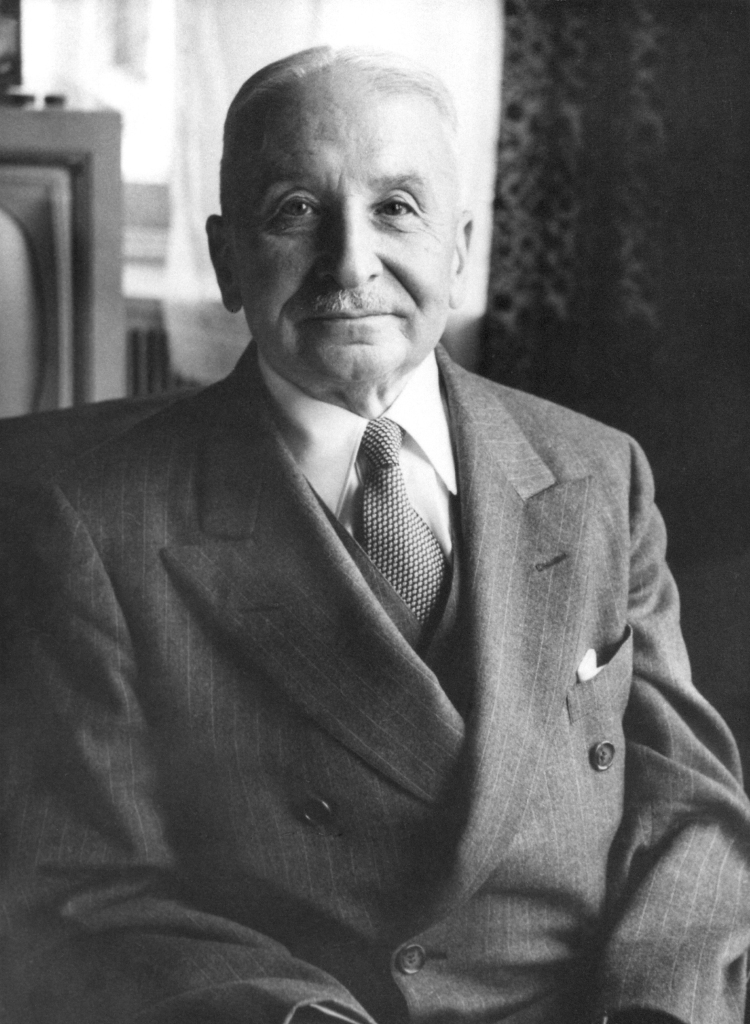
The rationale for the session: Three giants of twentieth-century thought — but few comparative studies have been done. The following panelists will discuss rights-related issues in the thought of Ludwig von Mises, Friedrich Hayek, and Ayn Rand.
Richard Ebeling, Department of Economics, Northwood University
Title: Mises on Rights and Principles
Eric Mack, Department of Philosophy, Tulane University
Title: Desert and Entitlement in Atlas Shrugged
Michelle Vachris, Department of Economics, Christopher Newport University
Title: Atlas Shrugged down The Road to Serfdom: Rand and Hayek on Rights
Stephen Hicks, Department of Philosophy, Rockford College
Title: Economic facts and values in Mises, Hayek, and Rand
One of my talks at Francisco Marroquín University was on making sense of our mixed economy–an unwieldy combination of market and socialist elements. The 28-minute talk integrates themes from my intellectual heroes–Smith, Mill, Mises, Hayek, Rand, Popper, Friedman, Buchanan, and Tullock–and connects market economics, politics, ethics, history, and public choice to explaining our semi-coherent mixed economy. The flowchart worked through is online here.
From November 3 to 6, I will be giving an invited series of lectures and seminars (nine hours worth of them!) at the Francisco Marroquín University in Guatemala.
My general themes will be entrepreneurship, ethics, philosophy, and political economy.
The times titles of my various talks are as follows.
Open Lecture (Thursday, November 3): “Entrepreneurs and Philosophers: Why a Philosophy of Freedom Matters.”
Luncheon Seminar (Friday, November 4): “Economics as a Value Science.”
Full-day Seminar (Saturday, November 5): “Philosophy for Economists and Economics for Philosophers.” Sub-units for the day:
1. Philosophy and the Evolution of the Mixed Economy
2. On the Best Arguments against Free-Market Capitalism
“Socialism is moral even if it isn’t practical.”
“Wealth is a social creation.”
“We live in a world of scarce resources.”
“The free market is dog-eat-dog.” “Humans are too depraved for freedom.”
“Humans are too incompetent for freedom.”
“Value is not of the material world.”
3. Ethics and Political-Economy
Entrepreneurship and Virtue Ethics
Objective, Subjective, and Intrinsic Value
Egoism, Altruism, and Predation
The Entrepreneurial Life
4. Government in a Free Society
What government is—the what and the how
Legislating morality
5. The Case for the Free Society
Moral and Economic Arguments for Freedom
Empirical Data and Theoretical Principles
“What” and “How” Arguments
Integrating Friedman, Hayek, and Rand
The Positive and the Negative Cases for Freedom
Why did the modern economic revolution in production and trade first happen in north-western Europe?
At the APEE conference, Deirdre McCloskey delivered a plenary address based on her new book, Bourgeois Dignity: Why Economics Can’t Explain the Modern World. Her argument is that neither material resources nor technology nor capital accumulation nor geographical factors drove the transformation. Rather, it was a change in ideas and attitudes: the producers, merchants, and traders who make up the bourgeoisie came to be respected. They got dignity, in marked contrast to the traditional disparaging in cultures dominated by the otherworldly, ascetic values of religion and the predatory martial values of tribal warriors and feudal aristocrats.
Respect for the bourgeoisie meant that they went on to develop the institutions of modern capitalism, they became a political force that undermined traditional feudalism and paved the way for modern democratic-republicanism, and the resulting more free political economy became wealthy, generating the science, the technology, and the educational institutions that we are now familiar with. A virtuous cycle was created.
Note that McCloskey’s explanation is in terms of ideas rather than reductive material forces, and in terms of ethical ideas in particular. That is to say, she is arguing that philosophical ideas are the key causal power.
Ludwig von Mises and Ayn Rand had earlier argued for ideational over materialist causes of history. Here is Mises in Planned Chaos (1947):
“The history of mankind is the history of ideas. For it is ideas, theories, and doctrines that guide human action, determine the ultimate ends men aim and the choice of the means employed for the attainment of these ends. The sensational events which stir the emotions and catch the interest of superficial observers are merely the consummation of ideological changes. There are no such things as abrupt, sweeping transformations of human affairs. What is called, in rather misleading terms, a ‘turning point in history’ is the coming on the scene of forces which were already for a long time at work behind the scene. New ideologies, which had already long since superseded the old ones, throw off their last veil, and even the dullest people become aware of the changes they did not notice before” (p. 62).
Here is Rand in For the New Intellectual (1961), focusing more narrowly on philosophical ideas as decisive: “Just as a man’s actions are preceded and determined by some form of idea in his mind, so a society’s existential conditions are preceded and determined by the ascendancy of a certain philosophy among those whose job it is to deal with ideas. The events of any given period of history are the result of the thinking of the preceding period” (p. 27).
McCloskey has been influenced by Israel Kirzner, who was one of Mises’s students. McCloskey’s importance is her is singling out of ethical ideas as fundamental. (Though see also Roark’s courtroom speech in Rand’s The Fountainhead (1943) for the mid-career Rand’s focus on a culture’s moral evaluation of innovators and creators as a key determinant of the course of history.)
First published 99 years ago, Mises’s The Theory of Money and Credit makes this observation:
“Gold is not an ideal basis for a monetary system. Like all human creations, the gold standard is not free from shortcomings; but in the existing circumstances there is no other way of emancipating the monetary system from the changing influences of party politics and government interference, either in the present or, so far as can be foreseen, in the future. And no monetary system that is not free from these influences will be able to form the basis of credit transactions.”
That observation has held up well across a century’s experience.
The title of my lecture is: “Austrians, Objectivists, and the Unrequited Love of Philosophy for Economics.” Here is the abstract:
The Austrian school of economics and the Objectivist school of philosophy have both been essential to the liberal/libertarian movement. Mises and Hayek did much work in political economy and explored relevant philosophical issues in metaphysics, epistemology, and values. Rand did much work in philosophy, which she then applied in fictional portrayals of mixed political economies in decline. Yet while there is mutual respect between Austrianism and Objectivism, there are also points of tension. My purpose in this talk is to discuss the key commonalities and differences. Much specialized work in economics and philosophy must be done, so there is a natural and important division of labor. But that work must also be coordinated in making a full and compelling case for the free society.
Thanks for the invitation to Federico Fernandez, the Bases Foundation, and the School of Economics at Catholic University of Rosario.
The Bases Foundation takes its inspiration from Juan Bautista Alberdi, one of the great nineteenth-century Argentine Enlightenment liberal political theorists.
Posted 1 year, 6 months ago at 8:33 am. 3 comments
At the APEE conference next month in Las Vegas, I will be presenting “The Evolution of the Mixed Economy - A Schematic Approach.”
My talk integrates themes from several major thinkers from whom I have learned a great deal: Adam Smith, Ludwig von Mises, Ayn Rand, Friedrich Hayek, Milton Friedman, James Buchanan, and Gordon Tullock.
The talk’s outline is based on this flow chart posted earlier under the title “Pathologies of the mixed economy (or, How we got into this frackin’ mess).”