Recent work by Newberry
A colorful list is here.
Michael Newberry finished Venus (pictured here) in 2008, the same year that my extended interview with him on the theme of Art and Entrepreneurship was published in Kaizen.
A colorful list is here.
Michael Newberry finished Venus (pictured here) in 2008, the same year that my extended interview with him on the theme of Art and Entrepreneurship was published in Kaizen.
My full interview with Ray Stata is now online at CEE’s site. (An abridged version of the interview was published in the December issue of Kaizen [pdf].)
Ray Stata is Chairman of Analog Devices, Inc., based in Norwood, Massachusetts. Working out of his basement, Mr. Stata co-founded Analog Devices in the 1960s. As of 2009, ADI serves over 60,000 customers, has 9,000 employees and a market capitalization of over $6 billion.
The interview’s theme is Entrepreneurship and Technology Leadership. Two sample excerpts, the first on the best kind of education:
“We’re finding that it is very, very challenging to be at the top of your game as an engineer. First, the technical knowledge required is both deep and broad, often cutting across multiple disciplines. And products are so complex that it often takes large teams of engineers with different specialties working across international borders. That requires human skills and communication skills to encourage collaboration and manage teams with quite varied backgrounds and experiences. And engineers must understand the financial implications of manufacturing and product development cost, as well as customer requirements and where products should be positioned in the market with respect to competition. The most successful engineers truly are ‘Renaissance Men’ and not just technical specialists.”
And the second on trust:
“First, one way or other you’ve got to be good at something, even though that something will no doubt change over time. As you enter your career, strive to achieve excellence at whatever you do.
“Back to some of the things we talked about, you soon find out that you don’t get very much accomplished in life on your own. Now there are exceptions, like musicians, artists and writers who can go off on their own and accomplish remarkable things. But most of us find that we accomplish more by working in concert with others to leverage our combined skills and competencies.
“I’ve found that one of the most important factors in being a leader, or more generally in engaging with people, is to build trustful relationships. What does that mean? Trust is built on honesty, integrity, reliability, sincerity, competence. Conduct yourself so that people can depend on what you say and what you do, on the fact that you’re more often right than wrong, on the fact that you meet your commitments, on the fact that you are straight with people and tell it how it is. If people trust you and you trust them, you can get a lot more out of relationships and out of life.”
Update: Ray Stata will be commencement speaker for MIT’s 2010 graduation ceremony.
More Kaizen interviews with leading entrepreneurs are at my site here or at CEE’s site here.
Business education is often good at teaching useful business theories and skills but less often good at teaching ethics. Ethics is often seen as irrelevant or as an obstacle, so business ethics is either not included in the core business curriculum or offered as an elective ornament.
Claim: Ethics is organically central to business success, and should be so built into business education. Two quotations from giants of American business in support.
First, from Georges Doriot, one of America’s trailblazing venture capitalists, as quoted in Jeffrey Young’s Forbes Greatest Technology Stories:
“Doriot spends most of his time talking to people who bring him prospective investments. He says he has considered no less than 5,000 of them since 1946. He is considered by friends and critics alike as a brilliant judge of character. But he has to be, he explains. ‘When someone comes in with an idea that’s never been tried, the only way you can judge is by the kind of man you’re dealing with’” (p. 101).
Second, from financier J. P. Morgan, who was once asked whether money was always loaned out based on one’s assets. Morgan replied, “No, sir, the first thing is character.” And, Morgan continued, if someone he couldn’t trust asked for funding, he wouldn’t make the loan even if he had “all the bonds in Christendom” (quoted in Kaizen, Issue 6 [pdf], featuring my interview with venture capitalist Kevin O’Connor).
For both Doriot and Morgan, character is fundamental. So what is good character? How does one acquire it, develop it, and make it second nature? How does one recognize it in others? How does one build institutions that support, nurture, and reward excellent character? That is a core part of business ethics.
And to make a plug for business and ethics here at Rockford College, the Center for Ethics and Entrepreneurship’s web log has a series of recent posts on patents and innovation, low-cost eye care in India, whether new jobs are most created in new or small businesses, and the psychic benefits of non-profit work.
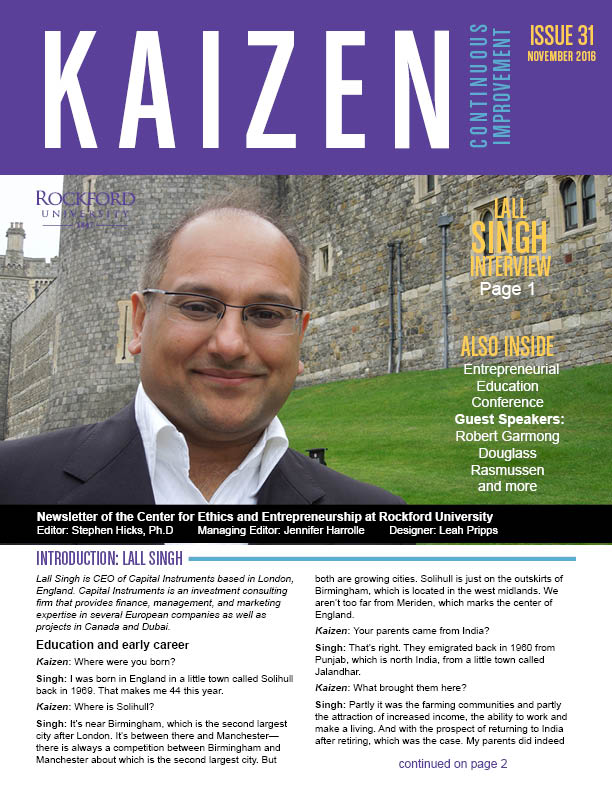
The latest issue of Kaizen features my interview with sports entrepreneur David Checketts. Checketts is former CEO of New York’s Madison Square Garden and is now chairman of SCP Worldwide, which owns the NHL’s St. Louis Blues and Major League Soccer’s Real Salt Lake.
Kaizen also features a course-development project by Rockford College Professor Bill Lewis, a paper given by Professor Shawn Klein at a sports ethics conference, and an international conference organized and hosted by Professor J. J. Asongu.
A PDF version of Kaizen is available at the Center for Ethics and Entrepreneurship’s Kaizen site, and the full interview with Mr. Checketts will be posted there soon.
If you would like to receive a complimentary issue of the print version of Kaizen, please email your name and postal address to CEE [at] Rockford.edu.
The Center for Ethics and Entrepreneurship has published its eighth issue of Kaizen [pdf], focusing on the theme of Education and Entrepreneurship. It features my interview with Steve Mariotti, founder of the excellent Network for Teaching Entrepreneurship (NFTE), an organization dedicated to providing entrepreneurship education to low-income youths.
Also featured are guest speakers David Mayer, who spoke at Rockford College on Thomas Jefferson, and C. Bradley Thompson, who spoke on John Adams, along with a mini interview with Professor Steve Kadamian on his new entrepreneurship course and a report on our 2009 High School Entrepreneur Day.
This and previous issues of Kaizen are also available at CEE’s Kaizen page.
The Center for Ethics and Entrepreneurship has published its first-ever summer issue of Kaizen. This issue features an interview I conducted with Jerry Reinsdorf, owner of the basketball’s Chicago Bulls and baseball’s Chicago White Sox. That issue also includes a short feature on Professor Shawn Klein, a philosopher and sports ethicist here at Rockford College.
Kaizen also recently published my extended interview with Ed Snider, CEO of Comcast-Spectacor, owner of hockey’s Philadelphia Flyers and basketball’s Philadelphia 76ers, and all-around great guy.
If you are interested in sports ethics and entrepreneurship, keep an eye out for my interview with David Checketts, CEO of SCP Worldwide, owner of hockey’s St. Louis Blues and soccer’s Real Salt Lake. Checketts is also the former CEO of the Madison Square Garden, which owns the New York Rangers, the New York Knicks, and the New York Liberty of the WNBA. That interview is forthcoming in the October 2009 issue of Kaizen.