I’ve started reading Guillermo M. Yeatts’s 2010 Plunder in Latin America. Yeatts lists thirteen American countries’ per capita GDP in 2008 US dollars, first alphabetically by country:
Argentina 8,281
Bolivia 1,948
Brazil 8,379 Canada 46,826
Chile 10,933
Colombia 5,478
Cuba 4,840
Ecuador 3,770
Mexico 10,278
Peru 4,454
Uruguay 8,942
USA 46,647
Venezuela 4,315
I re-arranged them by GDP from highest to lowest:
Canada 46,826
USA 46,647
Chile 10,933
Mexico 10,278
Uruguay 8,942
Brazil 8,379
Argentina 8,281
Colombia 5,478
Cuba 4,840
Peru 4,454
Venezuela 4,315
Ecuador 3,770
Bolivia 1,948
What a range. The two North American countries in the middle 40s. Five countries in the 8-10 range. Another five in the 3-5 range, and one around 2.
Yeatts raises the natural question: Why are the North American countries spectacularly more prosperous than the Latin American countries? Both are well endowed with natural resources, he points out, so that can be ruled out as the explanation. Several early hypotheses for our consideration:
* Religious differences: The majority of North Americans are Protestant and the majority of Latin Americans are Catholic.
* Colonial motivation: The Spanish colonists of Latin America were motivated primarily by extracting gold and silver and the earliest British colonists of North America were motivated by the desire to practice their religion freely.
* Philosophical: The North Americans adopted a Lockean view of the priority of individual rights over the power of government, while the Latin Americans accepted the Rousseauian priority of democratic majoritarianism over individual rights.
Along the way Yeatts introduces Douglass North’s institutional theory and James Buchanan’s Public Choice theory for further discussion, and that makes sense.
Whatever the full explanation turns out to be for the difference between North and Latin America, the differences within Latin America are also important. Why are Mexico, Brazil, and Argentina on average twice as wealthy as Venezuela, Cuba, and Peru? And why are the latter three nations on average twice as rich as Bolivia?
Source: Guillermo M. Yeatts, Plunder in Latin America (CreateSpace, 2010) p. 3. The data are from 2008.
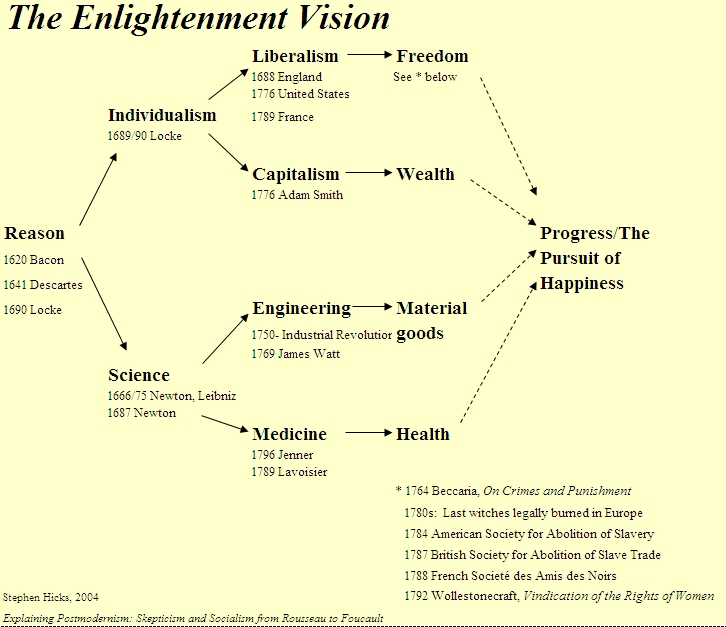
Here is a flowchart I’ve developed for use in some upcoming talks. The chart diagrams the positive claims about liberal capitalism by its defenders — John Locke, Adam Smith, John Stuart Mill, Ludwig von Mises, Ayn Rand, Friedrich Hayek, Milton Friedman, and others. Click on the image for full size.
Most advocates of liberal capitalism believe that most or all of the above claims are true. But they differ among themselves about which claims are most significant in morally justifying liberal capitalism. And that is the follow-up topic of my upcoming talks. More to come.
(Thanks to Chris Vaughan for the graphical design of the chart.)
“restrictions on our autonomy may lie at the heart of a great deal of our unhappiness. Studies show, for example, that one of the greatest sources of dissatisfaction among doctors isn’t having to deal with insurance companies or paperwork but lack of control over their daily schedules. (I’ve found this to be true: nothing distresses me more in the course of my work day than feeling hurried and unable to control how I spend my time.) I simply hate feeling forced to do things—even things I would want to do if I weren’t being forced to do them.”[1]
The good physician’s self-reflection is squarely within the long tradition of philosophical liberalism:
John Locke, for example: “We naturally, as I said, even from our cradles, love liberty, and have therefore an aversion to many things, for no other reason, but because they are injoined us.”[2]
John Stuart Mill is another: “Many a person remains in the same town, street, or house from January to December, without a wish or thought tending towards removal, who, if confined to that same place by the mandate of authority, would find the imprisonment absolutely intolerable.”[3]
And all three above are deeply, deeply opposed to the illiberal tradition that seeks to deny or crush individual autonomy: Augustine, Sulzer, Kant*, and Fichte.
Sources and note:
[1] Alan Lickerman, “The Desire For Autonomy”. The Creativity Post, November 30, 2012.
[2] John Locke, Some Thoughts Concerning Education [1690], Section 148.
[3] John Stuart Mill, Collected Works of John Stuart Mill: Principles of Political Economy. Robson, J. M., ed. Books I-II. Indianapolis: Liberty Fund, 2006, p. 213.
* Yes, Kant is a mixed case.
Posted 5 months, 1 week ago at 7:14 am. Add a comment
This quotation from twentieth-century education theorist Jean Piaget — “Play is the answer to how anything new comes about” — reminds me of a passage from seventeenth-century philosopher John Locke’s Some Thoughts concerning Education.
“Great care is to be taken, that [education] be never made as a business to him, nor he look on it as a task. We naturally, as I said, even from our cradles, love liberty, and have therefore an aversion to many things, for no other reason, but because they are injoined us. I have always had a fancy, that learning might be made a play and recreation to children; and that they might be brought to desire to be taught, if it were proposed to them as a thing of honour, credit, delight, and recreation, or as a reward for doing something else, and if they were never chid or corrected for the neglect of it.”
To my knowledge, Locke is the first modern theorist to emphasize liberty and play as foundational to education. Locke is in contrast to two of the great classical theorists of education, Plato and Augustine, who emphasize compulsion, obedience, and punishment as foundational. In Plato’s Allegory of the Cave, learners are compelled to stand and forced to turn and move toward the light, and Augustine famously said Per molestias eruditio (”True education begins with physical abuse”). A century after Locke, Immanuel Kant explicitly disavowed the view that education should be based on the student’s “inclination” and argued that it should be based on obedience and duty.
So: play versus top-down structure, self-motivation versus compulsion, recreation versus duty, liberty versus obedience. And the debate goes on.
Professor Kline visited Rockford College on Tuesday to give a talk on four major thinkers — Hobbes, Locke, Hume, and Smith — who in large part established the intellectual framework for our modern business world. Kline is a professor of philosophy at the University of Illinois, Springfield. Here is my seven-minute follow-up interview with Kline after his talk.
The following chart diagrams the positive claims about liberal capitalism by its defenders — John Locke, Adam Smith, John Stuart Mill, Ludwig von Mises, Ayn Rand, Friedrich Hayek, Milton Friedman, and others. Click on the image for full size.
Posted 6 months, 2 weeks ago at 3:12 pm. Add a comment
In Britain and America in the 1700s, the most influential philosopher of education was John Locke, with his Some Thoughts Concerning Education. In France, it was Jean-Jacques Rousseau with his Emile.
But in the German states, it was Johann Georg Sulzer, with his 1748 An Essay on the Education and Instruction of Children. Sulzer’s fundamental thesis:
“Obedience is so important that all education is actually nothing other than learning how to obey.”
He elaborates: “It is not very easy, however, to implant obedience in children. It is quite natural for the child’s soul to want to have a will of its own, and things that are not done correctly in the first two years will be difficult to rectify thereafter. One of the advantages of these early years is that then force and compulsion can be used. Over the years, children forget everything that happened to them in early childhood. If their wills can be broken at this time, they will never remember afterwards that they had a will, and for this very reason the severity that is required will not have any serious consequences.”[1]
Horrifying: they will never remember afterwards that they had a will.
To which I add from Immanuel Kant’s lectures on education, first delivered in 1776/77: “Above all things, obedience is an essential feature in the character of a child, especially of a school boy or girl.”[2] Much of Kant on education reads like a gloss on Sulzer, with its emphasis on obedience, duty, discipline, and punishment.
When we think of ethnic stereotypes — the English gentleman, the French romantic, the ramrod-straight Prussian — to what extent are those stereotypes grounded in explicit educational philosophies generated by a culture’s most influential philosophers?
Sources:
[1] Johann Georg Sulzer, Versuch von der Erziehung und Unterweisung der Kinder (An Essay on the Education and Instruction of Children), 1748. Quoted in Alice Miller, For Your Own Good.
[2] Immanuel Kant, On Education. Translated by Annette Churton. University of Michigan Press, 1960. In Ozmon and Craver’s Philosophical Foundations of Education, 7th ed.
Wonderful TED talk by educator Sugata Mitra on children’s natural initiative, the Internet, and what can be done without teachers. Thematically, Mitra’s fun talk is very Locke, Montessori, and, at the end, Hayek.
(Via Arnold Kling.)
Posted 1 year, 2 months ago at 9:49 am. 2 comments