[This excerpt is from Chapter 4 of Explaining Postmodernism: Skepticism and Socialism from Rousseau to Foucault]
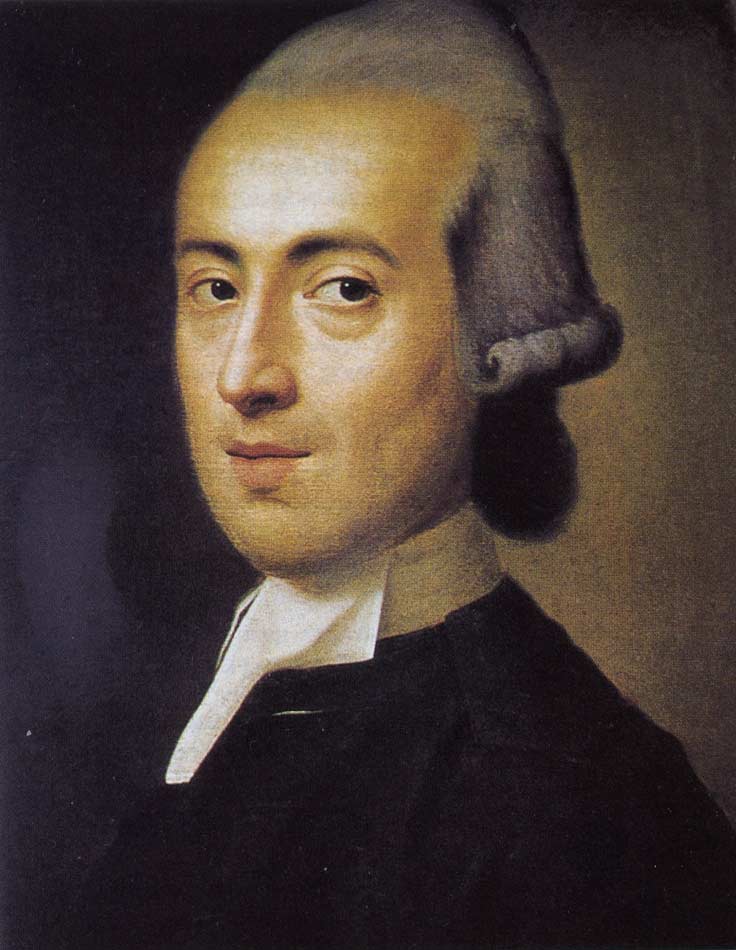
Herder on multicultural relativism
Sometimes called the “German Rousseau,”[57] Johann Herder had studied philosophy and theology at Königsberg University. Kant was his professor of philosophy; and while at Königsberg Herder also became a disciple of Johann Hamann.
Herder is Kantian in his disdain for the intellect, though unlike the static and rigid Kant he adds a Hamannian activist and emotionalist component “I am not here to think,” Herder wrote, “but to be, feel, live!”[58]
Herder’s distinctiveness lies not in his epistemology but in his analysis of history and the destiny of humankind. What meaning, he asks, can we discern in history? Is there a plan or is it merely a random happening of chance events?
There is a plan.[59] History, Herder argues, is moved by a necessary dynamic development that pushes man progressively toward victory over nature. This necessary development culminates in the achievements of science, arts, and freedom. So far Herder is not original. Christianity held that God’s plan for the world gives a necessary dynamic to the development of history, that history is going somewhere. And the Enlightenment thinkers projected the victory of civilization over the brutish forces of nature.
But the Enlightenment thinkers had posited a universal human nature, and they had held that human reason could develop equally in all cultures. From this they inferred that all cultures eventually could achieve the same degree of progress, and that when that happened humans would eliminate all of the irrational superstitions and prejudices that had driven them apart, and that mankind would then achieve a cosmopolitan and peaceful liberal social order.[60]
Not so, says Herder. Instead, each Volk is a unique “family writ large.”[61] Each possesses a distinctive culture and is itself an organic community stretching backward and forward in time. Each has its own genius, its own special traits. And, necessarily, these cultures are opposed to each other. As each fulfills its own destiny, its unique developmental path will conflict with other cultures’ developmental paths.
Is this conflict wrong or bad? No. According to Herder, one cannot make such judgments. Judgments of good and bad are defined culturally and internally, in terms of each culture’s own goals and aspirations. Each culture’s standards originate and develop from its particular needs and circumstances, not from a universal set of principles; so, Herder concluded, “let us have no more generalizations about improvement.”[62] Herder thus insisted “on a strictly relativist interpretation of progress and human perfectibility.”[63] Accordingly, each culture can be judged only by its own standards. One cannot judge one culture from the perspective of another; one can only sympathetically immerse oneself in the other’s cultural manifestations and judge them on their own terms.
However, according to Herder, attempting to understand other cultures is not really a good idea. And attempting to incorporate other cultures’ elements into one’s own leads to the decay of one’s own culture: “The moment men start dwelling in wishful dreams of foreign lands from whence they seek hope and salvation they reveal the first symptoms of disease, of flatulence, of unhealthy opulence, of approaching death!”[64] To be vigorous, creative, and alive, Herder argued, one must avoid mixing one’s own culture with those of others, and instead steep oneself in one’s own culture and absorb it into oneself.
For the Germans, accordingly, given their cultural traditions, attempting to graft Enlightenment branches onto German stock has been and would always be a disaster. “Voltaire’s philosophy has spread, but mainly to the detriment of the world.”[65] The German is not suited for sophistication, liberalism, science, and so on, and so the German should stick to his local traditions, language, and sentiments. For the German, low culture is better than high culture; being unspoiled by books and learning is best. Scientific knowledge is artificial; instead Germans should be natural and rooted in the soil. For the German, the parable of the tree of knowledge in the Garden of Eden is true: Don’t eat of that tree! Live! Don’t think! Don’t analyze!
Herder did not argue that the German way is the best and that it is justifiable for the Germans to become imperialistic and impose their culture upon others—that step was taken by his followers. He argued simply as a German in favor of the German people and urged them to go their own way, as opposed to following the Enlightenment.
Herder is relevant because of his enormous influence on the nationalist movements that were shortly to take off all over central and eastern Europe. He is also relevant to understanding how far from Enlightenment thinking the German Counter-Enlightenment was. If Kant is partially attracted to Enlightenment themes, Herder rejects those elements of Kant’s philosophy. While Herder is broadly Kantian epistemologically, he rejects Kant’s universalism: for Herder, how reason shapes and structures is culturally relative. And in contrast to Kant’s vision of an ultimately peaceful, cosmopolitan future, Herder projects a future of multicultural conflict. Thus, in the context of the German intellectual debate, one was offered a choice—Kant at the semi-Enlightenment end of the spectrum and Herder at the other.
References
[57] Barnard 1965, 18.
[58] In Berlin 1980, 14.
[59] Herder 1774, 188.
[60] Herder 1774, 187.
[61] In Barnard 1965, 54.
[62] Herder 1774, 205.
[63] Barnard 1965, 136.
[64] Herder 1774, 187.
[65] Herder 1769, 95; see also 102.
Bibliography.
[This is an excerpt from Stephen Hicks's Explaining Postmodernism: Skepticism and Socialism from Rousseau to Foucault (Scholargy Publishing, 2004, 2011). The full book is available in hardcover or e-book at Amazon.com. See also the Explaining Postmodernism page.]
Posted 2 years ago at 8:53 am. Add a comment
[This excerpt is from Chapter 2 of Explaining Postmodernism: Skepticism and Socialism from Rousseau to Foucault]
Kant’s skeptical conclusion
Immanuel Kant is the most significant thinker of the Counter-Enlightenment. His philosophy, more than any other thinker’s, buttressed the pre-modern worldview of faith and duty against the inroads of the Enlightenment; and his attack on Enlightenment reason more than anyone else’s opened the door to the nineteenth-century irrationalists and idealist metaphysicians. Kant’s innovations in philosophy were thus the beginning of the epistemological route to postmodernism.
Kant is sometimes considered to be an advocate of reason. Kant was in favor of science, it is argued. He emphasized the importance of rational consistency in ethics. He posited regulative principles of reason to guide our thinking, even our thinking about religion. And he resisted the ravings of Johann Hamann and the relativism of Johann Herder. Thus, the argument runs, Kant should be placed in the pantheon of Enlightenment greats.[2] That is a mistake.
The fundamental question of reason is its relationship to reality. Is reason capable of knowing reality—or is it not? Is our rational faculty a cognitive function, taking its material from reality, understanding the significance of that material, and using that understanding to guide our actions in reality—or is it not? This is the question that divides philosophers into pro- and anti-reason camps, this is the question that divides the rational gnostics and the skeptics, and this was Kant’s question in his Critique of Pure Reason.
Kant was crystal clear about his answer. Reality—real, noumenal reality—is forever closed off to reason, and reason is limited to awareness and understanding of its own subjective products. Reason has “no other purpose than to prescribe its own formal rule for the extension of its empirical employment, and not any extension beyond all limits of empirical employment.”[3] Limited to knowledge of phenomena that it has itself constructed according to its own design, reason cannot know anything outside itself. Contrary to the “dogmatists” who had for centuries held out hope for knowledge of reality itself, Kant concluded that “[t]he dogmatic solution is therefore not only uncertain, but impossible.”[4]
Thus Kant, that great champion of reason, asserted that the most important fact about reason is that it is clueless about reality.
Part of Kant’s motivation was religious. He saw the beating that religion had taken at the hands of the Enlightenment thinkers, and he agreed strongly with them that religion cannot be justified by reason. So he realized that we need to decide which has priority—reason or religion. Kant firmly chose religion. This meant that reason had to be put in its proper, subordinate, place. And so, as he stated famously in the Second Preface to the first Critique, “I here therefore found it necessary to deny knowledge in order to make room for faith.”[5] One purpose of the Critique, accordingly, was to limit severely the scope of reason. By closing noumenal reality off to reason, all rational arguments against the existence of God could be dismissed. If reason could be shown to be limited to the merely phenomenal realm, then the noumenal realm—the realm of religion—would be off limits to reason, and those arguing against religion could be told to be quiet and go away.[6]
References
[2] E.g., Höffe 1994, 1.
[3] Kant 1781, A686/B714.
[4] Kant 1781, B512/A484.
[5] Kant 1781, Bxxx.
[6] Kant 1781, Bxxxi.
Bibliography
[This is an excerpt from Stephen Hicks's Explaining Postmodernism: Skepticism and Socialism from Rousseau to Foucault (Scholargy Publishing, 2004, 2011). The full book is available in hardcover or e-book at Amazon.com. See also the Explaining Postmodernism page.]
Posted 2 years, 1 month ago at 5:17 pm. Add a comment
[This is Appendix 3 of Nietzsche and the Nazis. Sources for the quotations are at the end of this post.]
Appendix 3: Quotations on German anti-Semitism
Martin Luther (1483-1546): “The Jews deserve to hang on gallows, seven times higher than ordinary thieves.” And: “We ought to take revenge on the Jews and kill them.”[189]
Immanuel Kant (1724-1804): The Jews are by nature “sharp dealers” who are “bound together by superstition.” Their “immoral and vile” behavior in commerce shows that they “do not aspire to civic virtue,” for “the spirit of usury holds sway amongst them.” They are “a nation of swindlers” who benefit only “from deceiving their host’s culture.”[190]
Kant: “The euthanasia of Judaism is the pure moral religion.”[191]
Johann Herder (1744-1803) quoting Kant from his lectures on practical philosophy: “Every coward is a liar; Jews, for example, not only in business, but also in common life.”[192]
Johann Fichte (1762-1814): “A mighty state stretches across almost all the nations of Europe, hostile in intent and in constant strife with all others … this is Jewry.” Also: “As for giving them [the Jews] civil rights, I for one see no remedy but that their heads should be all cut off in one night and replaced with others in which there would not be one single Jewish idea.”[193]
Ernst Moritz Arndt (1769-1860, professor at University of Bonn). Arndt was a poet, a historian, a deeply-religious Lutheran, and post-Kantian philosophical idealist whose hero was Arminius, who defeated the Romans in 9 C.E., thus saving the pure German soul from “contamination” by Latin races. According to Arndt, the Jews were “a rotten and degenerate race” that had “evil and worthless drives and desires.”[194]
G. W. F. Hegel (1770-1831): Germany cannot assimilate the Jews because the Jews live an “animal existence that can only be secured at someone else’s expense.” Also: “Spirit alone recognizes spirit. They [the Jews] saw in Jesus only the man … for He was only one like themselves, and they felt themselves to be nothing. The Jewish multitude was bound to wreck His attempt to give them the consciousness of something divine, for faith in something divine, something great, cannot make its home in a dunghill.”[195]
Johann Fries (1773-1843), professor at University of Heidelberg: Fries was a Kantian logician, a disciple of Fichte, and influential among student nationalist societies. He called the Jews “rotten,” “worthless cheats,” “bloodsuckers,” a “diseased people,” argued they should be required to wear special signs indicating to others their race, and called for their “extermination.”[196]
Karl Marx (1818-1883): “Let us consider the actual, worldly Jew—not the Sabbath Jew, as Bauer does, but the everyday Jew. Let us not look for the secret of the Jew in his religion, but let us look for the secret of his religion in the real Jew. What is the secular basis of Judaism? Practical need, self-interest. What is the worldly religion of the Jew? Huckstering. What is his worldly God? Money. Very well then! Emancipation from huckstering and money, consequently from practical, real Jewry, would be the self-emancipation of our time. … We recognize in Jewry, therefore, a general present-time-oriented anti-social element, an element which through historical development—to which in this harmful respect the Jews have zealously contributed—has been brought to its present high level, at which it must necessarily dissolve itself. In the final analysis, the emancipation of the Jews is the emancipation of mankind from Jewry.”[197]
Friedrich Nietzsche (1844-1900): “I have not met a German yet who was well disposed toward the Jews; and however unconditionally all the cautious and politically-minded repudiated real anti-Semitism, even this caution and policy are not directed against the species of this feeling itself but only against its dangerous immoderation.”[198]
Adolf Hitler (1889-1945) in 1925: “I am convinced that I am acting as the agent of our Creator. By fighting off the Jews, I am doing the Lord’s work.” And in 1931: “The Jewish problem is a highly complex matter … our ideology is opposed to the interests of the Chosen Race in that we abominate their dance around the Golden Calf. For racial and financial reasons the Jews are basically opposed to communism.”[199]
Hitler: “Anti-Semitism is a useful revolutionary expedient.”[200]
Sidney Hook (1902-1989), a socialist philosopher: “anti-Semitism was rife in almost all varieties of socialism.”[201]
References
[189] Luther, quoted in Murphy 1999, p. 9.
[190] Kant, quoted in Weiss 1996, p. 67.
[191] Kant, Streit der Fakultaten, in Werke 11:321, quoted in Paul Lawrence Rose, Revolutionary Antisemitism from Kant to Wagner (Princeton, 1990), p. 96.
[192] Herder, quoted in Mack, 2003, p. 5.
[193] Fichte, quoted in Weiss 1996, pp. 72 and 68.
[194] Arndt, quoted in Weiss 1996, p. 74.
[195] Hegel, quoted in Weiss 1996, pp. 67 and 66.
[196] Fries, quoted in Weiss 1996, p. 74.
[197] Marx, “On The Jewish Question,” http://www.marxists.org/archive/marx/works/1844/jewish-question/. Viewed September 17, 2007.
[198] Nietzsche, BGE 251.
[199] Hitler, in interview with Richard Breiting, 1931, published in Edouard Calic, ed., “Second Interview with Hitler,” Secret Conversations with Hitler: The Two Newly-Discovered 1931 Interviews. New York: John Day Co., 1971, p. 86.
[200] Hitler, in Hermann Rauschning, The Voice of Destruction: Hitler Speaks, as quoted in George Seldes, The Great Thoughts. New York: Ballantine, p. 186.
[201] Hook, “Home Truths About Marx,” Commentary (September 1978) reprinted in Marxism and Beyond. Totowa, New Jersey: Rowman and Littlefield, 1983, p. 117.
[Bibliography.]
[Return to the Nietzsche and the Nazis page. Go to the StephenHicks.org main page.]
Posted 2 years, 2 months ago at 10:31 am. Add a comment