Stephen Hicks, Ph.D.

Philosopher

The great Renaissance medical bloodletting controversy

Why accurate translation and skilled editing are important:

Bloodletting was a common practice in medieval medicine and did not die out until the nineteenth century.

The practice was encouraged by the belief that the excellent Greek physicians Hippocrates and Galen practiced it. Most phelobotomists followed the Persian genius Avicenna’s editions of the Greek texts, which stated that the bloodletting was to be administered from the side of the body opposite to the disease’s location.

Along came Pierre Brissot (1478-1522), whose reading of the Greek texts argued that the bloodletting was to be carried out on the same side as the illness.

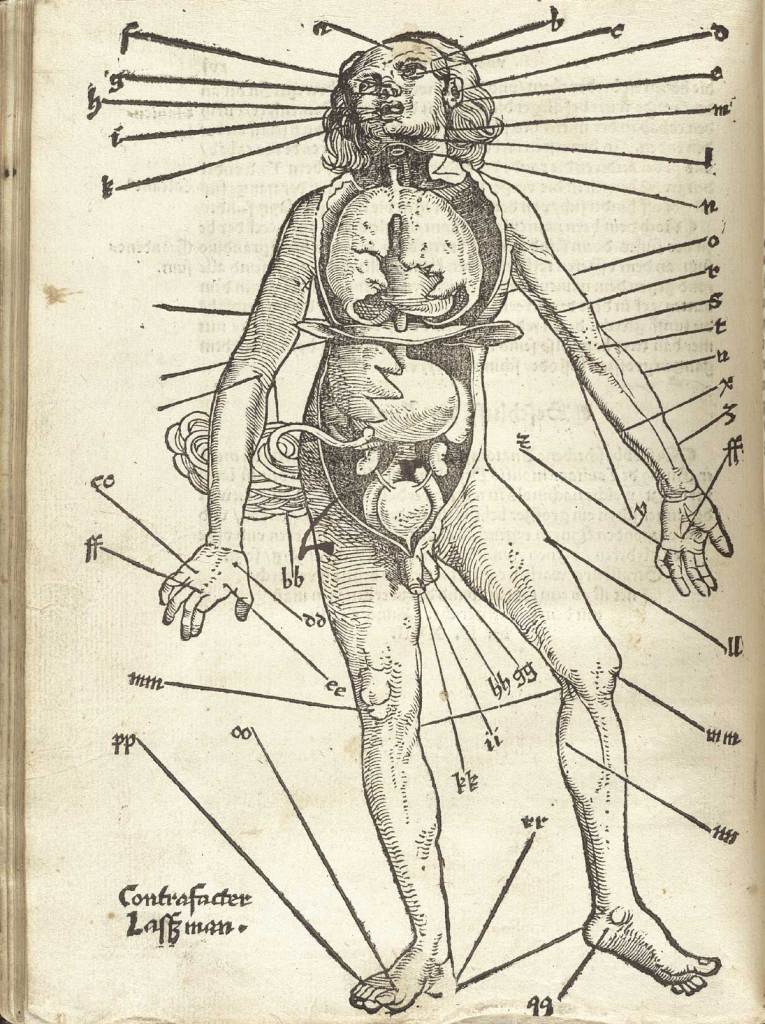
feldbuch-bloodletting-100x134Huge controversy among the phlebotomists! Same side or opposite? This text or that?

The “revulsive” bleeders (opposite side) asked by what right upstarts like Brissot challenged the centuries-old interpretations. The “derivative” bleeders (same side) wondered through what incompetence the original texts were altered.

Name-calling ensued, much of it in the name of the infallibility of the Greeks. Noted Jacobus Sylvius (1478-1555) of Hippocrates and Galen: “they had never written anything in physiology or other parts of medicine that was not entirely true.”

Still, the improved attention to the Greek texts did increase the accuracy of editing and translation and the bitter arguing sharpened logical skills and forced some experimenting.

[The image is Hans von Gersdorff's (ca. 1455-1529) illustration of the appropriate places for phlebotomists to practice their art.]

Posted 4 months ago at 4:05 pm.

Add a comment

Anatomy and philosophy

hunterj-reynolds-151x100Following up on The Knife Man and John Hunter, the great 18th-century anatomist and surgeon. In Hunter’s era surgery was brutal, in large part due to surgeons’ ignorance of anatomy, and in that earlier post I wondered why there was still such ignorance given that the 1700s were two centuries after Andreas Vesalius and a century after Francis Bacon.

Here’s my hypothesis: Philosophy has a lot to do with it.

Suppose you’re an early physician — your patients suffer and die, and you don’t know why. One option is not to think much of it: bad stuff happens, people die, accept it. It takes an active mind — curiosity, interest, follow through — for science to get going. Why do people die?

Even if you do decide to think about it, there are further obstacles.

One is the historically common belief that the gods cause things to happen. That metaphysical belief will stop you from looking for natural, anatomical causes.

If you reject religious cause-and-effect and suspect that the cause might be anatomical, there are aesthetic obstacles — think of the sights you will see, the textures you will feel, and (probably the worst) the odors you will smell.

There are moral obstacles: anatomy seems to disrespect the dead or to disrespect the living person the corpse once was. Moral obstacles might also be based on particular religious metaphysical beliefs, such as the resurrection of the body and so wanting to preserve the body intact for that eventuality.

So philosophy — metaphysics, morality, and aesthetics — can stop the impulse that leads to anatomy. And based on some or all of the above, there will be legal obstacles.

To those obstacles, all of which were operative in early modern Europe, let me add the epistemological barriers.

One was the reverence for tradition. Religion emphasized tradition, and the Renaissance respect for the ancients’ accomplishments often meant merely substituting a Greek or Roman authority for a Judeo-Christian one. For the early modern understanding of the inner workings of the human body, Galen’s humor theory was the mostly-unquestioned authority.

To the extent that early scientists were willing to think independently of traditional authorities, many simply speculated and spun theoretical just-so stories. An example here is Albrecht von Haller, a Swiss contemporary of John Hunter, who, based on no observational evidence, argued that every embryo was from day one already a perfect miniature of the mature organism and that embryonic development was merely a matter of increasing size.

And to the extent that anatomy was done, it was most often performed as a demonstration of traditional or speculative theories. Students would crowd around the anatomist while the professor read from the authoritative text telling the students what they were seeing. This usually meant that top-down confirmation bias simply reinforced the traditions and speculations.

So early anatomy was hobbled by three faulty epistemologies:

Tradition — the unthinking acceptance of others’ thinking.
Speculation — thinking independent of observation.
The demonstration method — observation only as the hand-maiden to thinking.

francis-baconThe primacy of observation: that epistemological principle had to be articulated and institutionalized. That is what Francis Bacon did for philosophy in the 1600s and what John Hunter did for anatomy in the 1700s.

Empiricism made anatomy possible. Anatomy made internal surgery possible. Surgery made dramatic live-saving and life-improvements possible. Conclusion: Philosophy is very practical.

Related:

My posts on Aristotle on the aesthetics of the “humbler animals” and Francis Bacon as the founder of modern philosophy.

Wendy Moore’s The Knife Man: Blood, Body Snatching, and the Birth of Modern Surgery [Amazon's site].

Sherwin Nuland’s Doctors: The Biography of Medicine [Amazon's site]. I love the chapter on Vesalius.

Posted 7 months, 1 week ago at 1:14 pm.

4 comments

Iatrochemists: why iron salts cure anemia

A fun anecdote from the history of medicine. (Fun in hindsight, though not necessarily fun for those who lived through the medical history.)

galenhippocratesavicenna-135x100The late-medieval Iatrochemists believed that progress could be made by uniting medicine with alchemy. Their intellectual leader was Paracelsus (1493-1541), a Swiss physician whose goal was to reform medical chemistry by rejecting reliance on traditions based on ancient texts. Symbolically, Paracelsus inaugurated his lecture series at Basel by burning the books of Galen and Avicenna. Alchemy, in turn, was a hybrid practice of experimental chemistry and astrology.

A perfect example of iatrochemical theory in action was the mystery of anemia: Why did iron salts cure it? Practicing physicians knew that it did, but nobody had a good theory explaining why.

iatrochemistry-anemia-126x100So here’s the iatrochemical explanation. Anemia, we believe, is a matter of having weak blood. Clearly, the weak blood needs to be strengthened, which iron salts do, but how? Let’s start with the fact that iron is hard and strong. That is why we use iron to make weapons of war. The Roman god for war is Mars. Mars is also the red planet — and we know that blood is red. Quod erat demonstrandum has been achieved: the strength of iron is astrologically communicated through Mars to the redness of the blood, thereby curing the anemia.

(Up next: How Venus makes those love potions work. Ever notice that Venus and Viagra start with the same letter? Coincidence?)

Posted 11 months ago at 12:52 pm.

1 comment