[We are reading Descartes' Meditations this week in my Introduction to Philosophy course, so this is a re-post for new readers this semester.]

I vote for Francis Bacon.
.
.
The standard answer gives the honor to René Descartes.
Descartes’s claim to the title is based primarily on his epistemology — specifically his method of doubt. The method of doubt is both a challenge to previous, more authoritarian epistemologies and a re-invigoration of a skepticism that exercises philosophers to this day.
Bacon’s reputation is also based in epistemology — his re-introduction and expansion of inductive methods. His empiricism is also a challenge to authoritarian epistemologies and grounds much of the scientific method used by investigators to this day.
How do we decide matters such as who should be considered the founder or father of modern philosophy? Let me propose four criteria.
1. Influence on academic philosophy. Descartes’s skeptical challenges have generated a huge literature in academic philosophy. Yet a huge literature has also been generated developing empirical methods in philosophy of science along lines established by Bacon. My call: a tie between Descartes and Bacon, absent a quantitative measure of the literature.
2. Influence on philosophy as used by all thinkers. Baconian epistemology has been internalized by most modern intellectuals (especially in the sciences and social sciences) and is part of their normal professional practice, and the more sophisticated inductive methods are explicitly used as guiding principles. The hardcore Cartesian skeptical challenges are rarely used outside academic philosophical discussions. My call: Bacon.
3. The positive and the negative. Descartes’s legacy is essentially negative. He digs philosophy into a skeptical hole from which many haven’t escaped. Bacon’s legacy is essentially positive. He provides tools many have used to develop new knowledge. Clearly there is still much truth to C. P. Snow’s “two cultures” thesis, in which much of the humanities is skeptical and pessimistic while much of the sciences is progressive and optimistic. My call: Absent a quantitative measure of the literature, a tie between Descartes and Bacon.
4. Chronology. Bacon’s key works were published in the first quarter of the 17th century: The Proficience and Advancement of Learning (1605), The Wisdom of the Ancients (1619), Novum Organum (1620), and The New Atlantis (1626). Descartes’s key works were written in the second quarter of the 17th century, and some were not published until the third quarter: Rules for the Direction of the Mind (1628; published posthumously in 1684), Discourse on Method (1637), Meditations on First Philosophy (written in 1641, published in 1647), and Principles of Philosophy (1644). My call: Bacon.
So by simple philosophy math, Bacon wins by two.
Before we revise the textbooks, let me ask: Are there other criteria we should consider?
Posted 5 months ago at 3:04 pm. 1 comment
Following up on The Knife Man and John Hunter, the great 18th-century anatomist and surgeon. In Hunter’s era surgery was brutal, in large part due to surgeons’ ignorance of anatomy, and in that earlier post I wondered why there was still such ignorance given that the 1700s were two centuries after Andreas Vesalius and a century after Francis Bacon.
Here’s my hypothesis: Philosophy has a lot to do with it.
Suppose you’re an early physician — your patients suffer and die, and you don’t know why. One option is not to think much of it: bad stuff happens, people die, accept it. It takes an active mind — curiosity, interest, follow through — for science to get going. Why do people die?
Even if you do decide to think about it, there are further obstacles.
One is the historically common belief that the gods cause things to happen. That metaphysical belief will stop you from looking for natural, anatomical causes.
If you reject religious cause-and-effect and suspect that the cause might be anatomical, there are aesthetic obstacles — think of the sights you will see, the textures you will feel, and (probably the worst) the odors you will smell.
There are moral obstacles: anatomy seems to disrespect the dead or to disrespect the living person the corpse once was. Moral obstacles might also be based on particular religious metaphysical beliefs, such as the resurrection of the body and so wanting to preserve the body intact for that eventuality.
So philosophy — metaphysics, morality, and aesthetics — can stop the impulse that leads to anatomy. And based on some or all of the above, there will be legal obstacles.
To those obstacles, all of which were operative in early modern Europe, let me add the epistemological barriers.
One was the reverence for tradition. Religion emphasized tradition, and the Renaissance respect for the ancients’ accomplishments often meant merely substituting a Greek or Roman authority for a Judeo-Christian one. For the early modern understanding of the inner workings of the human body, Galen’s humor theory was the mostly-unquestioned authority.
To the extent that early scientists were willing to think independently of traditional authorities, many simply speculated and spun theoretical just-so stories. An example here is Albrecht von Haller, a Swiss contemporary of John Hunter, who, based on no observational evidence, argued that every embryo was from day one already a perfect miniature of the mature organism and that embryonic development was merely a matter of increasing size.
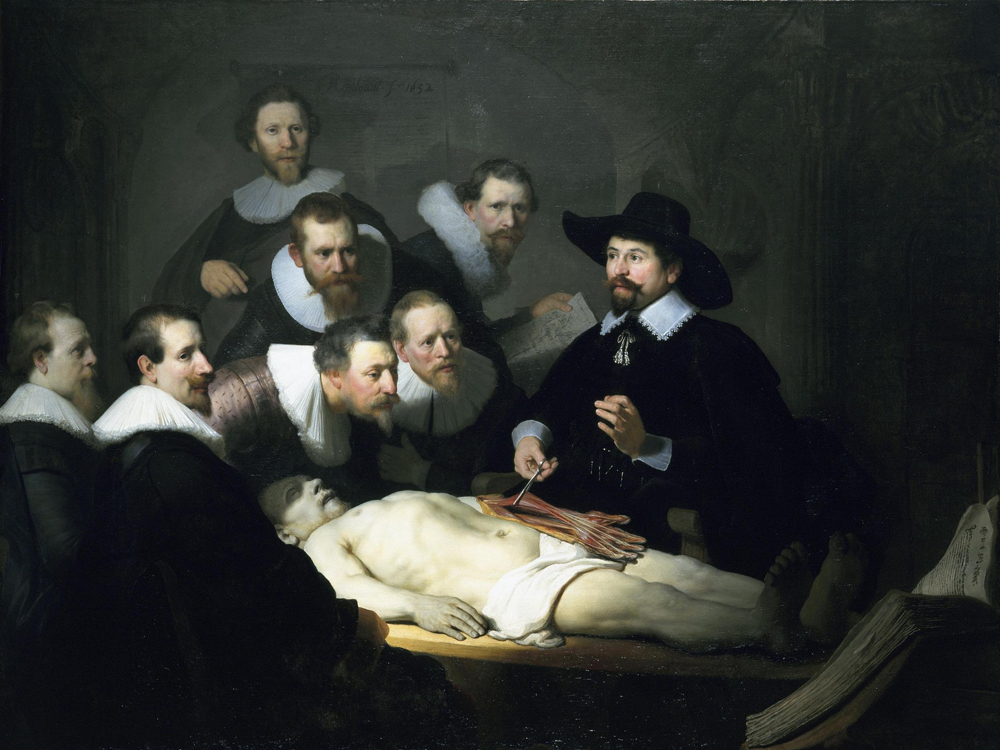
And to the extent that anatomy was done, it was most often performed as a demonstration of traditional or speculative theories. Students would crowd around the anatomist while the professor read from the authoritative text telling the students what they were seeing. This usually meant that top-down confirmation bias simply reinforced the traditions and speculations.
So early anatomy was hobbled by three faulty epistemologies:
Tradition — the unthinking acceptance of others’ thinking.
Speculation — thinking independent of observation.
The demonstration method — observation only as the hand-maiden to thinking.
The primacy of observation: that epistemological principle had to be articulated and institutionalized. That is what Francis Bacon did for philosophy in the 1600s and what John Hunter did for anatomy in the 1700s.
Empiricism made anatomy possible. Anatomy made internal surgery possible. Surgery made dramatic live-saving and life-improvements possible. Conclusion: Philosophy is very practical.
Related:
My posts on Aristotle on the aesthetics of the “humbler animals” and Francis Bacon as the founder of modern philosophy.
Wendy Moore’s The Knife Man: Blood, Body Snatching, and the Birth of Modern Surgery [Amazon's site].
Sherwin Nuland’s Doctors: The Biography of Medicine [Amazon's site]. I love the chapter on Vesalius.
Posted 7 months, 1 week ago at 1:14 pm. 4 comments
I am reading Wendy Moore’s The Knife Man: Blood, Body Snatching, and the Birth of Modern Surgery. A fascinating book, but not for the squeamish.
The key figure is John Hunter, an 18th-century anatomist and revolutionary surgeon of volatile temperament, with a hunger for knowledge that drove him to rob thousands of graves, record the tastes of corpses’ bodily fluids (”gastric juice,” apparently, “is a little saltish or brackish to the taste”), deliberately infect himself with syphilis, and … well, you should read the book.
Surgery in the 1700s was brutal, in large part due to surgeons’ appalling ignorance of anatomy. Moore puts it this way:
“Although medical students usually learned some rudimentary anatomy, this was considered a useful but not vital adjunct to on-the-job experience. And when patients died on the operating table as a result of ignorance and blundering, as they frequently did, few, if any, lessons were learned from the outcome.”
Antiseptic and anesthesia were not discovered until the 1800s, so the brutality and low success rates of surgery in the 1700s make some sense. But the ignorance of anatomy is odd — after all, the 1700s were two centuries after Andreas Vesalius and one century after Francis Bacon. How slowly things change sometimes.
The revolution in anatomical knowledge pioneered by Vesalius and the epistemological revolution pioneered by Bacon — with its emphasis on observation and experiment — had not yet reached English medicine, or only barely so. As Moore puts it, “treatment regimes still owed their basic principles largely to the theories of the ancient Greeks.” The reverence for tradition and authority was so strong that it took a pugnacious, thick-skinned man like Hunter to be willing to crack heads, literally and metaphorically, with his colleagues to get them to consider new methods.
I’m just starting Moore’s book. Exams are over for me at the end of next week, so I will follow up with more then.
For now, there’s more on John Hunter at the Endocrine Today site.
Follow up: My post on Anatomy and Philosophy.
Posted 8 months ago at 3:21 pm. 5 comments
I’m browsing Robert K. Massie’s excellent Peter the Great, a book that won the Pulitzer Prize in 1981, and came again across this quotation that struck me on my first reading years ago. The context is Peter’s trip to western Europe—an unheard of thing for Russian czars to do.
His objective was the Europe that had produced Bacon, Descartes, Leibniz, Milton, Rembrandt, Molière, Leeuwenhoek, Newton, and many other immortals. Russia, by contrast, seemed a backwater of feudalism and medieval stagnation.
So in 1697 the twenty-five year old Peter set off, traveling semi-incognito and declaring “I am a pupil and need to be taught.”
Here is Massie’s description of what Peter the Great saw:
“What he saw in the thriving cities and harbors of the West, what he learned from the scientists, inventors, merchants, tradesmen, engineers, printers, soldiers and sailors, confirmed his early belief, formed in the German Suburb, that his Russians were technologically backward—decades, perhaps centuries, behind the West. Asking himself how this had happened and what could be done about it, Peter came to understand that the roots of Western technological achievement lay in the freeing of men’s minds. He grasped that it had been the Renaissance and the Reformation, neither of which had ever come to Russia, which had broken the bonds of the medieval church and created an environment where independent philosophical and scientific enquiry as well as wide-ranging commercial enterprise could flourish. He knew that these bonds of religious orthodoxy still existed in Russia, reinforced by peasant folkways and traditions which had endured for centuries. Grimly, Peter resolved to break these bonds on his return” (p. 232).
Posted 9 months ago at 9:56 pm. Add a comment
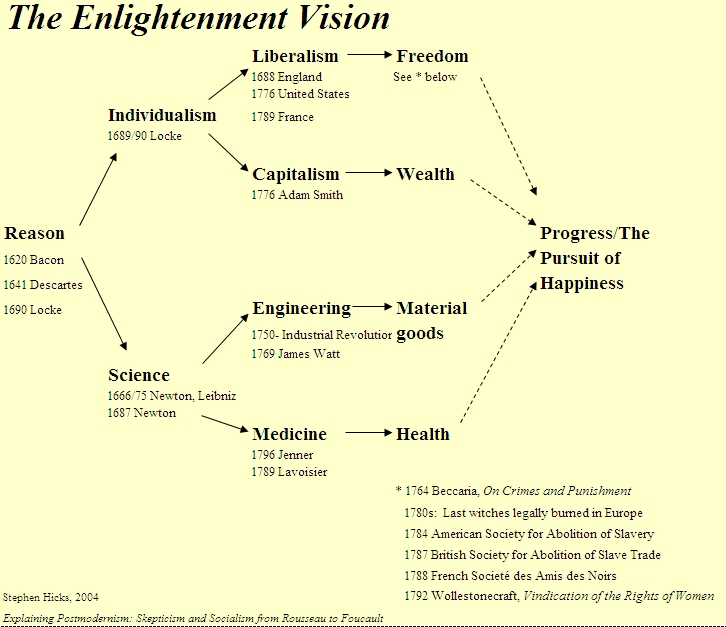
The Enlightenment of the long 18th century was an era of awesome intellectual and cultural transformation.
My Enlightenment Vision flowchart [pdf] is pitched at a high level of abstraction, showing schematically how the philosophical revolution of the 17th century led to the 18th-century revolutions in science, technology, politics, and economics — which in turn led to the dramatic increase in health, wealth, freedom, and goods in the 19th century.
To put it another way, the chronology shows how the ideas played out as philosophy, then as an intellectual movement, then as activism, then as the working technology of culture.
I use the chart in my classes and published a version of it in my 2004 Explaining Postmodernism. It’s here as a PDF and as an Excel file, in case you’d like to adapt it for your own purposes.
Posted 9 months, 3 weeks ago at 6:28 pm. Add a comment

My Explaining Postmodernism: Skepticism and Socialism from Rousseau to Foucault has, gratifyingly, had two hardcover printings and eight softcover printings from 2004-2009.
Over the next while I will be making portions of the book available online at this new Explaining Postmodernism page here at my site.
To start, here are the Table of Contents [pdf] and Chapter One: What Postmodernism Is [pdf]. Hope you enjoy.
And, of course, it’s available at Amazon.
Posted 10 months, 2 weeks ago at 10:56 am. Add a comment

I vote for Francis Bacon.
.
.
The standard answer gives the honor to René Descartes.
Descartes’s claim to the title is based primarily on his epistemology — specifically his method of doubt. The method of doubt is both a challenge to previous, more authoritarian epistemologies and a re-invigoration of a skepticism that exercises philosophers to this day.
Bacon’s reputation is also based in epistemology — his re-introduction and expansion of inductive methods. His empiricism is also a challenge to authoritarian epistemologies and grounds much of the scientific method used by investigators to this day.
How do we decide matters such as who should be considered the founder or father of modern philosophy? Let me propose four criteria.
1. Influence on academic philosophy. Descartes’s skeptical challenges have generated a huge literature in academic philosophy. Yet a huge literature has also been generated developing empirical methods in philosophy of science along lines established by Bacon. My call: a tie between Descartes and Bacon, absent a quantitative measure of the literature.
2. Influence on philosophy as used by all thinkers. Baconian epistemology has been internalized by most modern intellectuals (especially in the sciences and social sciences) and is part of their normal professional practice, and the more sophisticated inductive methods are explicitly used as guiding principles. The hardcore Cartesian skeptical challenges are rarely used outside academic philosophical discussions. My call: Bacon.
3. The positive and the negative. Descartes’s legacy is essentially negative. He digs philosophy into a skeptical hole from which many haven’t escaped. Bacon’s legacy is essentially positive. He provides tools many have used to develop new knowledge. Clearly there is still much truth to C. P. Snow’s “two cultures” thesis, in which much of the humanities is skeptical and pessimistic while much of the sciences is progressive and optimistic. My call: Absent a quantitative measure of the literature, a tie between Descartes and Bacon.
4. Chronology. Bacon’s key works were published in the first quarter of the 17th century: The Proficience and Advancement of Learning (1605), The Wisdom of the Ancients (1619), Novum Organum (1620), and The New Atlantis (1626). Descartes’s key works were written in the second quarter of the 17th century, and some were not published until the third quarter: Rules for the Direction of the Mind (1628; published posthumously in 1684), Discourse on Method (1637), Meditations on First Philosophy (written in 1641, published in 1647), and Principles of Philosophy (1644). My call: Bacon.
So by simple philosophy math, Bacon wins by two.
Before we revise the textbooks, let me ask: Are there other criteria we should consider?
Posted 1 year, 2 months ago at 12:53 pm. 4 comments